








Under Starbucks' promotion, Flat White entered the public eye under the name "馥芮白," but many people still can't distinguish its true differences from a latte. This article begins with the controversy over its origin, traces the evolution of this Australian coffee, and then focuses on the three core dimensions of milk foam thickness, cup size, and espresso base, comparing the differences between 馥芮白, latte, and cappuccino. The article also breaks down in detail the key steps for making a proper 馥芮白, and introduces how Front Street Coffee presents this drink with its own house blend and double ristretto, taking you from principle to practice for a comprehensive understanding of 馥芮白.

As coffee culture continues to deepen in China, all kinds of cafés have sprung up like bamboo shoots after rain, and menus iterate at an astonishing speed. In addition to classics like Americano, latte, mocha, and cappuccino, many relatively "niche" options have emerged, such as Flat White, Dirty, Piccolo, and Long Black. Among them, Flat White, with Starbucks' push, successfully joined the ranks of popular coffees and became widely known to consumers under the Chinese name "馥芮白."
The Origin Mystery of 馥芮白 Coffee
On September 29, 2015, Starbucks China launched a new product, Flat White, at the first Coffee Culture Festival, with the Chinese name set as "馥芮白." "白" is a semantic translation of White and also refers to the white dot on the surface during latte art; "馥芮" is both phonetically close to Flat White and conveys a rich, fragrant meaning. After that, other chain brands also followed suit with their own versions of Flat White—COSTA called it 醇艺白, Luckin Coffee called it 澳瑞白, and there were also various names such as 小白咖啡, 澳白咖啡, and 平白咖啡. Although there are many names, they actually refer to the same coffee drink originating from Australia—Flat White.
Regarding the origins of Flat White, Australia and New Zealand each insist on their own claim, both believing their country is the birthplace, and this debate remains unsettled to this day. In the early 1970s, Italians brought espresso machines to Australia, sparking a new wave of coffee culture. Compared with traditional lattes, Australians preferred milk drinks with thinner foam and more prominent coffee flavor. By the 1980s, Flat White could already be seen on fixed menus in many places in Australia, and it then gradually spread to cafés in Europe and America.
According to Australian standards, a latte must be served in a thick, wide-mouthed ceramic cup, and the milk foam thickness must reach at least 1 cm to be considered acceptable, with some even thicker. The thick, fine foam gives the latte a soft and delicate layered texture; with each sip you can feel the coffee aroma and also drink the milk foam in large mouthfuls. The requirements for 馥芮白 are different: the foam layer must be kept below 5 mm, with a smooth, delicate texture and a high degree of integration with the coffee liquid. The thin, fine foam does not bring the "softness" of a latte, but rather a silky "smoothness."
How to Make a Proper 馥芮白?
To make a proper 馥芮白, you first need to distinguish it from other hot milk coffees (latte and cappuccino).
In terms of foam thickness, the order of the three is: cappuccino > latte > 馥芮白. Cappuccino has the thickest foam, usually forming a 1–2 cm high "hamburger" shape, and you must first take a big sip of the foam before drinking. Latte's thickness is between 0.5 and 1 cm, pursuing a soft and balanced mouthfeel. 馥芮白 has the thinnest foam, generally 0.3–0.5 cm, and it should be thin enough to be level with the cup rim, with no obviously domed foam layer, so that every sip of strong coffee liquid carries dense foam.
New Zealand baristas believe that to make coffee stronger, the ratio of coffee to milk should be adjusted. So they switched to using a smaller cup than a latte (about 150 ml) for service, and uniformly used a double shot as the base. After reducing the amount of milk, the proportion of coffee increases accordingly, and the coffee flavor naturally becomes more prominent.
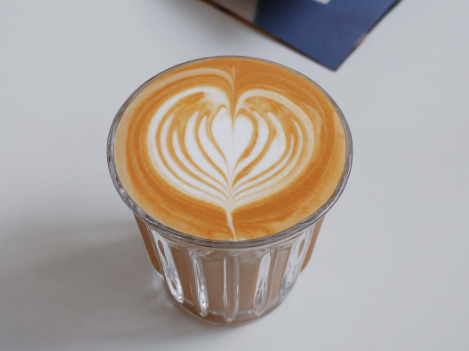
Melbourne baristas went a step further and replaced the base with double ristretto, blending milk foam of a thickness similar to a latte into a 150 ml cup. Ristretto refers to extracting less liquid weight from the same dose of coffee, and can be regarded as a reduced version of espresso; the extraction is more concentrated in the front and middle stages, the mouthfeel is richer, and therefore the quality requirements for the coffee beans used are also higher.
The espresso served at Front Street uses its own roasted "Sunflower Warm Sun Blend," composed of 70% Honduras Sherry coffee and 30% Yirgacheffe sun-dried Red Cherry coffee. The whisky, vanilla, and cream flavors brought by Sherry, combined with the tropical fruit and fermented notes of Red Cherry, make the coffee in the cup rich yet soft. Front Street retains the characteristics of a small cup size, thin foam, and double ristretto as the base for 馥芮白.
Since most espresso drinks in the store use Espresso as the base, the baristas at Front Street Coffee (FrontStreet Coffee) use standard-extraction Espresso as a reference before opening. The extraction plan for each coffee bean varies slightly, and this plan is adjusted by the baristas before opening each day according to the Warm Sun Blend used in the store. Front Street's Espresso extraction plan is: 20 grams of coffee powder extracted to 40 grams of coffee liquid, taking 28–30 seconds. For ristretto, without changing the grind size or powder dose, it also uses 20 grams of coffee powder, extracting 27 grams of coffee liquid, taking 20–25 seconds. In terms of flavor, it shows a more intense berry acidity, wine aroma, and caramel flavor.
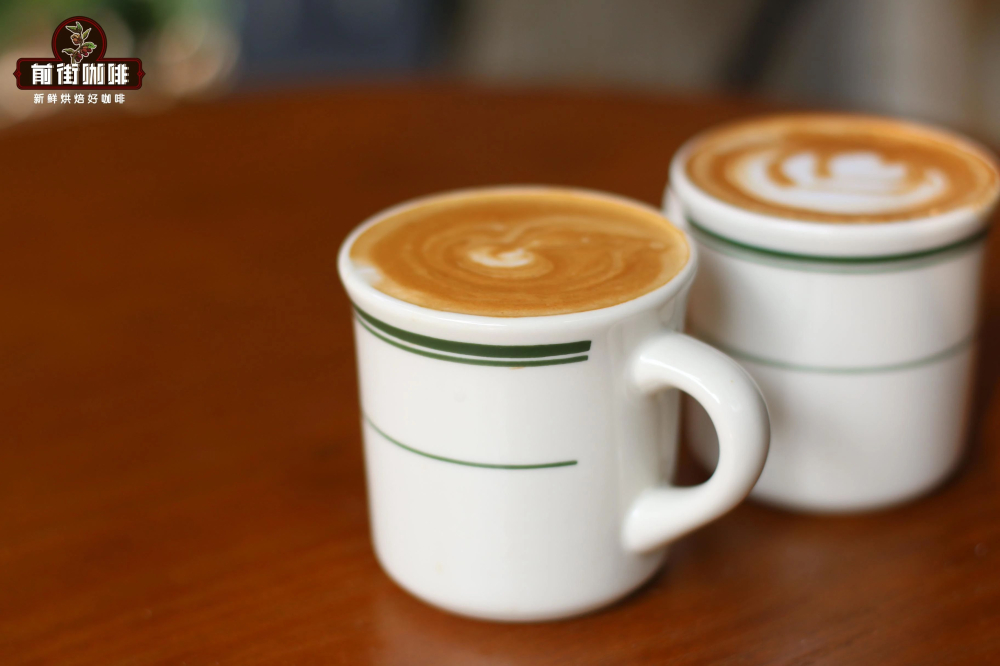
Pour the extracted coffee liquid into a pre-prepared cup with a capacity of about 200 ml, then take 150 ml of milk and pour it into a milk pitcher to steam. When steaming the milk, the amount of air introduced should be less than for a latte, and the foam layer should be thinner and denser. The temperature is best controlled at 55–60°C, making it easier to drink. Finally, evenly integrate the steamed milk into the coffee liquid; latte art is optional.
Front Street's 馥芮白 presents aromas of vanilla, cream, chocolate milk, and whisky-filled chocolate, as well as the sweet-and-sour notes of berries. It is soft, fragrant, and mellow on the palate, with a very long finish.
The above content is compiled by CoffeeHunters, a coffee news website.


