







Kenyan coffee has long been renowned for its bright fruity acidity and solid body, making it the top choice among African beans for many pour-over enthusiasts outside of Ethiopia. This article starts with the Kenya Cherry Tomato coffee beans produced by Front Street Coffee, systematically sorting out the meaning of Kenyan AA grading, the terroir characteristics of core producing regions such as Thika and Kirinyaga, the origins of main varieties like SL28 and SL34, and an in-depth analysis of Kenya's signature K72 washed processing method. The article also compares the differences in acidity between Kenya and Ethiopia, helping readers new to African beans gradually build their flavor awareness.
Front Street Coffee: Kenya Cherry Tomato Coffee Beans
Region: Thika, Kenya
Washing Station: Asali Honey Washing Station Altitude: 1550-1750m Grade: AA TOP Variety: SL28, SL34 Processing Method: Kenya 72-hour Washed
Front Street Kenya Coffee has long won the favor of many coffee enthusiasts with its distinctive fruity acidity and full body. Many friends who come to Front Street to order single-origin coffee want something with acidity but don't want to choose Ethiopian beans— Kenyan coffee beans are often the ideal alternative. When mentioning Kenyan coffee , one naturally can't avoid Kenyan AA coffee beans . What exactly does AA stand for? Below, Front Street will introduce Kenyan AA coffee beans to you.
Coffee Producing Regions Located in eastern Africa, the equator passes through its center, and the East African Rift Valley runs north to south through the country. It borders Somalia to the east, Tanzania to the south, Uganda to the west, Ethiopia and Sudan to the north, and faces the Indian Ocean to the southeast. The terrain is dominated by plateaus, with an average altitude of about 1,500 meters. Mount Kirinyaga (Mount Kenya) in the center reaches 5,199 meters, with year-round snow at its peak, making it the second-highest mountain in Africa. Kenyan coffee beans have a wonderfully captivating aroma, balanced and pleasant acidity, uniform bean size, and excellent fruit-toned characteristics. Front Street once compared Kenyan beans with beans from neighboring Ethiopia and found that although both feature fruity acidity, the actual experience is completely different: Kenya's acidity is powerful and heavy, while Ethiopia's is light and transparent. If trying African coffee for the first time, Front Street suggests starting with Ethiopian beans and gradually transitioning to Kenyan beans.
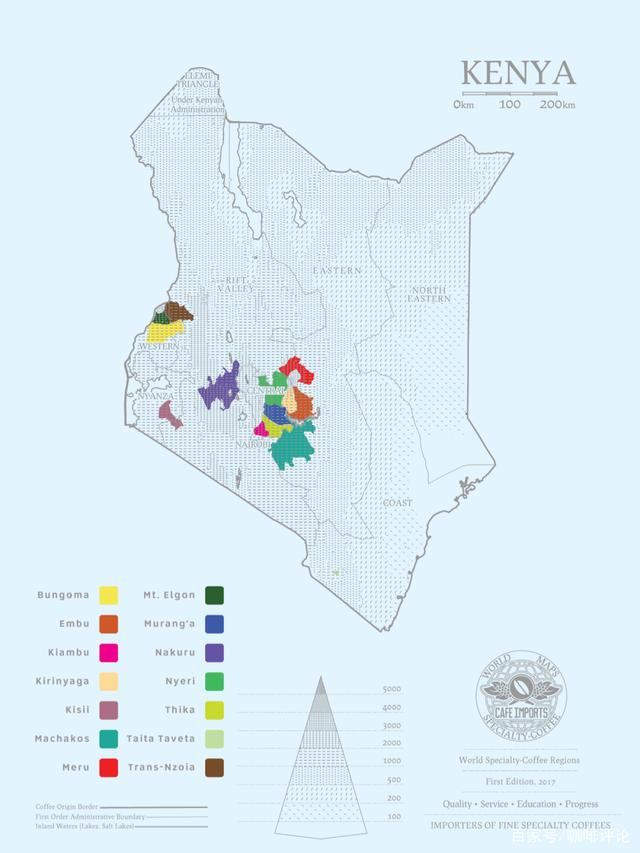
Kenya's coffee-growing areas are concentrated in the central and western parts of the country, covering six major producing regions: Thika, Kirinyaga, Mt. Kenya West, Nyeri, Kiambu, and Muranga. Their harvest windows are the same, with the main crop falling from October to December each year, and the secondary crop from June to August.
Among the six major producing regions, Thika and Kirinyaga best showcase the typical flavors of African producing regions.
Thika
Thika is a small town near Kenya's capital, Nairobi. A large number of coffee fields are distributed around Nairobi, and although Thika itself is an industrial town, it is surrounded by farmland and waterfalls. The area has approximately 2,000 coffee growers. The history of coffee cultivation in Thika, Kenya can be traced back to the late 19th century, when the trees were first introduced from neighboring Ethiopia to the north, and later improved through local varieties. Currently common varieties include Bourbon, Kents (SL34, SL28), Typica, and Riuri 11. Today, about 90% of planted varieties are SL34 and SL28. The new variety Batian, released in 2007, has not yet been widely promoted. The flavor profile of this region features bright fruity acidity, thick berry juice sensation, and honey-like sweetness. Altitude: 1550-1750m, Variety: SL-28, SL-34.
Kirinyaga
The Kirinyaga producing region is located on the slopes of Mount Kenya, adjacent to the Nyeri producing region. It is renowned worldwide for coffee with strong flavors, rich layers, and solid body, and together with the Nyeri region is regarded as one of Kenya's two currently finest producing regions. Producers here are mostly small-scale coffee farmers who join cooperatives. The cooperatives take on a coordinating role and provide washing stations, while coffee farmers deliver harvested cherries to the cooperative's washing station for processing. The flavor of this region is characterized by bright fruity acidity, medium body, and delicate sweetness. Altitude: 1300-1900m, Variety: SL-28, SL-34, Ruiru11, Batian.
Nyeri
Located in central Kenya, Nyeri is home to the extinct volcano Mount Kenya. The red soil here nurtures Kenya's finest coffee. Agriculture holds an extremely important position locally, with coffee being the main crop. Cooperative societies made up of smallholder farmers are more common than large estates. The region has two harvests per year, but the main crop season typically produces better quality coffee. The region's flavor presents bright berry juice sensation, mixed with citrus and faint floral notes. It is the coffee beans produced here that made Kenyan coffee famous worldwide. Altitude: 1200-2300m, Variety: SL-28, SL-34, Ruiru11, Batian.
Coffee Bean Varieties Kenya mainly cultivates three varieties: SL28, SL34, and Ruiru11. SL28, SL34: Both are genetic mutations that account for the vast majority of Kenya's high-quality coffee production, with the drawback of being susceptible to leaf rust. SL34 carries French missionary, Bourbon, and more Typica lineage. The broad bean-shaped seeds produced by plants with bronze-colored leaves have outstanding sweetness, good balance, and complex, varied flavors, with citrus and smoked plum characteristics particularly prominent.
Ruiru 11: In 1985, when global coffee leaf rust broke out on a large scale, Kenya bred this hybrid variety that prioritized yield over quality under these circumstances. However, its flavor quality falls far short of the earlier SL28 and SL34, and it has failed to establish itself in the specialty coffee world. Nevertheless, many suppliers of famous imported coffees still mix this hybrid bean into blends to lower costs.
Earlier we mentioned Kenyan AA coffee beans. Actually, AA refers to the grading method for Kenyan coffee beans. Next, let's look at how Kenya grades coffee. Kenyan coffee grading is mainly based on bean size, typically divided into eight grades.
AA Plus (AA+): AA grade with particularly excellent cup quality (flavor, mouthfeel). AA: Screen Size 17-18. AB: Screen Size 15-16, accounting for the majority of production. C: Smaller screen size than AB. TT: Lightweight beans blown out from AA and AB grade beans using an airflow separator. T: Lightweight beans blown out from C grade beans using an airflow separator. E Elephant Bean: Large mutated bean formed by two beans fused together, also known as Elephant ear. PB Peaberry: Classified by appearance, unrelated to flavor or weight. Coffee Bean Processing Methods
The traditional washed process is not complicated: flotation → pulping → fermentation → washing → drying → hulling → packaging. However, execution requires ample water sources and is highly dependent on equipment assistance, so producers using the washed method must also have sufficient funds to purchase machinery. The rise of the washed method coincided with the era of capital-funded early American plantations, which had ample operating funds. Combined with the invention of pulpers and hullers that emerged to meet the needs of the times, the washed method spread rapidly throughout the Americas.
The original wet processing method only rinsed the fermented coffee beans once with clean water, washed off the mucilage, and sent them directly to the drying yard for drying and packaging. But in Kenya, coffee beans that have been washed once are re-immersed in a pool of clean water, fished out and washed again, and only then sent to the drying yard for dehydration.
Kenya's original shift from conventional washing to "secondary soaking" was not driven by the pursuit of flavor, but rather by limited local drying space. Kenya is a typical cooperative-operated model in Africa. During harvest season, smallholder farmers deliver freshly picked cherries to washing stations all day long. The pulping and fermentation process itself is simple and time-saving, but each batch of fermented beans needs at least 5 to 7 days to dry. When processing volume is too large, there is nowhere to dry the washed beans. So people could only pour the wet beans back into the pool to let them "cool down" first to prevent spoilage or contamination, and wait until the drying yard had space before fishing them out for processing.
This secondary soaking form of washing is called "Double Washed," or dual washing, and some in producing regions also call it "Fully Washed." Since Kenya was the earliest region to popularize this processing method, this type of washing is also called "Kenyan Process." Later, people discovered that this locally adapted, twice-fermented washed coffee not only helped stabilize quality control in production but also brought rich, layered fruity acidity to the coffee.
In addition to the two processing methods mentioned above by Front Street, Kenya's most iconic is undoubtedly the K72 washed method. The key to the washing process lies in controlling fermentation time: first, 24 hours of washed fermentation, then cleaning off the detached mucilage, fermenting another 24 hours in a clean water tank, then removing residual components again, introducing clean water into the tank for a final 24 hours of fermentation, totaling 72 hours. This technique gives Kenyan coffee a bright and clean high-quality fruity acidity. Front Street's daily offering, Asali, uses exactly this washing technique, and the brewed coffee presents a cherry tomato and smoked plum-like acidity.
Afterward, ferment again with clean water for 24 hours, wash, and repeat this cycle 3 times, reaching 72 hours, hence the name Kenyan-style 72-hour fermentation washed processing method, abbreviated as [K72]. Front Street Coffee believes that the K72 washed method, compared to conventional washed processing, can further enhance the acidity and cleanliness of coffee beans.
The above content is compiled by CoffeeHunters, a coffee news website.


