







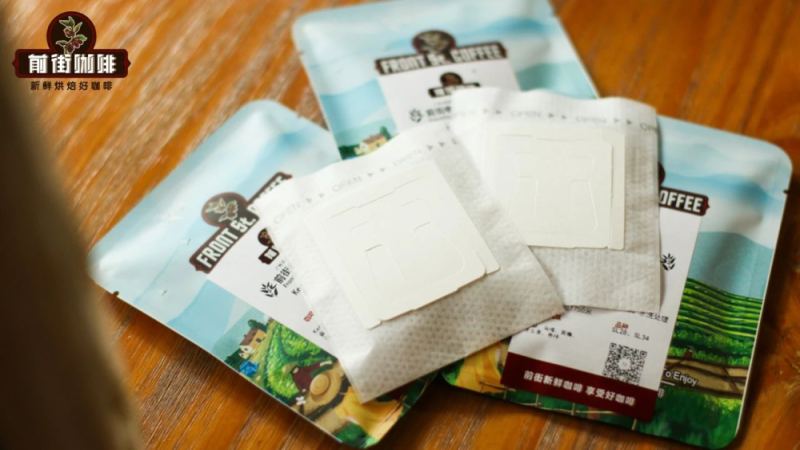

Many coffee enthusiasts enjoy drinking specialtypour-over coffee, but feel that pour-over requires skill and a lot of equipment to operate. For this reason, Front Street has launched a drip bag series. The Front Street drip bag coffee series features flavors from multiple origins, such as Sidamo, Brazil, Honduras Sherry, and more. Of course, there are other types of coffee beans available; if customers want them made into drip bags, Front Street will prepare them according to their needs. For example, a few days ago, a customer tried a Front Street Indonesia PWN Golden Mandheling in-store, was satisfied with the taste, but didn't want to grind it at home, so we made it into a drip bag on the spot for them.
How to choose drip bag coffee?
1. Production date: Generally, freshly ground coffee powder is the freshest. Drip bags are produced by carefully roasting and meticulously grinding, then immediately sealing in bags. Try to buy ones close to the roasting date; after more than 2 months, the taste will deteriorate.
2. Completeness of information: Coffee bean information includes variety, grind size, origin, roaster, etc.

Advantages of drip bag coffee:
1. Compared to instant coffee, drip bag coffee has a richer flavor. Drip bag coffee offers more choices to experience coffee from different origins, different processing methods, and different roast levels, and you can enjoy more specialty coffees with unique flavors.
2. Drip bag coffee contains no additives such as flavorings or creamers, making it healthier.
3. Affordable, quick and convenient to brew, easy to carry, and no brewing equipment needed.
Front Street Sidamo coffee has always been loved by everyone. To make daily coffee brewing more convenient, this time Front Street Coffee (FrontStreet Coffee) has made Sidamo coffee into drip bags. In order to make the best-tasting drip bags,Front Street Coffee (FrontStreet Coffee) pays great attention to grinder cleanliness, grind size, and packaging.

Grinding
The primary determining factor in the brewing quality of drip bags is the flow rate—neither too slow nor too fast will do, and this depends on the grinder's grind. If the grinder used is not of sufficient grade and the grind quality is poor, a large amount of fines will inevitably be produced during grinding, resulting in uneven grind. During brewing, this will cause "traffic jams" and slow down the flow rate. If the steeping time is too long, it will over-extract, resulting in a cloudy taste and poor flavor. No matter how good the beans are, they cannot express their proper flavor.

Grinder cleaning
What affects coffee flavor is not only the grind size but also the cleanliness of the grinder. Front Street strictly requires that before every session of grinding for drip bag coffee, the grinder must be carefully cleaned. Not only that, Front Street also regularly inspects the cleanliness and cleaning status of the grinders, and supervises the overall grinding machine cleaning and packaging process.

Automatic packaging machine / nitrogen flushing
Using mechanical automatic packaging serves two purposes: first, to improve the sealing effect of the outer packaging; second, to inject nitrogen during packaging to eliminate oxygen as much as possible, making oxidation less likely and greatly extending the freshness period of the coffee flavor. If it is manually packaged without nitrogen flushing, the freshness period of the drip bag may be only one month. With automatic packaging and added nitrogen, the shelf life can easily reach one year.
This time Front Street introduces two seasonal drip bag coffees and the ever-popular Front Street Honduras Sherry drip bag coffee. Front Street's current seasonal drip bag coffees include Front Street Ethiopia Natural Sidamo Drip Bag and Front Street Brazil Semi-Washed Red Fruit Drip Bag.

Front Street Brazil Semi-Washed Red Fruit Drip Bag (obvious sweetness, faint lemon aroma, rich nutty flavor, with a distinct dark chocolate note in the aftertaste)
Brazilian coffee beans were introduced from French Guiana (a country in northern South America) in 1720. At that time, Brazil was a Portuguese colony, while many other South American countries were Spanish colonies. Therefore, most South American countries speak Spanish, while Brazil speaks Portuguese.
A Portuguese military officer stationed in Brazil, in order to introduce coffee beans from Guiana to Brazil (at the time, exporting coffee to other countries was strictly prohibited), won the heart of the governor's wife of Guiana and successfully brought coffee seeds into Brazil. Since then, coffee quickly adapted in Brazil, spreading from the north to the southeastern state of São Paulo. By 1845, Brazilian coffee beans accounted for 45% of the world's total coffee beans. Currently, Brazil is the world's largest coffee exporter.
Front Street Coffee (FrontStreet Coffee) not only includes Brazil in its drip bag series, but Brazil coffee can also be found in Front Street's everyday drinking bean coffee series. This shows that Brazil, as a coffee-producing country, is an indispensable presence in classic coffee flavors. Front Street's everyday drinking beans are the "face" of regional coffee beans, because the basic flavor of their origin is more easily recognizable, and they are also low-priced, high-value coffee beans.

Semi-Washed Processing Method
In the semi-washed processing method, after selecting suitable coffee cherries, the skin, pulp, and part of the mucilage are removed, and the beans are dried with a small amount of mucilage remaining until the moisture content reaches 12%.
Front Street Coffee (FrontStreet Coffee) believes that the semi-washed processing method is actually similar to honey processing. Costa Rica, for example, is famous for honey processing. Honey processing was simply Costa Rica's term for semi-washed, and Costa Rica has made honey processing more refined, divided into yellow honey, red honey, black honey, etc. So gradually, the term semi-washed became less famous than honey processing. However, when Front Street Coffee (FrontStreet Coffee) cupped Costa Rican honey-processed coffee beans, it found a clear difference from Brazilian semi-washed coffee beans. Although both have obvious sweetness, Costa Rica's sweetness tends toward dried fruit sweetness, which is lighter, while Brazil's sweetness tends toward chocolate sweetness, which is heavier.

Front Street Natural Ethiopia Sidamo (faint floral aroma, rich berry acidity, with a fermented note)
The Sidama region is located in southern Ethiopia. The industry here is mainly agriculture, and the coffee-growing areas are located around the Great Rift Valley. The largest town in Sidama province is Hawassa, an important local coffee export hub. Sidama's coffee flavors are very diverse because different soil compositions, regional microclimates, and countless native coffee varieties create obvious differences and characteristics in the coffee produced in each town and area. Ethiopian Sidama has a balanced flavor and higher sweetness. Its body is also somewhat higher than that of Yirgacheffe, especially the red-wine-like acidity and sweetness produced during the natural fruit fermentation process.
Natural Processing Method (African Drying Beds)
The coffee cherries are spread directly on concrete ground or drying racks to dry, with the aim of making the coffee dry and easy to preserve. Usually depending on weather changes, the drying time is about 2-4 weeks.
Coffee typically used for commercial purposes is spread on concrete ground to dry, and the coffee cherries must be constantly and promptly turned so that both sides are heated evenly, which aids drying and also prevents mold from the bottom contacting the ground for too long. Hand-selected cherries and coffee beans used for specialty coffee are processed naturally using African Beds (African drying beds). The coffee cherries are spread on breathable mesh beds to sunbathe, and the thickness of the layer on the racks varies according to local conditions.

Front Street Honduras Sherry Wine Barrel Drip Bag (obvious wine aroma, vanilla, cream, balanced, cocoa aftertaste, moderate acidity)
This Front Street Honduras Sherry coffee bean comes from Masaguara, a city in the Intibucá department in the southwest. Front Street Coffee (FrontStreet Coffee)'s bean list also includes another wine barrel coffee bean from Mocha Estate—Front Street Honduras Lychee Orchid. The flavor of Sherry coffee beans tends toward the taste of whiskey sherry, with rich vanilla cream, and a lasting nutty chocolate flavor in the aftertaste. Front Street Honduras Lychee Orchid tends toward a brandy note, with flavor layers slightly weaker than Front Street Sherry, and also has a lasting nutty chocolate flavor in the aftertaste. Judging from Front Street Coffee (FrontStreet Coffee)'s sales rankings, Front Street Honduras Sherry is indeed more popular than Front Street Honduras Lychee Orchid.
Fine Washed Whiskey Sherry Wine Barrel Fermentation
First, freshly picked coffee cherries are finely washed, then placed into barrels that have previously aged sherry wine, fermented at low temperature for 30-40 days (at about 15-20℃), and then shade-dried.
Sherry barrels are barrels used by sherry wineries in the whiskey industry for aging. During the production of sherry, it undergoes the Solera System maturation process. This process refers to the blending and aging of sherries from different years after fortification, and this is also what makes sherry flavor unique.

Drip Bag Coffee Brewing Method
1. Taking Front Street Coffee (FrontStreet Coffee)'sdrip bag coffeeas an example, the coffee powder weight is 10g.
2. Tear open the outer packaging bag, take out the drip bag coffee packet inside, tear open the opening of the drip bag, pull open the two small ears on both sides, and set it on the cup.
3. Try to choose a cup with a rim that is not too wide; otherwise, the two ears of the drip bag may not hang securely. The cup used by Front Street Coffee (FrontStreet Coffee) has a rim diameter of about 8-9cm.
4. The brewing technique for drip bag coffee is actually the same as for pour-over coffee, just not as rigorous as pour-over. But basically, water temperature, blooming, and circular pouring are still necessary. For reference, Front Street Coffee (FrontStreet Coffee)'s drip bag coffee brewing parameters are as follows: water temperature 90℃, bloom for about 10s, and the blooming water amount can be equal to the coffee powder amount.
5. After blooming ends, pour water directly until finished. If you want to be more particular, you can also pour in two stages. The amount of water is determined by the chosen cup. Front Street Coffee (FrontStreet Coffee) uses a 300ml glass cup, pouring in a small circular stream, and stops when the water reaches the 7th part of the cup.

After brewing, remove the drip bag. It cannot be reused after one brewing, because the substances in the coffee powder have already been extracted. If brewed again, there will be nothing left to extract, and the taste will be very watery. Don't feel that brewing only once is wasteful. The drip bags currently sold on the market basically guarantee fresh grinding, and the price is also very nice.
The above content is compiled by CoffeeHunters, a coffee news website.


