







Before fruit-forward acidic coffees swept the market, the public's understanding of specialty coffee was still shallow, and coffee at that time was mostly dominated by bitterness. Blue Mountain coffee, with its richly layered aroma and its balance of acidity, sweetness, and bitterness, became an irreplaceable classic in the hearts of many coffee lovers. This article will provide a detailed explanation of the grading standards for Jamaican Blue Mountain coffee, the unique qualities of Blue Mountain No. 1, and Front Street Coffee's actual brewing parameters and flavor performance, giving you a comprehensive understanding of this legendary coffee bean.
In an era when fruit-forward acidic coffees had not yet become mainstream, the concept of specialty coffee was not clear in most people's minds, and coffee at that time was mostly based on bitterness. Among these bitterness-dominant coffees, Blue Mountain coffee, with its rich aromatic layers and its balanced acidity, sweetness, and bitterness, became the ideal choice in the hearts of many coffee enthusiasts.
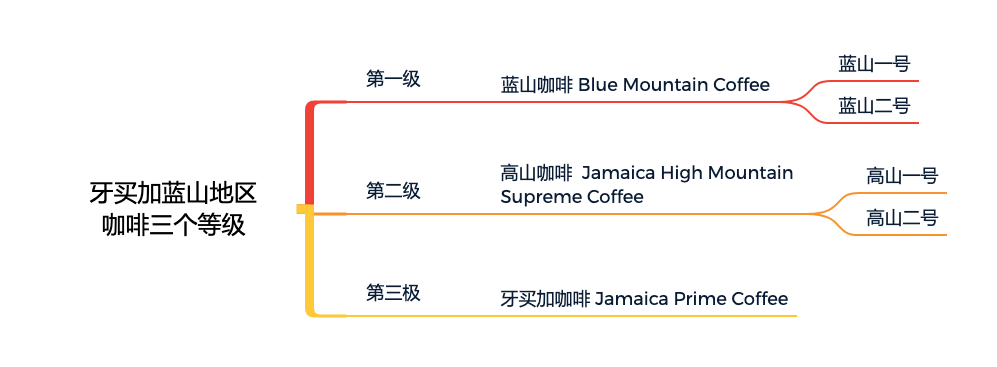
How are the grades of specialty Blue Mountain coffee defined?
According to Jamaica's Coffee Industry Regulation Act, the legal cultivation area for Blue Mountain coffee is concentrated in four administrative parishes: Saint Andrew, Saint Thomas, Portland, and Saint Mary, and it explicitly stipulates that only Typica varieties grown at altitudes between 910 and 1,700 meters are eligible to be called Jamaica Blue Mountain. The total area of these four producing regions is about 6,000 hectares, accounting for only one-third of the entire Blue Mountain growing area, while the remaining 1,200 hectares are used for Jamaican High Mountain coffee and Jamaican Supreme coffee. In recent years, fewer than 15% of the coffee beans produced in Jamaica can bear the Blue Mountain label, which shows just how scarce it is.
According to the strict standards of the Jamaica Coffee Industry Board CIB, Jamaican Blue Mountain coffee is divided into four grades: Blue Mountain No. 1, Blue Mountain No. 2, Blue Mountain No. 3, and Blue Mountain Peaberry. Among them, the highest-grade Blue Mountain No. 1 coffee beans must reach a screen size of 17 or above, with defective beans not exceeding 2%, moisture content controlled between 10% and 12.5%, and in cupping they must also display just the right acidity, sweetness, bitterness, body, and aroma. From this, it is easy to imagine that top-grade coffee beans with such refined flavor have extremely limited production.
An analysis of the characteristics of Blue Mountain No. 1 coffee
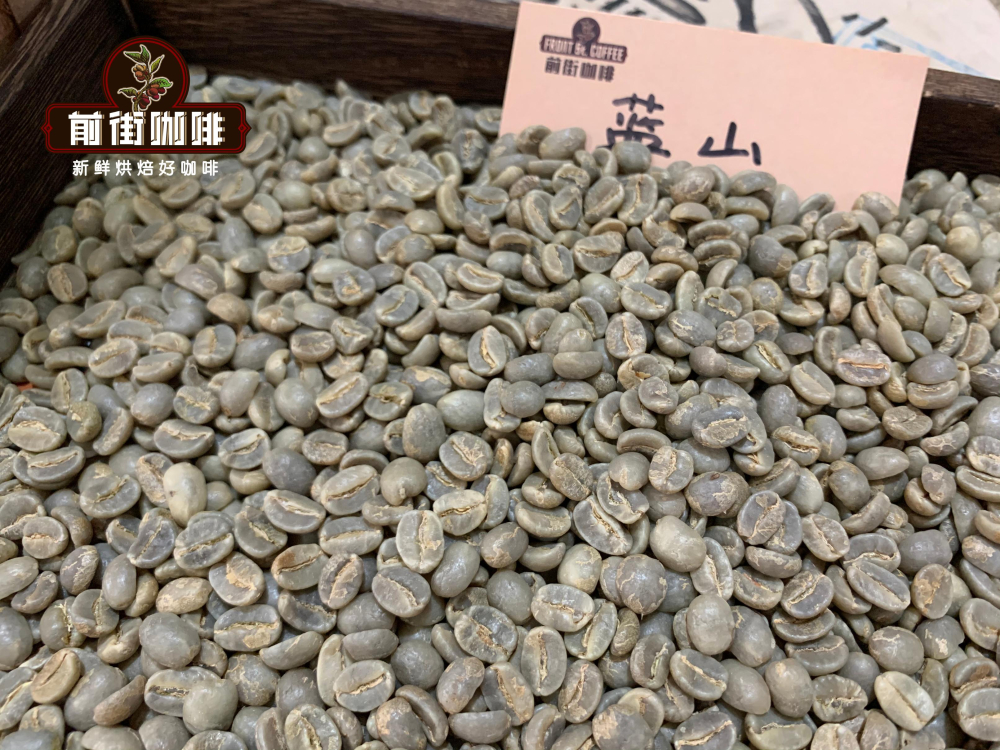
Blue Mountain coffee green beans are packaged in wooden barrels, which makes them appear especially distinctive from the very start. Compared with the burlap sacks commonly used in other producing regions, the advantage of oak barrels is that they can absorb and release moisture from inside and outside, while blocking coffee aromas from escaping outward, helping the beans maintain a more stable moisture content and thus making the roasting process more controllable.
By observing the wooden barrel, Front Street can pick up some information related to Blue Mountain. The CIB certification mark is printed on the top of the barrel lid, and the shipping marks of the registered exporter and the official importer are printed on each shipment's barrel. For example, this batch at Front Street comes from Clifton Mount Estate, and the barrel also bears the Rainforest Alliance frog logo. In addition, this Blue Mountain No. 1 coffee from Front Street also comes with a quality certificate issued by the Jamaica Coffee Board, an authorized sales certificate issued by the Blue Mountain coffee producer, and a certificate of origin for Jamaican Blue Mountain coffee.
When Front Street received the Blue Mountain No. 1 green beans, the beans were plump and uniform, consistent in size, and overall showed a translucent blue-green color. After roasting, Front Street conducted a cupping. The dry aroma carried notes of nuts, melon, and chocolate. After pouring in hot water, oolong tea, caramel, honey, and dark chocolate could be smelled. On the palate, there were rich flavors of dark chocolate, roasted hazelnut, cream, and dark brown sugar. The mouthfeel was clean and transparent, full-bodied, with a long-lasting aroma.
For such a top-grade Blue Mountain No. 1 coffee bean, Front Street lists it at 158 yuan/100 grams. If you want to directly taste hand-brewed black coffee, you can go to the Front Street Dongshankou store to order. Blue Mountain No. 1 coffee is priced at 60 yuan/cup.
"A cup of Blue Mountain"
Customers who come to Front Street to drink Blue Mountain coffee usually do not need Front Street Coffee baristas to introduce it much, because Blue Mountain's fame is already deeply rooted in people's hearts. They will directly tell Front Street, "A cup of Blue Mountain!" and then sit down and wait for the barista to bring the coffee.
Considering that Blue Mountain No. 1 coffee beans are a medium-dark roast, the caramelization reaction will be more complete than with light-roasted beans, making it easier to release large-molecule substances with burnt bitterness. To avoid extracting too many unwanted flavors, Front Street will appropriately lower the water temperature. The brewing water temperature for light-roasted coffee is 91 to 93°C, while for medium-dark roasted coffee beans Front Street recommends 87 to 88°C.
The finer the grind, the more soluble substances in the coffee are released within the same extraction time. To keep the extraction yield of Blue Mountain No. 1 coffee from becoming too high and bringing out a strong bitter taste, Front Street will adjust the grind coarser and use a medium grind, with the store's EK43s setting at 10.5 and a Chinese standard sieve passing rate of 75%.
Front Street's extraction parameters for hand-brewed Blue Mountain No. 1 coffee are: Kono dripper, 88°C water temperature, 1:15 coffee-to-water ratio, 15g coffee dose, grind size (75% passing rate on a No. 20 standard sieve).
In the first stage, pour 30 grams of water with a gentle stream for blooming, with a blooming time of 30 seconds; in the second stage, pour water to about 125 grams, circling outward evenly and steadily. Then wait for the coffee liquid to descend, and when the liquid level drops to halfway, pour the final stage of water to 225 grams. After all the coffee liquid has finished dripping, the total extraction time is usually about 2 minutes.
The flavor and mouthfeel of Front Street's hand-brewed Blue Mountain No. 1 coffee: on the palate, it presents flavors of dark chocolate, roasted nuts, and toffee, with caramel sweetness, soft and elegant acidity, a balanced combination of various tastes, and a smooth, rich mouthfeel. As the temperature drops, the aroma becomes more transparent and the layers become richer and more varied.
For professional coffee knowledge exchange and more coffee bean information, please follow Coffee Workshop (WeChat public account cafe_style)
For more specialty coffee beans, please add the private WeChat of Front Street Coffee (FrontStreet Coffee). WeChat ID: qjcoffeex
The above content is compiled by CoffeeHunters, a coffee news website.


