







Yunnan coffee, also known as Yunnan small bean, is famous for its plump and uniform beans and its mellow yet moderate taste. Front Street Coffee has always followed the development of Yunnan coffee and understands deeply how variety determines flavor. At present, the coffee varieties that can be produced on a large scale in Yunnan are mainly Catimor, Typica, and Bourbon. This article will systematically review the historical origins, botanical characteristics, and cupping performance of these three varieties, and share Front Street Coffee's roasting curves and brewing parameters. From the introduction of Typica by missionaries in 1904, to the large-scale promotion of Catimor because of its resistance to leaf rust, and then to the trial cultivation of Bourbon in Yunnan, readers can gain a comprehensive understanding of the evolution of Yunnan coffee varieties and the unique performance of each variety in aroma, acidity, and body.
Yunnan coffee is also called Yunnan small bean. The beans are uniform and plump, and the cup is mellow yet soft. The reason Front Street favors Yunnan coffee is that it belongs to the Chinese people themselves, and Front Street has always held a wish—to help more people change their preconceived impressions of Yunnan coffee. Front Street knows well that variety is the key factor determining coffee flavor. At this stage, the varieties in Yunnan with the capacity for mass production include Catimor, Typica, and Bourbon. Today Front Street Coffee (FrontStreet Coffee) will review the evolutionary history of Yunnan coffee varieties.
Yunnan Typica Coffee
The history of Yunnan Typica can be traced back to 1904. At that time, the French missionary Théodore Monbeig brought coffee seeds (Typica) from Vietnam into Yunnan and successfully trial-planted them in Zhugula Village, Binchuan County, marking the beginning of coffee cultivation in Yunnan. This coffee is usually classified as small bean, and in China it is customarily called Yunnan small bean coffee.
After 1930, the renowned overseas Chinese leader Mr. Liang Jinshan introduced coffee cultivation to the Pupiao and Luoming areas, and planting continued until the founding of New China. After 1952, under the guidance of expert Ma Guojin from the Baoshan Tropical Economic Research Institute, large-scale coffee expansion began in areas such as Lujiang, and the history of large-scale cultivation has now lasted nearly sixty years. Most of the Yunnan Typica we can taste today comes from the plants set out during that period.
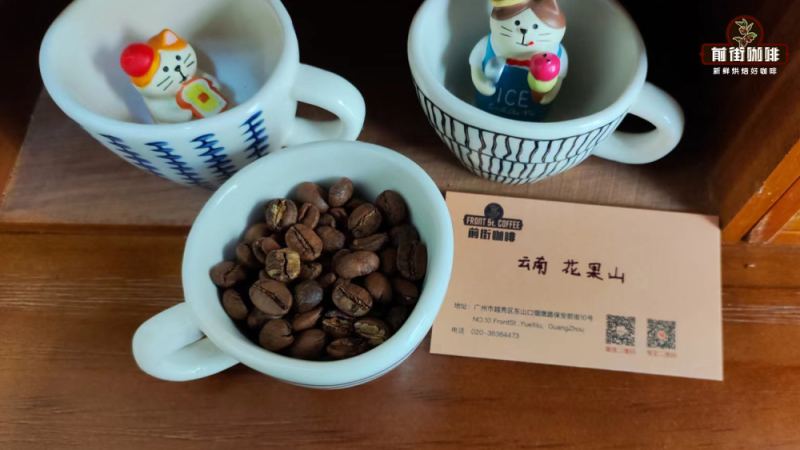
Front Street Coffee (FrontStreet Coffee) Yunnan Huaguoshan
Region: Baoshan, Yunnan, China
Altitude: 1200m
Variety: Typica
Processing method: Washed
Front Street Coffee (FrontStreet Coffee) Roasting Analysis
Front Street's roaster believes that Huaguoshan coffee beans are best suited to a medium slow roast, which can fully bring out their round, smooth mouthfeel and rich floral and fruity aroma.
Roaster: Yangjia 600g semi-direct fire: charge the beans when the drum temperature rises to 200°C, set the damper to 3, after 30 seconds adjust the heat to 160°C and keep the damper unchanged, turning point at 1'33; when the temperature reaches 168°C, adjust the heat again. At this point the bean surface turns yellow, the grassy smell has completely dissipated, and the dehydration stage is over. Lower the heat to 130°C and open the damper to 4; at 8'45, wrinkles and dark spots appear on the bean surface, and the toasted bread aroma clearly changes into coffee aroma, marking that first crack is about to begin. At this time it is necessary to carefully catch the sound of first crack; first crack begins at 9'07, reduce the heat to 80°C and open the damper fully to 5 (when adjusting the heat you must be especially careful and not reduce it so much that the cracking sound cannot be heard). After 3'00 from first crack, discharge the beans at 198°C.
Front Street Coffee (FrontStreet Coffee) Cupping Results
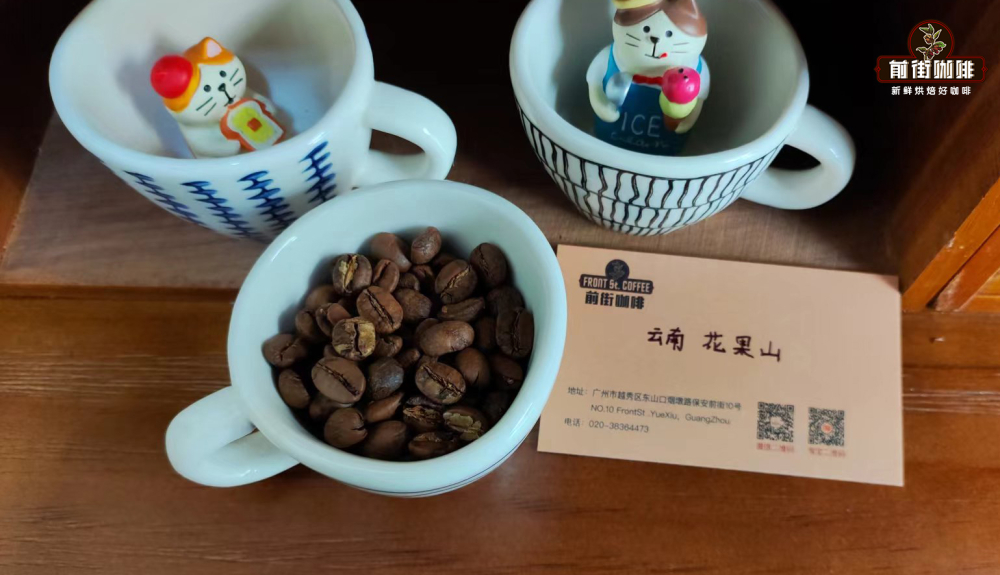
Front Street 2013 Typica: abundant fruity aroma on entry, with notes of melon and herbal plants, and a smooth mouthfeel; the mid-palate shows nutty and milk chocolate tones; the finish has a lively and bright plum-like acidity, excellent balance, medium body, and a full body. As the temperature goes from hot to warm, layered changes in sweetness and acidity can be felt, first sweet then acidic, accompanied by apricot and citrus-style acidity, with a black tea finish and a slight brown sugar note.
Front Street Coffee (FrontStreet Coffee) Brewing Recommendations
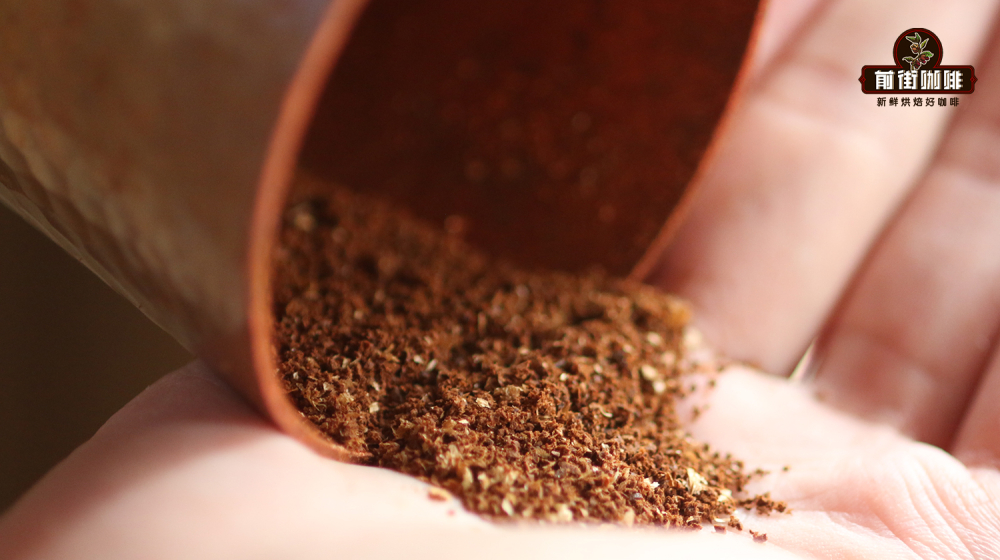
Use 15 grams of coffee grounds, with a recommended粉水比 of 1:15; if you want a clearer flavor, adjust it to 1:16. Use a V60 dripper, and control the brewing water temperature at 88°C in order to make the acidity softer. Grind to a medium-fine setting, about the size of fine granulated sugar (80% passing a No. 20 sieve).
Brewing method: First bloom with 30g of water for 30 seconds; in the first pour, stop when the water reaches 125g, using a vertical stream and a slow small-circle pour; in the second pour, continue pouring to 225g, and the stream and circling speed can be slightly faster to reduce over-extraction caused by grounds clogging the dripper. (Start timing from the bloom.) Total extraction time is 2 minutes.
Yunnan Catimor Coffee
In 1959, the Portuguese brought the Brazilian Bourbon mutation Caturra to East Timor and crossed it with Timor, which contains Robusta lineage, successfully developing Catimor with strong disease resistance and excellent productivity. Because leaf rust was rampant in coffee-producing regions around the world, with the assistance of international organizations, producing countries vigorously promoted Catimor to resist leaf rust and increase yields.
Starting in 1992, Nestlé established a coffee agriculture department to specifically guide and research the improvement and cultivation of Yunnan coffee, and introduced the high-yield, disease-resistant Catimor, purchasing coffee at the U.S. spot market price. Catimor is not pure Arabica lineage; it is the hybrid offspring of Timor (a hybrid of Arabica and Robusta) and Caturra (a Bourbon mutation), and therefore carries 25% Robusta genes. This portion of Robusta lineage also leads to its flavor defects: the aroma expression is not rich enough, the overall bitterness is relatively heavy, and it is prone to astringency and a somewhat pungent musty taste.
At present, the variety commonly planted in Yunnan is Catimor and its improved varieties, which is what the market often calls Yunnan small bean coffee (originally Yunnan small bean specifically referred to Typica, but later Catimor came to occupy most of Yunnan coffee, so what is now called Yunnan small bean actually refers to Yunnan Catimor).
Front Street Coffee (FrontStreet Coffee) Yunnan Small Bean Coffee
Region: Baoshan, Yunnan, China
Altitude: 1200m
Variety: Catimor
Processing method: Washed
Front Street Coffee (FrontStreet Coffee) Roasting Analysis
Yunnan small bean coffee: Yangjia 800N (300g batch): charge at 190°C, heat 120, damper set to 3; turning point at 1'40", when the drum temperature reaches 145°C open the damper to 4 and keep the heat unchanged; when the drum temperature reaches 166°C the bean surface turns yellow, the grassy smell completely disappears, and it enters the dehydration stage; when the drum temperature reaches 188°C, adjust the heat to 60°C and set the damper to 5; at 8'37" wrinkles and dark spots appear on the bean surface, and the toasted bread smell clearly changes into coffee aroma, marking the arrival of the prelude to first crack. At this point it is necessary to hear the sound of first crack clearly; first crack begins at 9'00", keep the damper unchanged, develop for 3 minutes after first crack, and discharge at 198°C.
Front Street Coffee (FrontStreet Coffee) Cupping Results
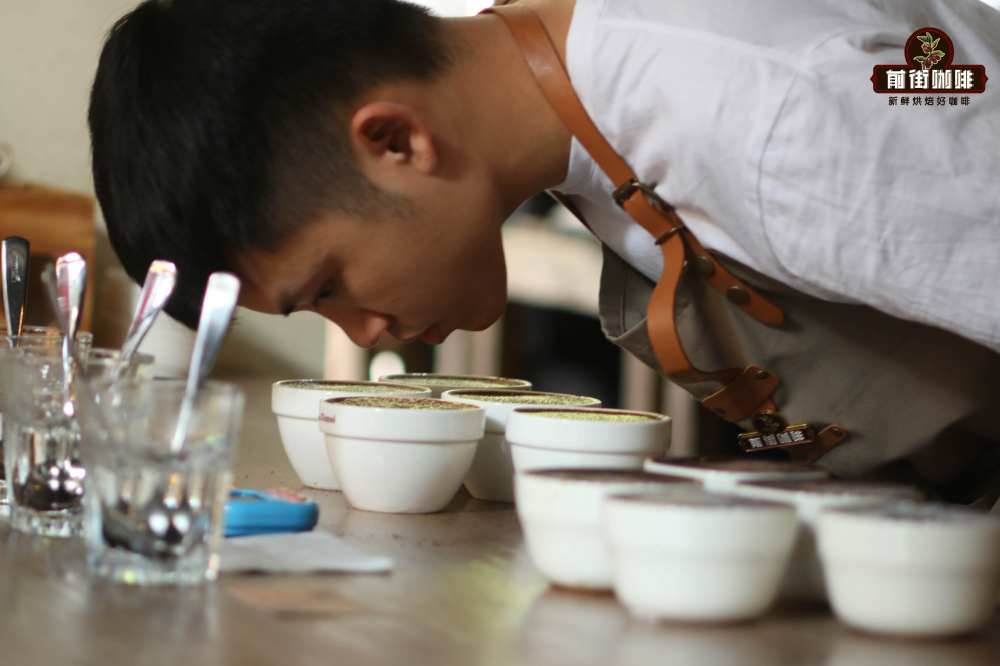
Yunnan small bean coffee cupping: smooth on entry, with Asian herbal plant aroma, lively and bright acidity, salivation on both sides of the cheeks, soft acidity, good mellow balance, rich layers, and in the finish obvious notes of dark chocolate, honey, and sucrose; after completely cooling, it presents a brown sugar flavor.
Front Street Coffee (FrontStreet Coffee) Brewing Recommendations
Use 15 grams of coffee grounds, with a recommended powder-to-water ratio of 1:15, use a V60 dripper, and control the brewing water temperature at 88°C in order to make the acidity softer and highlight a Pu'er tea sensation and tea aroma. Grind to a medium-fine setting, about the size of fine granulated sugar (80% passing a No. 20 sieve).
Front Street's segmented brewing method: bloom with 30 grams of water for 30 seconds, pour in a small circle with a small stream until 125 grams and then pause; when the water level drops and is about to expose the coffee bed, continue pouring to 225 grams and stop; when the water level drops again and is about to expose the coffee bed, remove the dripper, with an extraction time of 2'00" (timed from the start of the bloom).
In small bean Catimor coffee you can taste nutty aroma, as well as herbal, chocolate, and caramel flavors, with a slight faint fruity acidity in the finish.
Yunnan Bourbon Coffee
In 1952, experts from the Yunnan Academy of Agricultural Sciences distributed 80 kg of coffee seeds (Typica and Bourbon) to farmers in Lujiangba, Baoshan, and several years later carried out large-scale planting guidance, which led to the stretches of coffee trees along the Yunnan-Burma Road afterward. Because of the huge demand for supplying the Soviet Union, Yunnan coffee cultivation once experienced a period of rapid development. A survey by Professor Ma Xijin in 1981 showed that in the old coffee forest of Zhugula Village, Typica accounted for 31% and Bourbon for 69%.
Bourbon is a natural mutation of Typica, traceable at the earliest to Yemen's Mocha round coffee. It gradually spread after being planted by the French on Bourbon Island (now Réunion) in 1708. Bourbon also has a beautiful aroma and rich flavor, and is superior to Typica in yield and vigor. It is suitable for planting at altitudes of 1200 to 2000 meters, but has weaker resistance to pests and diseases and is also relatively sensitive to strong winds and heavy rainfall. Bourbon is the mutation of small bean coffee second only to Typica. Its main branches initially grow upward at a 45-degree angle to the trunk and droop as the fruit load increases; the nodes of the side branches are relatively dense, it bears many fruits and has higher yield, but the berries are smaller and ripen more slowly. The young leaves of the Bourbon terminal bud are green, so it is called green-tip coffee.
At Front Street Coffee (FrontStreet Coffee)'s Yunnan coffee plantation, mainly Typica and a small amount of Bourbon are planted. Because Bourbon is not the main variety, Front Street Coffee (FrontStreet Coffee)'s Bourbon is still at the experimental trial-planting stage.
For more specialty coffee beans, please add the private WeChat Front Street Coffee (FrontStreet Coffee), WeChat ID: kaixinguoguo0925
The above content is compiled by CoffeeHunters, a coffee news website.


