







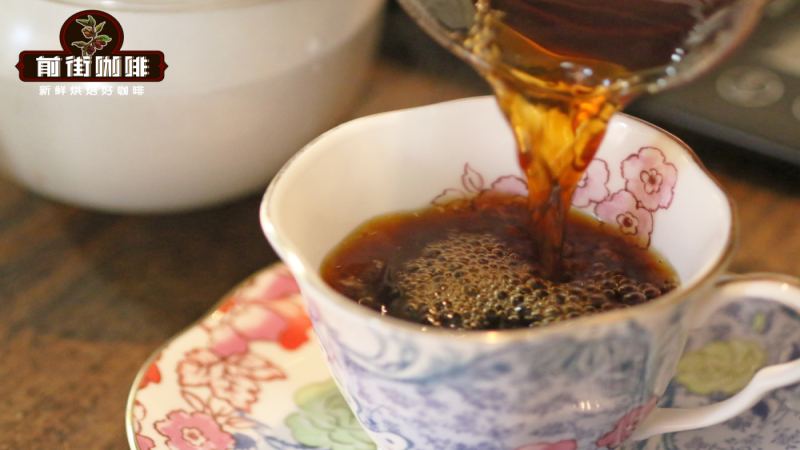
Pour-over coffee, with its clean and transparent flavor expression, has become one of the most favored brewing methods among specialty coffee enthusiasts. This article starts from the basic definition of pour-over coffee, traces its century-old origins, compares in detail the effects of conical, fan-shaped, and flat-bottom drippers on extraction, and introduces the key points for selecting coffee beans, grinders, drippers, gooseneck kettles, filter papers, electronic scales, and other equipment one by one. At the same time, the article also provides Front Street Coffee's recommended beginner's everyday bean series, as well as specific suggestions for core brewing parameters such as coffee-to-water ratio, grind size, water temperature, and extraction time, helping readers systematically master the complete pour-over coffee process.
For professional coffee knowledge exchange and more coffee bean information, please follow Coffee Workshop (WeChat public account: cafe_style)
For more specialty coffee beans, please add the private WeChat of Front Street Coffee (FrontStreet Coffee), WeChat ID: qjcoffeex
Walking into any coffee shop, the barista behind the counter often opens the conversation with a greeting like this: "Hello~ Would you like pour-over or espresso today~"
As specialty coffee becomes increasingly ingrained in people's minds, enthusiasts' expectations for coffee are also changing. People no longer regard coffee merely as a pick-me-up tool, but hope to taste clean and richly layered flavors without adding anything at all.
What exactly is pour-over coffee?
Essentially, pour-over coffee is the process of letting hot water pass through ground coffee particles to extract soluble flavor substances, then using filter paper to complete filtration, ultimately obtaining a cup of drip coffee.
Filter paper is prone to deformation during brewing, so a dripper is usually needed as a supporting structure. Different dripper designs change the speed at which water passes through the coffee bed, and the extraction rate changes accordingly, ultimately resulting in differences in the coffee's concentration and mouthfeel thickness.
The historical origins of pour-over coffee
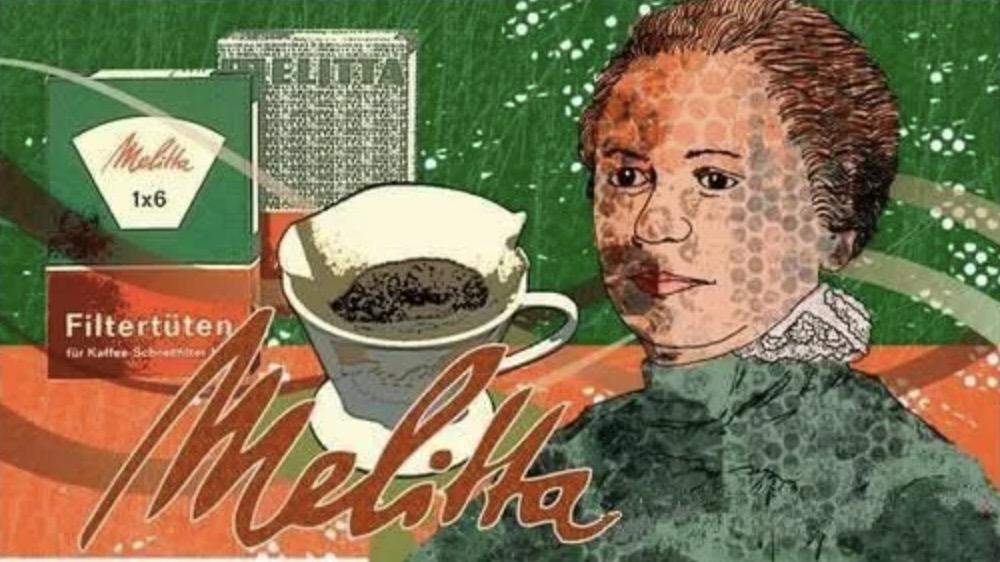
It is said that in the early twentieth century, a German woman named Melitta, in order to obtain coffee with a cleaner taste, had a sudden inspiration: she made an arched copper holder with a hole at the bottom, lined it with her son's blotting paper as a filtering medium, then put coffee grounds in it and poured in hot water. Unexpectedly, she brewed a kind of coffee completely different from traditional methods.
This accidental attempt made her relatives, friends, and neighbors all fall in love with this clean-tasting coffee. In 1908, Melitta registered her invention at the Royal Patent Office, and this was precisely the world's first drip coffee dripper. She also registered her residence as a company and used her handwritten signature as the trademark.
The dripper quickly spread in Germany and became a common utensil in German family kitchens. By the mid-1920s, orders poured in from all over, and the manufacturing business of the Melitta dripper expanded rapidly. The original family-style company site could no longer handle production orders for 100,000 filters, including ceramic filters, so in 1929 the company moved to Minden. To this day, the Melitta company is still run by the founder's grandchildren.
Nowadays, as people's research into coffee extraction becomes increasingly deep, dripper styles are no longer limited to the fan-shaped Melitta dripper. Drippers of various forms, such as conical and cylindrical (flat-bottom), continue to emerge.
What are the differences between coffee drippers of different shapes?
According to observations by Front Street Coffee (FrontStreet Coffee), the main dripper shapes currently on the market are conical, fan-shaped, and flat-bottom. Differences in appearance design mainly affect the shape of the coffee bed.
Typical representatives of conical drippers include the V60 and Kono; representatives of fan-shaped drippers include the aforementioned Melitta and Kalita drippers; flat-bottom drippers are represented by the Kalita Wave and others.
The 60-degree angle design of the conical dripper makes the coffee bed take an inverted triangle shape that is wide at the top and narrow at the bottom. After water passes through the coffee bed, it finally converges at a single point below. The coffee grounds in the lower half are extracted to a higher degree, meaning extraction is not uniform, and the purpose of this is to increase the coffee's layering. Coffee brewed with a conical dripper has richer flavor and a cleaner mouthfeel, suitable for brewing light-roasted coffee beans with prominent floral and fruity aromas.
The advantage of the flat-bottom dripper lies in its flat bottom, which makes the coffee bed thinner than that of a conical dripper, and water passes through the coffee bed faster (fast flow rate, short extraction time). This provides more room for fine adjustment of grind size, which can both improve the uniformity of coffee particles and increase the extraction rate. Coffee made with a flat-bottom dripper has a fuller and more balanced flavor, with a smooth and mellow mouthfeel, suitable for brewing medium-roasted coffee beans with soft acidity and a certain mellowness.
The characteristic of the fan-shaped dripper is that its trapezoidal structure makes the coffee bed resemble an elongated cone, and the exposed surface area of the coffee bed is larger. At the same time, the small-hole design at the bottom slows the speed at which water passes through, thereby increasing the extraction rate and enhancing the coffee's fullness. Coffee brewed with a fan-shaped dripper has a stronger flavor and a more solid mouthfeel, suitable for brewing dark-roasted coffee beans with no acidity and high mellowness.
What preparations are needed to make pour-over coffee?
1. Freshly roasted coffee beans
The soul of pour-over coffee lies in the freshness of the coffee beans. Generally speaking, coffee beans release a large amount of carbon dioxide during roasting, and these gases lock in the coffee's flavor. After roasting is completed, carbon dioxide gradually decreases over time, and the flavor dissipates accordingly, so the longer coffee sits, the less flavor it has. After coffee is ground, the cut surface area of the particles increases, and the speed of flavor dissipation also accelerates.
Although coffee beans can be stored for about a year in a dry state, the preservation period of flavor is actually quite short. Front Street Coffee (FrontStreet Coffee) suggests that the best tasting period for a bag of freshly roasted coffee beans is around 30 days after the roast completion date.
2. Grinder
In a complete set of pour-over equipment, the grinder occupies an extremely important position!! Therefore, the budget for the grinder absolutely must not be excessively compressed. Price determines the quality of the grinder, and there is no doubt about this.
If it is only for daily personal use rather than shop production, Front Street Coffee (FrontStreet Coffee) suggests setting the budget for a manual grinder at around 500-2000 yuan; a budget of around 1500-5000 yuan for an electric grinder is more appropriate.
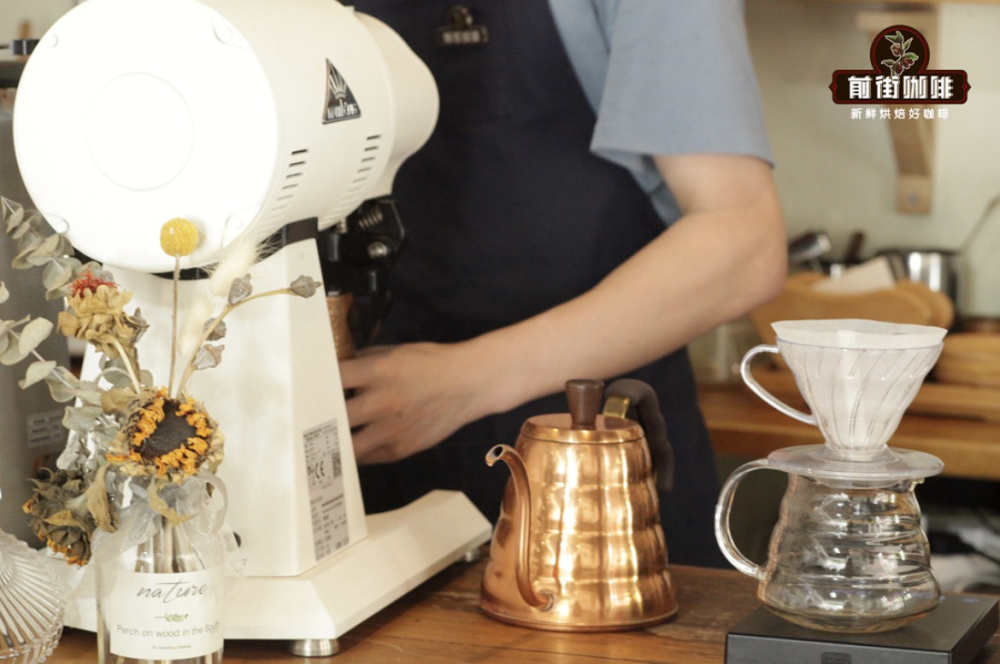
For making pour-over coffee, you should choose a grinder with conical burrs. Conical burrs grind coffee beans by crushing them into particles that are irregular in shape but overall uniform. The particles ground by conical burrs are close to block-like, with a longer water absorption path and longer contact time with water, so less soluble matter is released initially and the concentration will not be too high, but during long extraction the woody part absorbs less water and is less likely to produce off-flavors and astringency.
3. Coffee dripper
If you are just getting into pour-over coffee, Front Street Coffee (FrontStreet Coffee) suggests choosing the conical V60. The spiral protrusion design on the inner wall of the V60 dripper can create a twisting squeeze in the water flowing down, and the 60-degree angle design can guide the water flow to converge toward the center, extending the extraction path and increasing the contact time between the coffee grounds and the water flow, thereby ensuring complete extraction of the coffee. As brewing skills become increasingly proficient, the consistency of the coffee produced will also become stronger and stronger~
4. Pour-over kettle
Many friends who are just starting to learn pour-over coffee often do not have ideal water-pouring stability at first, so kettles with a large spout diameter are not recommended. Front Street Coffee (FrontStreetCoffee) suggests that beginners choose a gooseneck fine-spout kettle. The spout diameter is small, so even if water control is not stable enough, the water flow and parabola will not be too large, making it easier to handle. Everyone can choose a pour-over kettle without a temperature-holding function and just pair it with a separate quick-read thermometer~
5. Coffee filter paper
Currently, coffee filter paper on the market comes in two colors—natural wood color and bleached white~ Front Street Coffee (FrontStreetCoffee) suggests choosing bleached white filter paper. At present, bleached filter paper from well-known major brands uses advanced enzyme bleaching. Unlike traditional chemical bleaching, enzyme bleaching uses bioactive enzymes for bleaching and is widely used in the pharmaceutical field. Its advantage is that it has no papery taste, and its disadvantage (which cannot really be called a disadvantage) is that it costs a few yuan more than natural wood filter paper.
It should be noted that whatever shape and model of dripper you use, you must pair it with filter paper of the corresponding shape and color. If you use a conical dripper, choose conical filter paper. Dripper models are divided into size 01 (brewing for 1-2 people) and size 02 (brewing for 3-4 people), and filter paper should also be chosen in the corresponding model.
6. Electronic scale
The electronic scale is responsible for weighing the coffee beans and poured water and calculating the brewing time. Only by digitizing every parameter can it be replicated, while also ensuring the stability of each coffee brewing, so Front Street Coffee (FrontStreetCoffee) recommends everyone use an electronic scale with a timing function.
Recommended pour-over coffee beans for beginners
Front Street Coffee (FrontStreetCoffee) believes that a good coffee bean should allow you to taste regional flavor, and coffee beans from different producing regions each have different regional flavor characteristics. In order to let everyone try coffee beans from major coffee-producing regions at the highest cost-performance ratio, Front Street Coffee (FrontStreetCoffee) has launched a series of 7 everyday coffee beans, namely:
Ethiopia Yirgacheffe region (citrus notes, refreshing and clean), Guatemala Huehuetenango (nutty notes, soft acidity), Colombia Huila region (nutty notes, caramel finish), Costa Rica Tarrazu region (dried fruit notes, obvious sweetness), Indonesia Sumatra Lintong region (herbal notes, mellow without acidity), Brazil Cerrado region (nutty notes, mellow without acidity), Yunnan Baoshan region (black tea notes, slightly acidic and mellow)
How do you brew pour-over coffee?
Brewing pour-over coffee is actually not complicated. The key is to control several variables that affect the taste of the coffee, namely coffee-to-water ratio, grind size, water temperature, and extraction time.
When producing coffee, Front Street Coffee (FrontStreetCoffee) first weighs 15 grams of coffee beans, with a ratio of 1:15, meaning 225 grams of hot water is poured. Coffee beans of different roast levels correspond to different grind sizes and brewing water temperatures.
If it is light to medium-roasted coffee beans, Front Street Coffee recommends grinding to a medium-fine degree (caster sugar size / 75-80% passing rate on the Chinese No. 20 standard sieve), paired with a water temperature of 90-91 degrees Celsius for brewing.
If it is dark-roasted coffee beans, Front Street Coffee (FrontStreetCoffee) recommends grinding to a medium-coarse degree (granulated sugar size / 65-70% passing rate on the Chinese No. 20 standard sieve), paired with a water temperature of 88-89 degrees Celsius for brewing.
Before brewing, first use hot water to wet the filter paper so that the dripper and filter paper fit more closely. Pour the ground coffee into the dripper, and once the water temperature reaches the temperature needed for brewing, you can begin brewing.
The entire brewing process is divided into three pouring stages: in the first stage, pour 30 grams of water for blooming, ensuring all coffee grounds are moistened, with a blooming time of 30 seconds, the purpose being to release carbon dioxide so that subsequent water flow can better extract the coffee; in the second stage, pour water until 125 grams, then wait for the coffee liquid to drop by half; finally pour the third stage of water until 225 grams, likewise waiting for the coffee liquid to finish filtering, with a total extraction time of 2 minutes.
The above content is compiled by CoffeeHunters, a coffee news website.


