







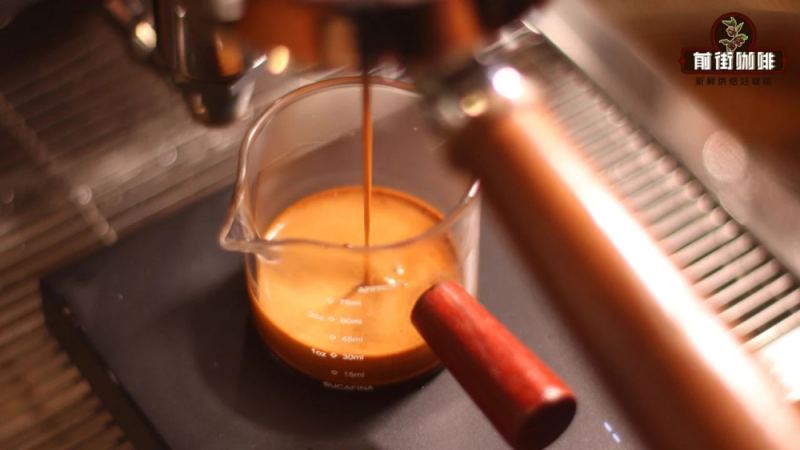
Espresso is the shared base of many drinks such as Americano, latte, cappuccino, and flat white, and it was born during the improvement of pressurized coffee machines from the late 19th to the early 20th century. In this article, Front Street Coffee will guide you through the evolution of Italian coffee culture and the story of the birth of the espresso machine, then use diagrams to break down the complete Espresso extraction process, covering key parameters such as dose, ratio, time, and grind size, and provide Front Street store's practical data and blended bean recommendations, helping coffee lovers understand the history while mastering the essentials of making a good espresso.
For more specialty coffee knowledge, please follow the WeChat public account: Front Street Coffee (FrontStreet Coffee)
In the daily life of Italians, coffee has long been in their blood, and behind every cup of Italian coffee are imprints of regional characteristics, cultural accumulation, and social change. Italian coffee first appeared in the late 19th century, while the version we drink in coffee shops today originates from the improved pressurized coffee machine of the early 20th century.
Americano, latte, cappuccino, flat white... the common foundation of these drinks is espresso, and it is precisely with the support of espresso that they can present their own different flavor profiles. So is espresso actually good to drink? And how should it be made? In this article, Front Street will take everyone through the birth of the Italian espresso machine and illustrate the detailed extraction steps of Espresso.
Early Italian coffee culture
Italy's coffee history is quite long. Starting in 1580, coffee beans from producing regions in Africa and the Middle East were shipped into Italy through the port of Venice, and at the time it was only an exclusive drink for the upper class. Because coffee originated from the Middle East and Turkey and was regarded as a "Muslim drink," many Christian Italians gave it the title "the devil's drink."
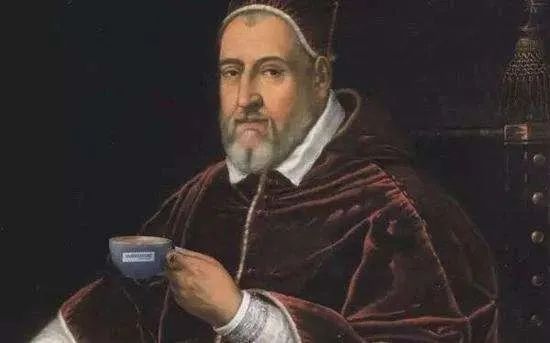
By the early 17th century, Pope Clement VIII fell in love with this black liquid and even held a baptism for coffee, formally declaring it something Christians could drink and naming it "the drink of God." Thereafter, in 1645, Europe's first coffee house appeared in Rome, and it was also Italy's earliest shop dedicated to selling coffee, after which coffee spread rapidly throughout Italy.
Italians' contribution to coffee lies not only in taste, but even more in the development of equipment
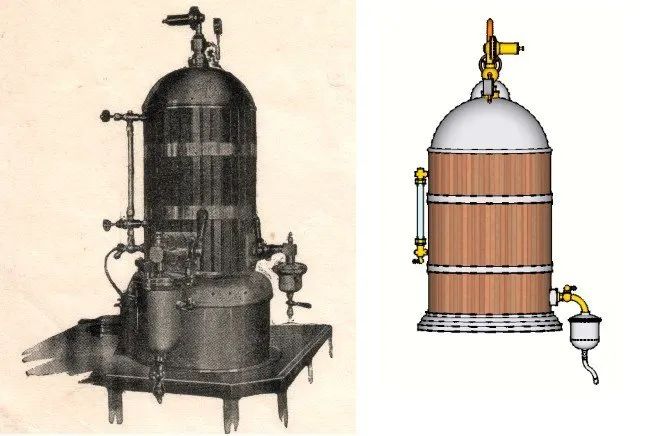
In the early days, people were used to brewing coffee with old-fashioned Turkish pots and drinking it after filtration. After the Industrial Revolution arrived, everything emphasized efficiency, and Italians were no exception. In 1884, Angelo Moriondo successfully registered a patent in Turin, Italy, for a steam-powered coffee-making machine. However, this device relied entirely on steam and was difficult to control in temperature, often brewing the coffee so burnt and bitter that it was hard to swallow, so it was later repeatedly modified by many people.
(Angelo Moriondo's Espresso Machine)
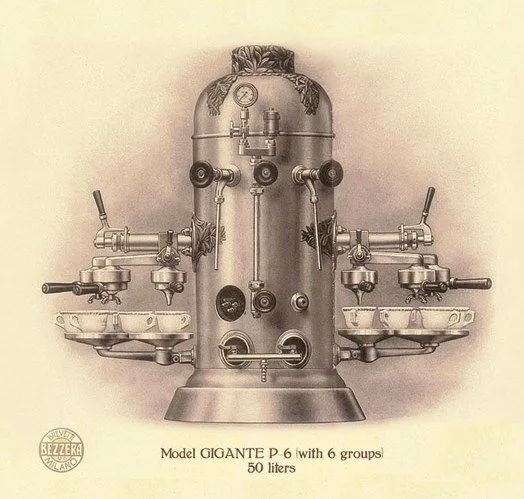
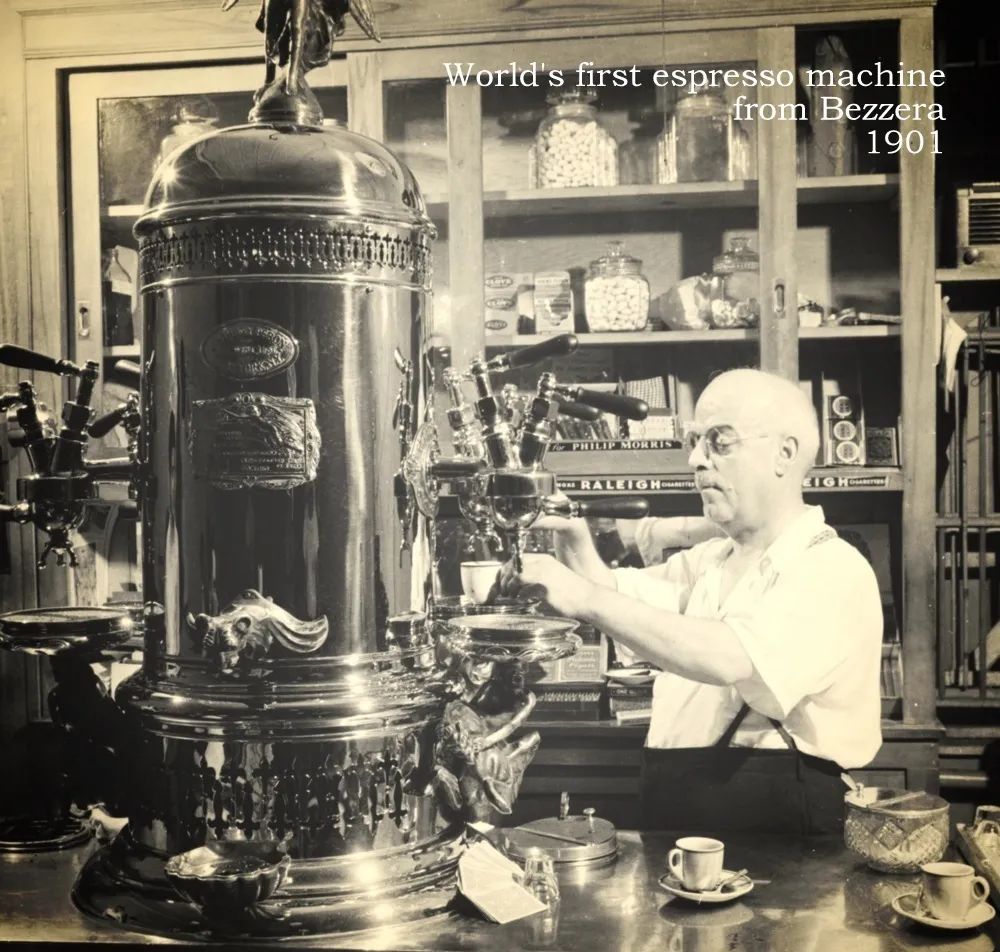
In the early 19th century, Milanese manufacturer Luigi Bezzara improved the patent and introduced the prototype of the world's first steam-pressure coffee machine, which was equipped with a detachable handle and a separable group head and could extract coffee under high pressure in a short time.
(Luigi Bezzera's Espresso Machine)
As the new machines were put into use, more and more Italians became fascinated by this quickly extracted coffee. The term "espresso" was also officially included in Italian dictionaries around 1920, with the definition: concentrated coffee made with a pressurized machine or filter.
For people tasting this "fast coffee" for the first time, the flavor was not pleasing, but when they learned that it was a drink obtained quickly by using steam pressure, Italians instead seemed to have their enthusiasm ignited, constantly thinking about how to upgrade and transform steam-powered coffee machines to make the output taste better.
For example, Milanese engineer Achille Gaggia managed in 1938 to add a lever to the coffee machine, which could sharply increase water pressure from 1.5bar to 9bar, not only producing a dark brown "Crema" on the surface of the coffee, but also making the volume of the solution quantifiable, thus making coffee quality more stable.
It was precisely under the impetus of the continuous improvement and popularization of these machines that coffee-making methods underwent tremendous changes. High speed and convenience became the new standard of service in every coffee shop, and that small cup of espresso gradually evolved into the foundational core of the modern coffee system.
When espresso developed into its final form, coffee culture also kept pace. Compared with many countries, Italian coffee shops focus on an efficient, fast-paced atmosphere, which fits perfectly with the small cup size of espresso, making it convenient for passing customers to enjoy quickly and leave after a few words with acquaintances. Taking advantage of a brief leisure moment to go to a coffee shop and order an espresso can be said to be one of Italians' most deeply rooted habits.
Walking into a coffee shop, they will directly tell the barista to make a single espresso. Most are dominated by the bitter taste of dark roasting, and robusta beans are usually added to make the crema richer. Some people add a little yellow sugar and stir before tasting, then drink it in one go, which is very satisfying. A cup of espresso in Italy usually costs only 1 euro, about 7 yuan in RMB, making it a very popular drink.
How is espresso made?
Each extraction of espresso corresponds to a different dose limit according to the size of the filter basket. When making a single espresso (1 shot), Front Street Coffee (FrontStreet Coffee) uses 10-11g of coffee grounds to extract 20-25g of coffee liquid, with an extraction time of about 22 seconds; when making a double espresso, it uses 19-20g of coffee grounds to make 35-40g of coffee liquid, with an extraction time of about 29 seconds.
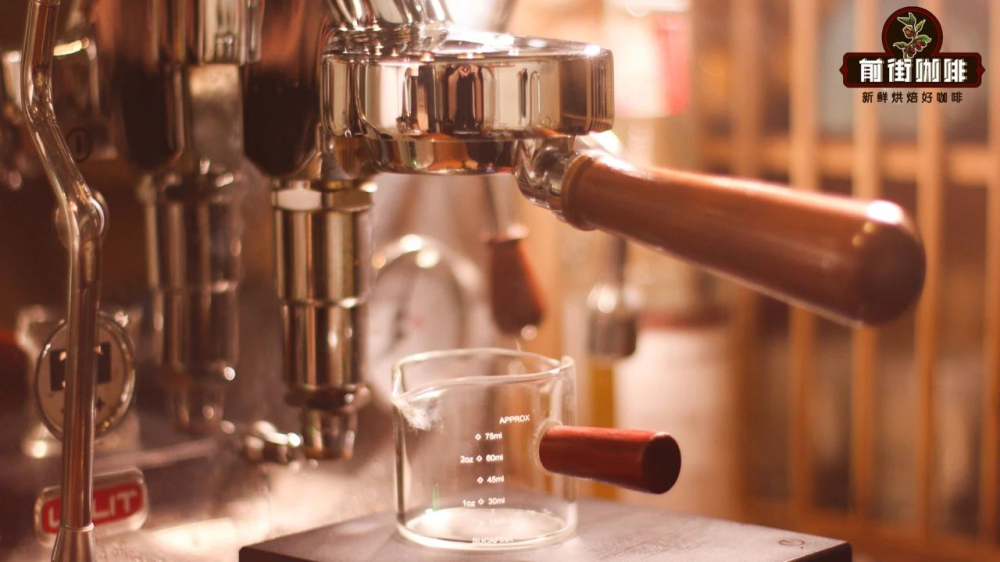
The performance of every espresso machine and espresso grinder is different, and different coffee beans also have their own conditions, so it is not the case that applying these data 100 percent will extract delicious espresso. The above are only the parameters for extracting espresso at Front Street Coffee (FrontStreet Coffee) stores, using the Q18 grinder, Lelit coffee machine, and Front Street Coffee (FrontStreet Coffee) Sunflower Warm Sun blend coffee beans (a blend of 30% sun-dried Yirgacheffe coffee beans + 70% Sydney coffee beans).
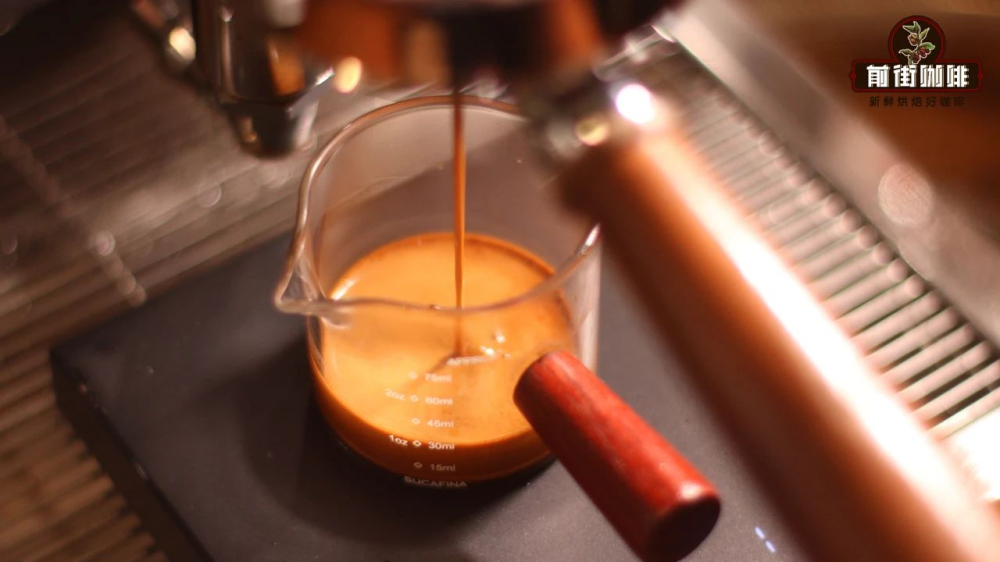
Through extremely fine grinding, and in a vacuum environment of 9-10bar, 94-degree water is quickly passed through the coffee particles. The extracted espresso drips smoothly from the portafilter like honey, with the color transitioning from reddish-brown to pale golden yellow. After extraction is complete, the surface is covered with a layer of delicate golden coffee crema (the oily foam produced when carbon dioxide in the coffee particles combines and emulsifies with coffee oils under a vacuum environment).
Important factors determining the taste of espresso
When making espresso, the most critical things are dose, ratio, time, grind size, water temperature, and pressure. Each step affects the final presentation of the coffee's taste. For water temperature and pressure, most machines have preset settings, and there is no need to change them unless necessary. Therefore, the parameters we ultimately need to determine are dose, ratio, time, and grind size.
"Dose" According to the size of the filter basket, there are different dose limits. Front Street Coffee (FrontStreet Coffee) uses 10-11g of coffee grounds when making a single espresso (1 shot); when making a double espresso, it uses 19-20g of coffee grounds.
"Coffee-to-liquid ratio" Common espresso ratios range from 1:1.5 to 1:2.5. Front Street suggests starting with a 1:2 coffee-to-liquid ratio for extraction, that is, 20g of coffee grounds extracting 40g of coffee liquid.
"Extraction time" Controlling the extraction time within 20-30 seconds makes it easier to obtain delicious espresso. Espresso that finishes extracting in less than 20 seconds will most likely taste thin and watery; if extraction takes more than 30 seconds, it is prone to a burnt-bitter taste. Front Street Coffee (FrontStreet Coffee) uses double espresso for daily output, with an extraction time of about 28-30 seconds.
"Grind size" The settings on every grinder differ, so repeated extraction and tasting are needed to feel the changes in flavor until it is balanced. The coffee machine is very sensitive to the degree of grinding: if the grind is slightly coarser, the flow rate will be too fast, the extraction time will become shorter, and the coffee will taste thin; if the grind is slightly finer, the flow rate will be too slow, the extraction time will become longer, and the coffee will taste burnt and bitter.
Espresso extraction steps
①Dosing
Before dosing, wipe the coffee filter basket clean and keep it dry. Turn on the grinder switch, begin grinding the coffee beans, and catch the coffee grounds with the coffee filter basket.
②Distribution & tamping
Use your fingers or a distribution tool to distribute the grounds, with the goal of ensuring the coffee grounds are evenly distributed and avoiding inconsistent density during subsequent tamping. Front Street Coffee (FrontStreet Coffee) recommends using a distribution tool, which ensures stability and speed for beginners. Place the distribution tool flat on the coffee filter basket, rotate it several times, and then lift it.
③Confirmation before extraction
Before locking on the group head, two things need to be confirmed: first, whether the tamp is level, and second, whether there are residual grounds around the filter basket. After that, press the brew button to wet the group head, then gently lock the portafilter onto the group head, and be sure to confirm it is locked tightly to avoid leaking.
④Extraction
After locking on the group head, quickly press the brew button to avoid the high-temperature group head scorching the surface of the coffee grounds. About 4 seconds after pressing the extraction button, the espresso drips smoothly from the portafilter like honey, with the color transitioning from reddish-brown to pale golden yellow. After extraction is complete, the surface is covered with a layer of delicate golden coffee crema (the oily foam produced when carbon dioxide in the coffee particles combines and emulsifies with coffee oils under a vacuum environment).
Espresso bean recommendations
To give espresso a more stable flavor performance, Front Street Coffee (FrontStreet Coffee) recommends using blended coffee beans specially customized for espresso. The advantage of blended beans lies in using coffee beans from different producing regions in different proportions to complement each other's strengths, stabilizing and balancing the coffee's taste, while dark roasting can enhance the coffee's body.
The main flavor performance of espresso is determined by the coffee beans. Among Front Street's currently sold products, several are Italian-style blended coffee beans. If you want to replicate the same effect as a coffee shop at home, Front Street's commercial blend coffee beans are recommended. This is a formula specially designed for those opening a shop, allowing espresso to have rich coffee crema and a full-bodied mouthfeel, while also being suitable for common categories such as Americano, latte, cappuccino, and flat white.
For more specialty coffee knowledge, please follow: Front Street Coffee ( Frontsteet Coffee )
The above content is compiled by CoffeeHunters, a coffee news website.


