







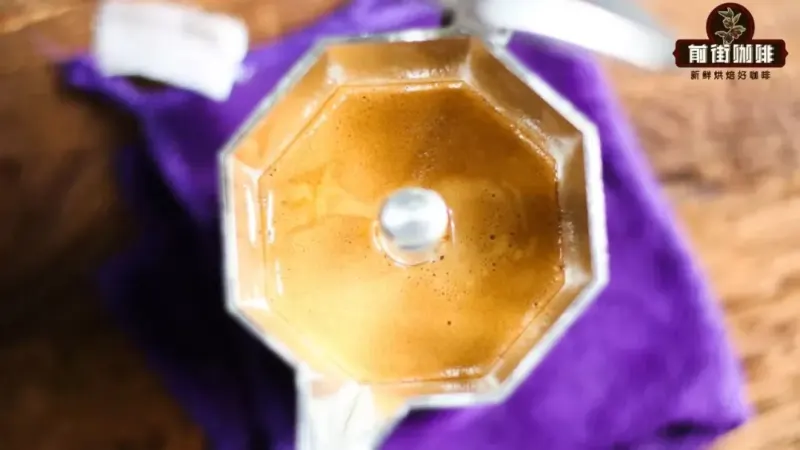
The moka pot is one of the most common espresso brewing tools in Italian households, easily extracting rich coffee at home using steam pressure. This article will start with the invention background, structural composition, and the differences between single-valve and double-valve moka pots, then provide a detailed analysis of its extraction principle, along with Front Street Coffee's recommended blend beans and complete brewing steps. Whether you are a beginner just getting into coffee or a seasoned enthusiast looking for a portable device, you can learn about the advantages and limitations of the moka pot, master the correct usage, avoid common mistakes, and make a cup of espresso with golden crema.
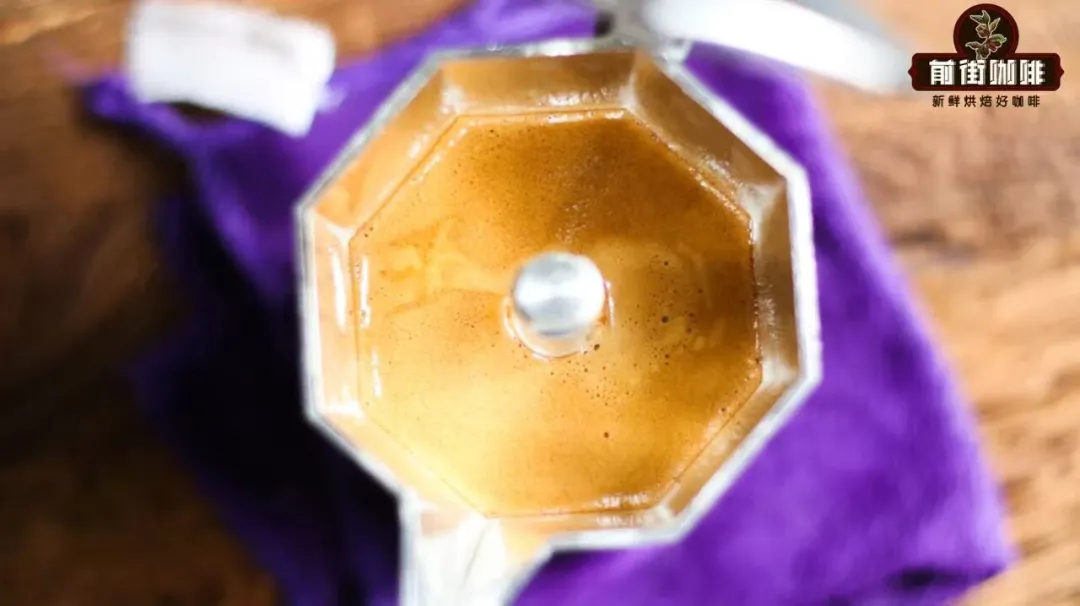
The history of espresso is long and storied, and it can be considered the foundation of all coffee drinks. Many people think that only semi-automatic espresso machines can make espresso, but there is actually another device that can do the job just as well—the moka pot.
Now Front Street will give you a detailed introduction to the moka pot.
What is a moka pot?
Since the moka pot can make delicious espresso, let's first get to know this device. The moka pot was invented in 1933 by the Italian Alfonso Bialetti. It brews coffee by heating the base, belongs to the distillation-style extraction category, and is the most economical and accessible of all espresso-making devices. It is extremely common in Italian households.
The English name for the moka pot is Moka Pot, and it is a common tool for daily espresso extraction in Italian households. Its structure has remained basically unchanged since its invention, but its appearance and materials have continuously evolved. Early traditional moka pots were made of aluminum, which scratched easily, could only be heated over an open flame, and could not be used on induction cooktops. In addition, aluminum easily reacts with the acidic substances in coffee, producing off-flavors. Later, moka pots gradually switched to stainless steel and even heat-resistant glass. In recent years, moka pot designs have become increasingly diverse, and many people love them so much that they can't resist buying several to display at home—practical and decorative at the same time. Moka pots are widely used in Europe and Latin American countries, and in the United States they are called "Italian drip pots." With one, you can easily make delicious coffee at home.
The structure of the moka pot
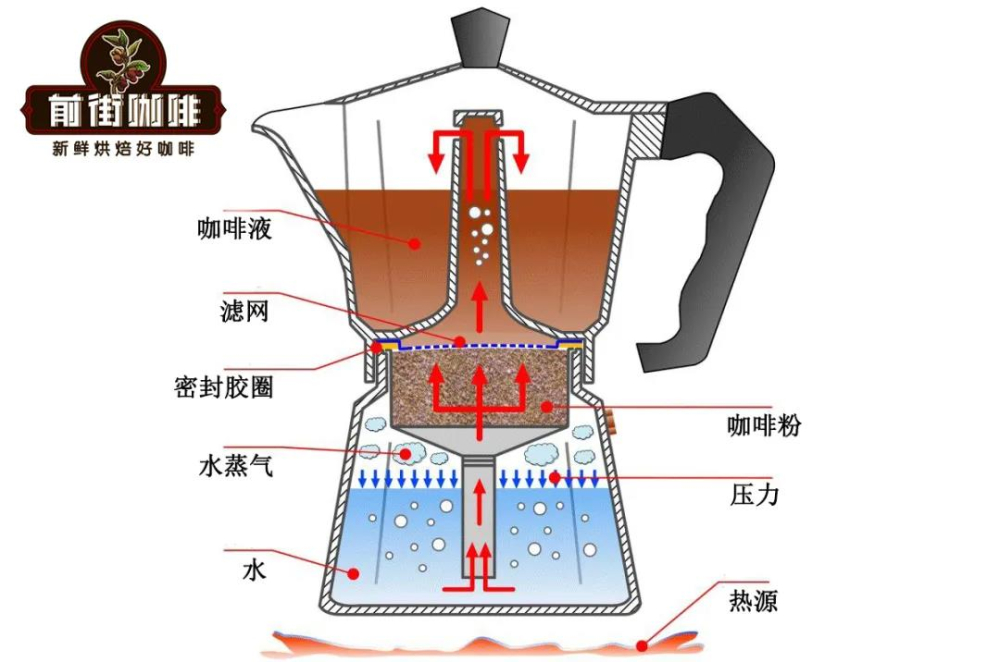
Since the moka pot can make such delicious espresso, let's take a look at its structure. The moka pot consists of three parts: the upper chamber, the filter basket, and the base. The base holds water, the filter basket holds finely ground coffee, and the upper chamber collects the extracted coffee liquid. The principle of moka pot extraction is not complicated—it uses the steam pressure generated in the base. When the pressure is sufficient to penetrate the coffee grounds, the hot water is pushed up to the upper chamber, brewing rich and aromatic coffee.
Through the following images from Front Street Coffee (FrontStreet Coffee), you can see its internal structure and the principle of coffee extraction at a glance.
Moka pots also come in single-valve and double-valve versions, and double-valve moka pots can produce more crema than single-valve ones. Single-valve means the coffee liquid flows directly out from two small holes at the top of the hollow tube. Double-valve adds a pressure valve on top of the hollow tube; this pressure valve normally blocks the small hole where the coffee liquid exits, and a certain amount of steam pressure is needed to push it upward and let the coffee liquid spray out. The coffee flavor brewed by single-valve and double-valve also differs: single-valve moka pot coffee is lower in concentration with less crema; double-valve produces higher concentration and richer crema.
Placing the moka pot directly on a stove to heat and extract using steam pressure is commonly called a direct-fire espresso pot. The moka pot attracts many people with its exquisite and beautiful appearance, and it can brew coffee that is rich enough. Coffee made with a moka pot still has the concentration and flavor of Italian Espresso.
Advantages and disadvantages of the moka pot
The principle of moka pot extraction is very simple—it uses the steam pressure generated in the base. When the pressure is sufficient to penetrate the coffee grounds, it pushes hot water up to the upper chamber. Coffee extracted with a moka pot has a strong taste, both acidic and bitter, and comes with crema. Therefore, the biggest advantage of the moka pot is that it is small, lightweight, and easy to carry—a must-have for outdoor enthusiasts. It is rugged and impact-resistant, can brew decent-quality coffee, and is simple to operate, so ordinary people can master the skill of brewing coffee. Moreover, it can easily brew aromatic coffee with golden crema.
But its disadvantages are also very obvious: the flavor ceiling of coffee made with a moka pot is relatively low. It is neither as clear and bright as pour-over coffee, nor as rich and delicate as what an espresso machine produces. Therefore, moka pots are almost nowhere to be seen in specialty coffee shops, but as a home coffee device, it is a very easy product to get started with.
The principle of moka pot coffee extraction
Moka pot extraction uses the steam pressure generated inside the base (about 1.5-3.0 atmospheres). When the steam pressure is high enough to penetrate the coffee grounds, it pushes hot water up to the upper chamber. On the way to the upper chamber, the hot water passes through the coffee grounds in the filter, extracting the essence of the coffee very quickly. The extracted coffee essence has a strong taste with both acidity and bitterness, making it the coffee device that comes closest to espresso.
What tools are needed to make a cup of espresso with a moka pot
1. Moka pot 2. Gas stove and stove rack or "induction cooktop" 3. Coffee beans 4. Grinder
[Front Street Specialty Blend Coffee Beans]
Blend: Brazil + Colombia
Roast level: Medium-dark roast
Flavor description: Chocolate, cream, nuts, butter, caramel
[Brewing method]
(1) First, add cold water to the base.
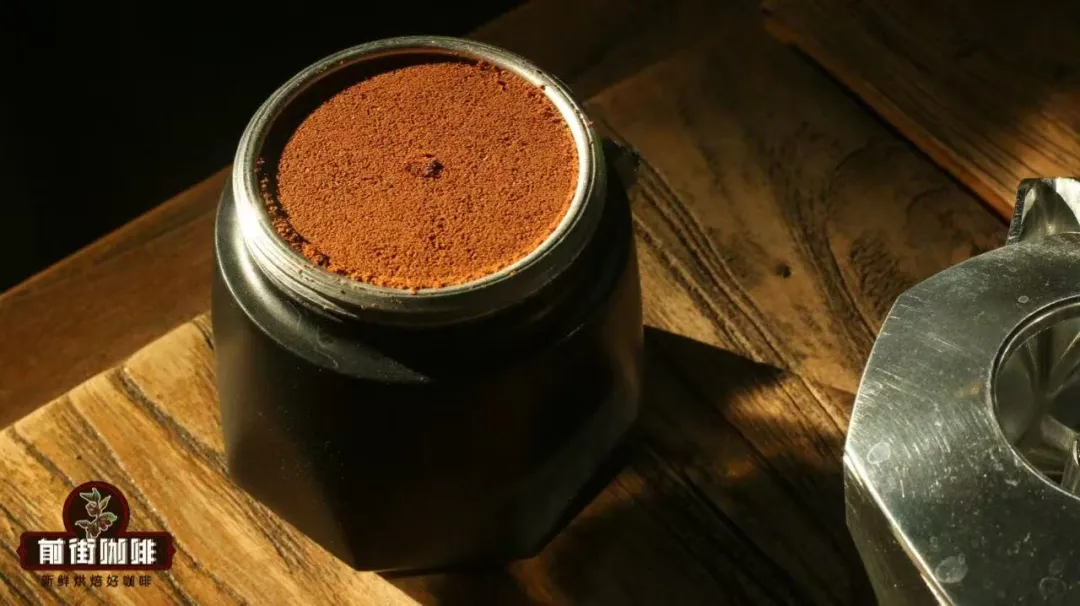
(2) Put the coffee grounds into the filter basket, filling it to about 9/10 full, and gently tap the edges so the coffee grounds are compact and level.
(3) Tighten the upper and lower chambers to prevent coffee liquid from spilling out during the process.
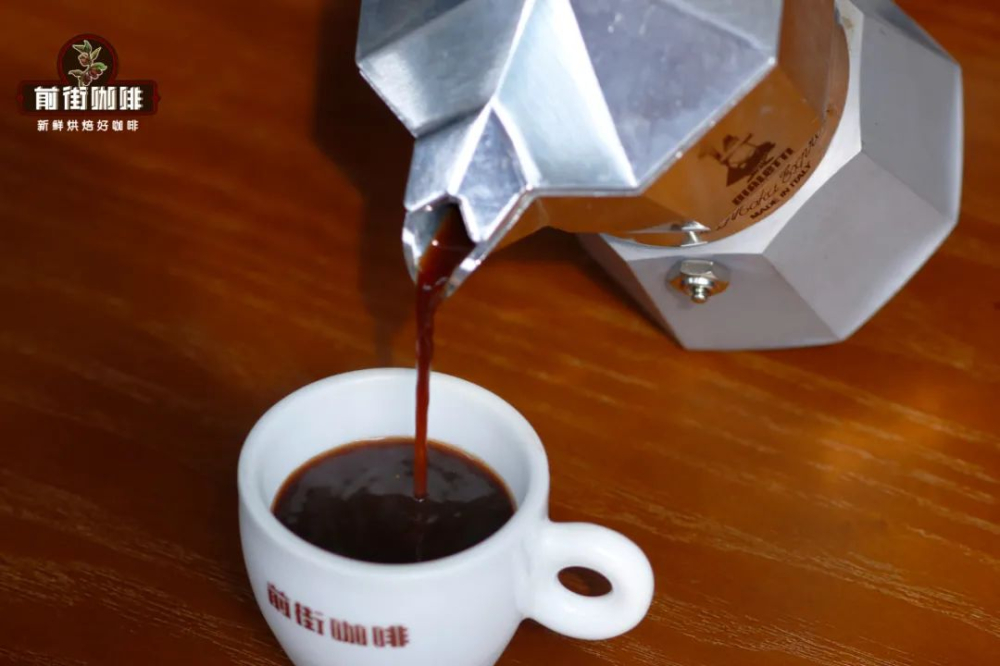
(4) Place the moka pot on a small gas burner or induction cooktop to heat. Start with medium heat, and when you hear a hissing sound, turn the heat to low, and the coffee will naturally flow out slowly.
(5) When the sound turns to a faint bubbling sound, turn off the heat to avoid over-extraction. The aromatic coffee is now ready.
[Important reminders]
(1) The moka pot belongs to the Italian coffee brewing method, so the concentration is relatively high, and it is usually paired with milk foam or fresh milk.
(2) It is suitable for finely ground coffee, and the brewing result will be even better!
(3) Please avoid heating the moka pot empty, as this may damage the pot's structure.
(4) A moka pot that has been used must be cleaned to prevent fine grounds from affecting the filter holes and rubber structure.
(5) Never brew a pot of coffee to taste right away with a brand-new moka pot. It is best to boil water in it twice first, and then start using it to make coffee!
Now it's time to taste the delicious coffee.
The most basic way to drink it is as an americano with water. With no sugar and no milk, it couldn't be better as a fat-loss coffee.
Of course, you can add fresh milk directly, and then the taste becomes like the latte from a coffee shop. If you want to add fresh milk, heat the milk to about 60 to 65 degrees, and it will present a perfect fusion of milk and coffee. In this way, a perfect cup of latte is ready.
Of course, add some ice cubes and condensed milk, and imitating a Vietnamese coffee is no problem either. After mixing the espresso liquid with condensed milk, just add ice. In winter, add condensed milk directly and add an appropriate amount of hot water according to the desired strength.
Front Street believes that everyone's taste is different, so you can add ingredients according to personal preference. Of course, you can also try more other flavors, such as the espresso beans recommended by many baristas—Front Street Black Cocoa Blend, Front Street Specialty Blend, and Front Street Commercial Blend. These can all be used to make espresso, and each has a different taste. Try more, and you will be able to taste even more pleasure that coffee brings you.
The above content is compiled by CoffeeHunters, a coffee news website.


