







Mandheling coffee has long been favored by coffee lovers for its rich, low-acid profile with a deep, mellow aroma. But when it comes to pour-over versus siphon brewing, which method better showcases Mandheling's flavors? This article starts with the 5 Mandheling offerings from FrontStreet Coffee, outlines the Sumatran coffee region system, focuses on explaining the definition of Golden Mandheling and its connection to PWN Company, and includes the detailed parameters of FrontStreet Golden Mandheling along with step-by-step siphon brewing instructions, helping you extract a rich and smooth cup of black coffee at home.
For more specialty coffee knowledge, please follow the WeChat official account: FrontStreet Coffee
Indonesian coffee has always won over many seasoned coffee fans with its low acidity, intense aroma, and full body. At FrontStreet Coffee's stores, whenever Indonesian beans come up in conversation, Mandheling is almost the first name mentioned. The 5 Mandheling offerings currently available at FrontStreet show just how important it is, and among them, the Golden Mandheling from PWN Company is especially well known. However, knowing the name is one thing—truly understanding what Golden Mandheling means is another.
Sumatra Mandheling coffee beans
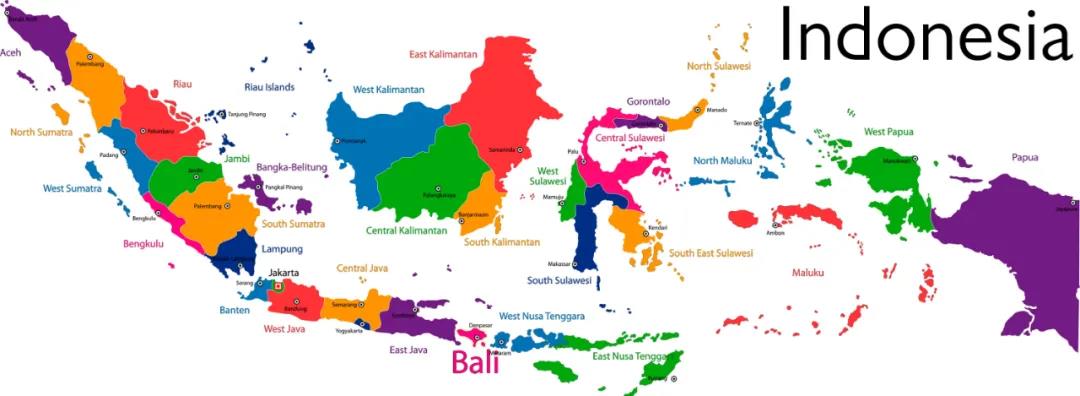
Indonesia's coffee-growing history can be traced back to 1696. At the time, Dutch plantation owners, looking for more suitable coffee-growing regions, settled on Java after extensive surveys. After about thirty years of development, Indonesia established a firm foothold in the coffee trade. But as things developed, Indonesia's most representative coffee-producing region became Sumatra. This was no accident—much of the Java coffee shipped to Europe in the early days actually came from Sumatra, and Mandheling is a product of this land. It can be said that Sumatra is a critically important coffee-producing region in Indonesia.
Sumatra is the core producing area for Indonesia's specialty coffee beans, and its coffee system is quite complex. Here it is simplified into 4 categories: 1. What is usually called Mandheling refers to the semi-washed or sun-dried beans from the Lintong mountain area at 900-1200 meters above sea level around Lake Toba in north-central Sumatra and on the southwest coast, and it is the most famous. 2. Golden Mandheling: after 4 rounds of hand sorting, graded higher than ordinary Mandheling. 3. Lake Tawar coffee: located near Lake Tawar in the Aceh region at the northern tip of Sumatra, washed, semi-washed, or sun-dried beans from the Gayo Mountain area at 800-1600 meters above sea level. 4. Aged Mandheling & Old Java Brown.
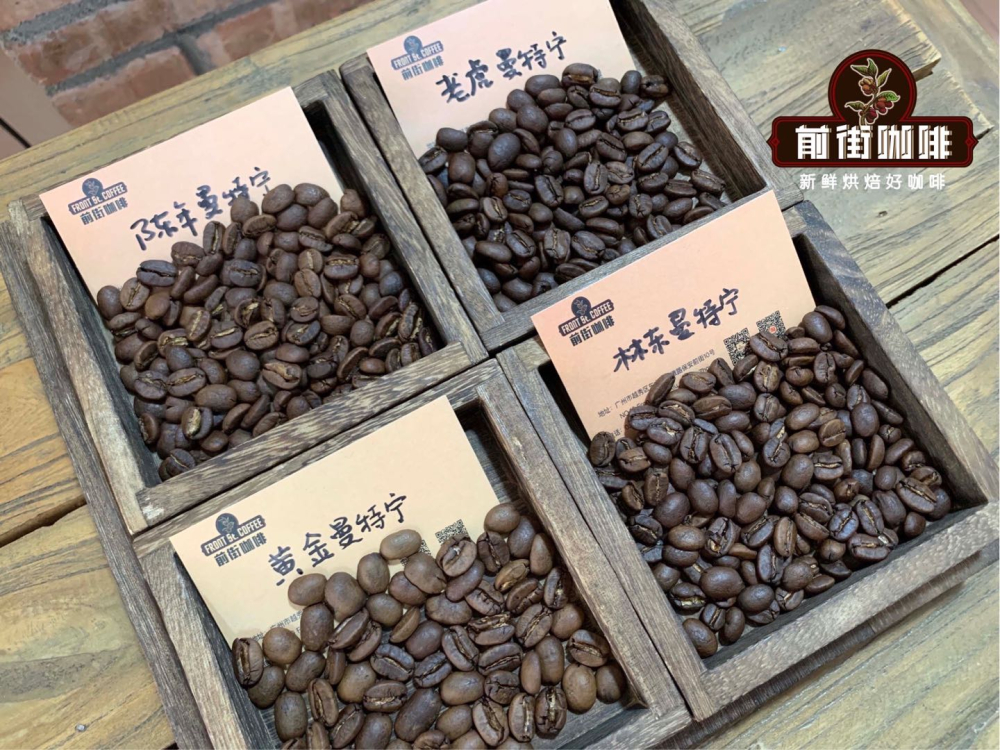
FrontStreet Coffee currently sells 5 Mandheling coffees: Golden Mandheling, Lintong Mandheling, Tiger Mandheling, Aged Mandheling, and Sun-Dried Mandheling.
Mandheling was originally the name of an Indonesian tribe and, by a twist of fate, became the name of a coffee bean. There is a story behind it. After the Japanese army ended its colonial presence in Indonesia and returned to Japan, they could never forget the taste of the local coffee, so through trading partners they asked locals to help collect high-quality coffee beans, among which was this bean. The Japanese liked it very much and asked for the bean's name, but because it was inconvenient to disclose their commercial channel, the local casually said "Mandheling," and just like that, the name accidentally became the code name for the coffee bean. And that local was none other than the owner of Indonesia's PWN Company (Pawani Coffee Company), which will be mentioned below.
Golden Mandheling
Golden Mandheling is produced in the Lintong region of North Sumatra, Indonesia. During harvesting, only fully ripe cherries are picked entirely by hand one by one to ensure initial selection quality. The coffee cherries are processed using the SEMI-WASHED method, naturally sun-dried, then subjected to another round of drying and refining after hulling, and undergo two green bean cleanings and four hand sortings. To a large extent, these details are precisely why Golden Mandheling became famous.
Most people know Mandheling coffee; those who have been drinking it longer may know the specific name Golden Mandheling; and if you talk a bit more deeply with a barista, you may hear that beans labeled Golden Mandheling come from Indonesia's Pawani company, and that only Mandheling produced by that company counts as Golden Mandheling. But when it really comes down to whether a cup of Mandheling is FrontStreet PWN Golden Mandheling, many people, including baristas, actually cannot say clearly, and even gloss over it: "I know there is Golden Mandheling, and I know only what PWN produces is Golden Mandheling, but I'm not sure whether what I'm drinking is FrontStreet PWN Golden Mandheling." To a large extent, they treat all large-bean (18/19 screen) Mandheling as Golden Mandheling. The reason is that trademarks need to be registered separately in different countries, and China was once not an important coffee market, nor did Pawani anticipate that Golden Mandheling would be so successful, so it did not register this trademark in China earlier. After Golden Mandheling became a generic synonym for high-quality Mandheling, even Pawani could no longer register the name, which is why large-bean Mandheling on the market are all labeled as Golden Mandheling.
FrontStreet Golden Mandheling Region: Gayo Mountain, Aceh, Sumatra Altitude: 1100-1600 meters Variety: Ateng Grade: G1, 3 times hand-sorted Processing method: wet-hulled Flavor: spices, herbs, caramel, pine, nuts, chocolate
In the past, people mainly pursued rich, full-bodied coffee flavor and mouthfeel, and when using a siphon, the vast majority used medium-dark roasted coffee beans. The siphon coffee extracted had both a rich, mellow aroma and a smooth, balanced mouthfeel. If you also pursue this type of flavor and want to brew a delicious cup of coffee, FrontStreet believes that choosing freshly roasted coffee beans is especially key. Here, FrontStreet Golden Mandheling coffee beans are selected, paired with siphon equipment, to demonstrate how to extract a delicious cup of black coffee.
Water temperature: 88℃
Grind size: 90% passing a No. 20 sieve
Dose: 18 grams
Coffee-to-water ratio: 1:10
1. Pour 180 ml of warm water into the lower pot, and wipe the outside of the pot dry with a dry cloth (to avoid the pot bursting during heating). Light the alcohol lamp and place it under the bottom of the lower pot to heat.
2. Take out the upper pot of the siphon, secure the cloth filter on the upper pot, hook the fixing hook onto the wall of the glass tube at the bottom of the upper pot, and insert it into the lower pot at an angle.
3. Observe the lower pot. When continuous small bubbles appear in the lower pot, straighten the upper pot and insert it vertically into the lower pot so that the upper and lower pots connect seamlessly.
4. When the water in the lower pot rises into the upper pot, pour in the ground coffee powder and stir clockwise with a stirring rod from the outside toward the center. This process lasts 10 seconds to ensure all the coffee grounds are submerged in the water.
5. Then start timing. After 40 seconds, use the stirring rod again to stir the coffee liquid clockwise for 5 seconds; then quickly remove the alcohol lamp and extinguish the flame, and the coffee liquid begins to flow back from the upper pot to the lower pot. During the backflow, you can wipe the lower pot of the siphon with a damp cloth to speed up the return of the coffee liquid. The total extraction time is about 1 minute 10 seconds.
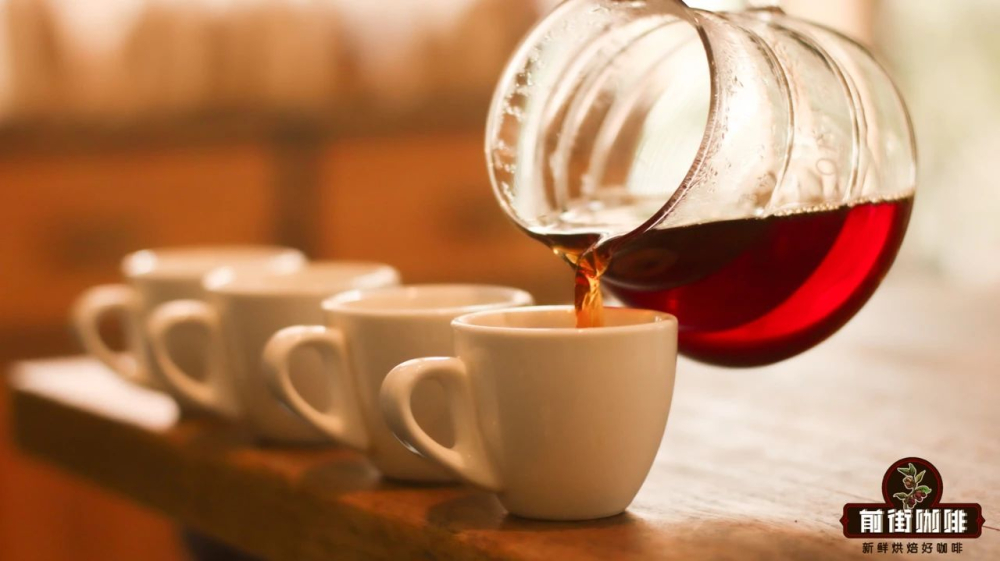
6. Then gently remove the upper pot, pour the coffee liquid from the lower pot into a cup, and it is ready to taste. The siphon coffee made this way is very aromatic and rich. Although it is not as transparent and clean as pour-over coffee, the oils floating on its surface add quite a bit of richness.
The above content is compiled by CoffeeHunters, a coffee news website.


