







Mandheling coffee, with its low acidity, full body, and thick, syrupy mouthfeel, has become the top choice for many coffee lovers who dislike sour flavors. This article provides a comprehensive analysis of this legendary coffee, covering the origin of the name Mandheling, the growing environment of the Sumatra production region, the grading and screening standards of Front Street Golden Mandheling, and how the unique wet-hulling process shapes its herbal and driftwood aromas. It also offers pour-over parameter suggestions for Front Street Lintong Mandheling and Front Street Golden Mandheling, including water temperature, grind size, coffee-to-water ratio, and the three-pour technique, helping you brew a rich, full-bodied coffee with no acidity and abundant layers at home.
People often ask: can you recommend a coffee that isn't sour? Front Street usually recommends Front Street Indonesian Mandheling coffee. Front Street Mandheling has a very full body, making it an ideal option for those who dislike acidity. Mandheling rose to fame around the same era as Blue Mountain coffee. In the last century, black coffee was synonymous with a rich, full body, and both Blue Mountain and Mandheling, through the efforts of the Japanese, eventually secured their place on the world coffee map.
Amid all the praise, Front Street Mandheling has almost become synonymous with Indonesian specialty coffee. However, Mandheling is neither a place name, a production region name, nor a port name in Indonesia, nor is it a coffee variety name. It is actually a mistransliteration of "Mandailing," an ethnic group originally living in Sumatra. How did this ethnic group become associated with coffee? Therein lies a legendary story of a fortunate accident.
According to FrontStreet Coffee: the origin of Mandheling coffee has an interesting connection with the Japanese. During World War II, Japanese soldiers on the island of Sumatra in Indonesia drank an extremely full-bodied coffee and asked the coffee shop owner for the name of the coffee. The owner mistakenly thought the Japanese soldier was asking about his identity, so he answered "Mandailing." Since "Mandailing" and "Mandheling" sound very similar in Japanese, the Japanese soldiers remembered the name "Mandheling." After the war, wanting to taste that full-bodied flavor again, the Japanese soldiers asked their Japanese merchant friends to find Mandheling coffee locally in Indonesia. Later, Mandheling coffee sold extremely well in Japan, and the name gradually spread.
Front Street Sumatra Mandheling Coffee
Front Street has mentioned before: there are many coffee-producing regions worldwide, each with distinct flavors, and the differences between producing countries are even more pronounced. Indonesian Sumatra coffee is widely acclaimed and renowned globally for providing rich, satisfying flavors, though it may be somewhat overwhelming for beginners. But Mandheling is called one of the best-quality specialty coffees in the world.
Front Street takes you through Mandheling's growing environment. Mandheling coffee is produced in Sumatra, Indonesia, in Asia, also known as "Sumatra coffee." The main producing areas include Java, Sulawesi, and Sumatra, of which 90% is Robusta. The "Mandheling" produced on Sumatra is the most famous. Among the fine traditional Arabica coffees produced in northern Sumatra, the best are sold on the market under the names Lintong and Mandheling. To be precise, Lintong refers to coffee grown in a small area southwest of Lake Toba in the Lintong administrative region. The small coffee-growing areas are scattered across a high, undulating clay plateau covered with ferns, with coffee cultivation altitudes in the production area averaging between 1,200 and 1,500 meters, and coffee grown by smallholders under shade trees. Lintong coffee is not shade-grown, uses no chemicals, and is almost entirely owned by small private holders. Mandheling is a broader term, encompassing Lintong coffee and coffee from Diari [capital Sidikalang] and the northern Lake Toba growing areas under similar conditions.
Front Street Golden Mandheling Coffee
Does hearing "Front Street Golden Mandheling" make you think it sounds very prestigious? Coffee described with the word "golden"—it must be quite precious! Front Street tells you: this Front Street Golden Mandheling is indeed different. Front Street Mandheling is a high-quality specialty coffee, so Front Street Golden Mandheling is the cream of the crop among specialty coffees, naturally a grade above Front Street Mandheling in both quality and taste.
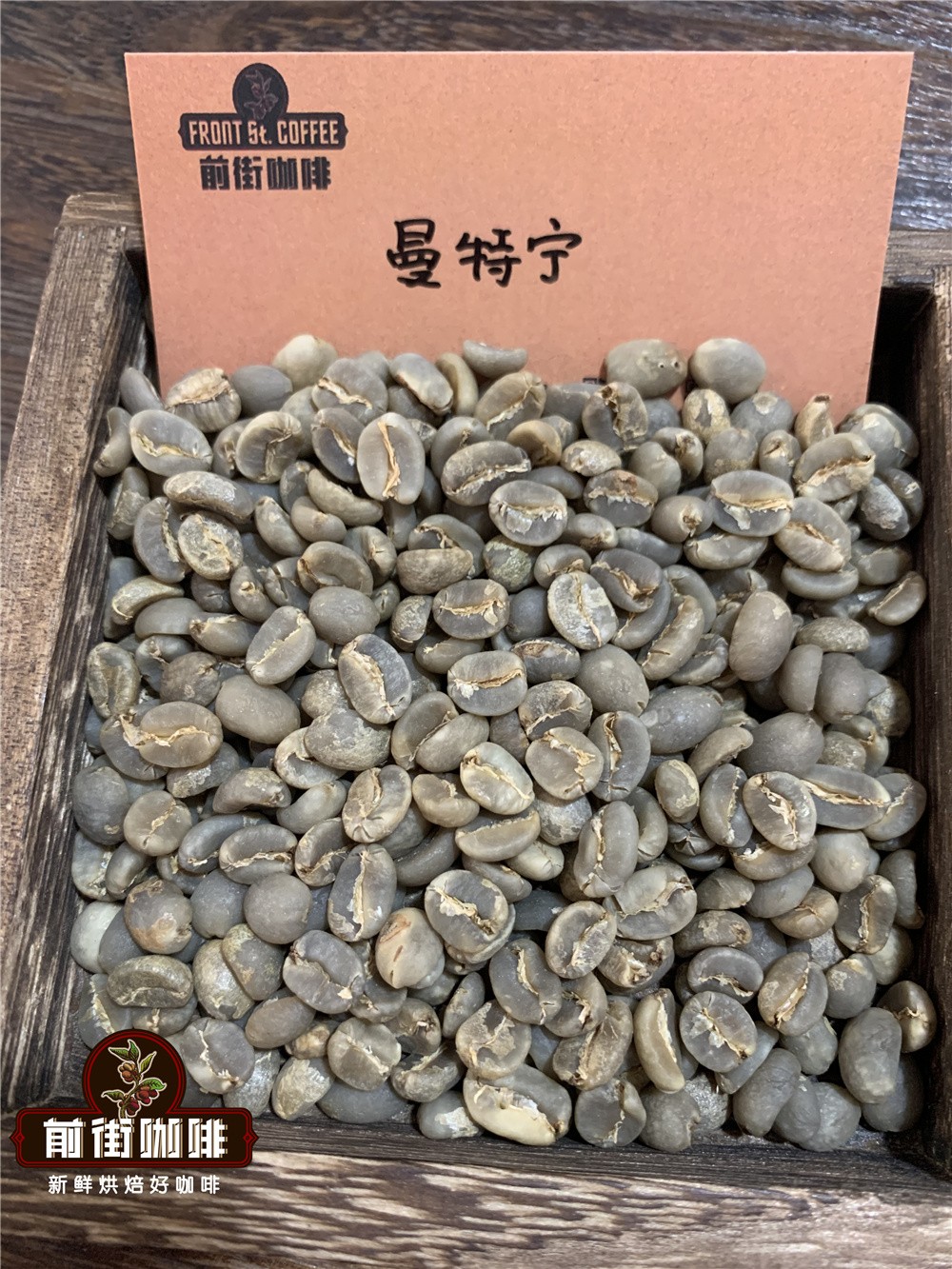
Front Street Golden Mandheling coffee comes from the renowned Indonesian coffee company Pawani Coffee Company, abbreviated PWN, which is also the company that registered the trademark for Golden Mandheling. Golden Mandheling produced by PWN is characterized by strict screening standards and large, uniform beans, with a cleaner taste as well. The Mandheling coffee obtained through careful hand-selection—plump and lustrous—is absolutely a beauty among coffees. In fact, to address the problem of Mandheling's high proportion of defective beans, the Japanese began implementing carefully selected quality control long ago. After one machine sorting and three rounds of hand-picking to remove defective beans, they produced Golden Mandheling coffee beans with a dark green color and uniform appearance, creating another wave of market demand—even Europe and America went crazy for it.
FrontStreet Coffee · Mandheling Coffee Beans Grading
Currently, most of the best Indonesian coffee beans come from this company—PWN (Pwani Coffee Company), and
G1 is an extremely rare product, a grade originally tailor-made specifically for Japanese trading companies. G1 allows a maximum of only 3 defect points per 300 grams.
The Front Street Golden Mandheling on the FrontStreet Coffee bean list is PWN's Golden Mandheling. This Front Street Mandheling coffee bean has a green bean screen size of 18 mesh or above, with fewer than 3 defective beans per 300-gram sample, at the highest G1 grade. Front Street Golden Mandheling comes with the PWN logo and certificate both outside and inside the burlap bag, and the Front Street Golden Mandheling specification is 18 mesh or above. Through cupping, FrontStreet Coffee found that the strictly screened Front Street Golden Mandheling tastes cleaner than Front Street Indonesian Mandheling. The original herbal, earthy, and woody flavors of Mandheling are almost gone, but the caramel sweetness is more intense, and the fruity acidity is brighter and more elegant. PWN has registered a trademark for Golden Mandheling, meaning only Golden Mandheling produced by PWN can be considered truly "Golden Mandheling."
FrontStreet Coffee · Mandheling Coffee Processing Method
The flavor of any coffee is greatly related to its processing method. Front Street believes that although local coffee will have local flavors, the processing method directly affects coffee flavor. Indonesia is located in a typical tropical rainforest climate zone, where it rains frequently and sunshine hours are short, making it unsuitable for sun-dried processing. Combined with the generally modest local economic conditions, there isn't enough funding to invest in washed processing, so this semi-washed processing method was developed.
This three-stage divided drying method works as follows: farmers pick fresh coffee cherries from the trees and process them the same day, using a wooden pulping machine to remove the skin and pulp of the coffee cherry, then ferment for 3 hours before drying. When the parchment beans are in a semi-dry, semi-wet state, they are collected and sold to a local coffee processing station. After receiving these semi-dry, semi-wet parchment beans, the processing station first removes the mucilage layer and parchment layer, then continues with the later stage of sun drying. This shortens the time needed for green coffee drying to between 2 and 4 days. Once the green coffee moisture content drops to 12% to 13%, it can be stored in the warehouse.
Characteristics of Front Street Mandheling coffee: a unique herbal aroma (similar to grass jelly) and driftwood flavor, caused by high humidity and the three-stage drying of the mucilage layer. This is also a rare processing method that accidentally created Mandheling's distinctive low acidity, thick body, and deep, muted aroma.
Brewing parameter suggestions for Front Street Lintong Mandheling and Front Street Golden Mandheling coffee:
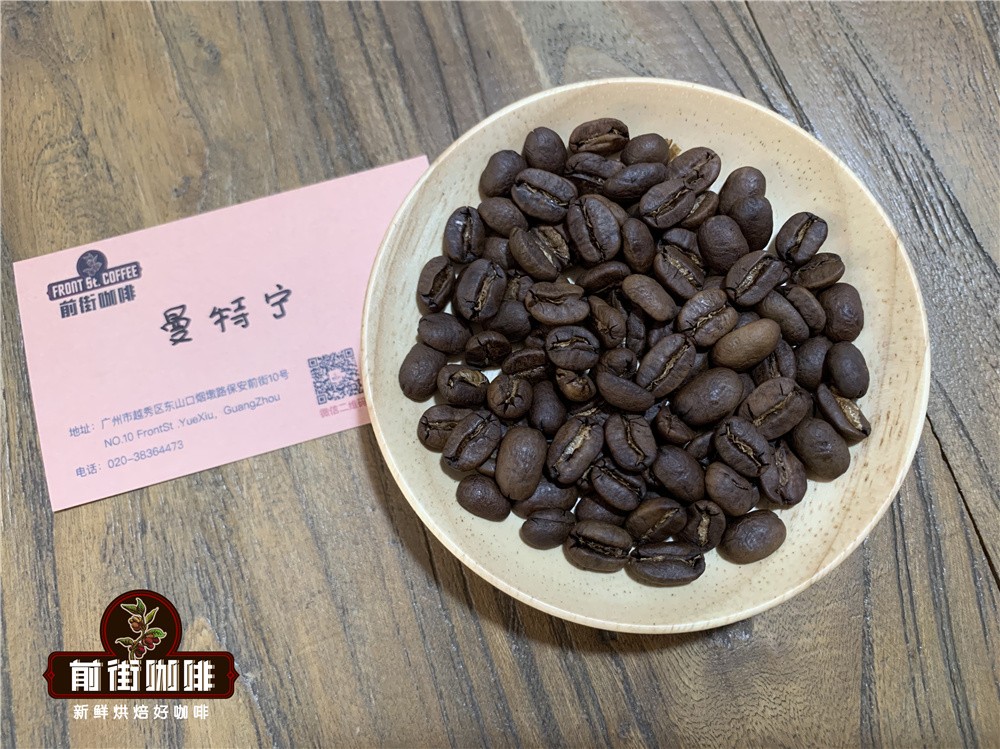
After receiving Front Street Mandheling green beans, FrontStreet Coffee's roasters use a medium-dark roast level to bring out Front Street Mandheling's characteristic full body, sweetness, and clean flavor. Since the darker the roast, the faster the dissolution rate of coffee compounds, Front Street recommends a water temperature of 88°C and a medium-coarse grind to avoid over-extraction. At the same time, to better extract Front Street Mandheling's sweetness and full body, you can use a slower-flow dripper, such as the KONO dripper.
Dripper: KONO dripper
Water temperature: 88°C
Coffee dose: 15 grams
Coffee-to-water ratio: 1:15
Grind size: medium-coarse (75% passing through a Chinese standard No. 20 sieve)
During brewing, you can use a three-pour method to extract, giving the coffee a richer layering. First pour 30 grams of water to fully wet the coffee grounds and bloom for 30 seconds, then slowly pour the second stage in small circles up to 125 grams. Once the water level in the dripper drops to just about to expose the coffee bed, continue pouring. Pour the third stage up to 225 grams and stop. Wait for the water in the dripper to fully drip into the carafe below, then remove the dripper. Total extraction time: 2 minutes.
Front Street Lintong Mandheling coffee flavor: toasted bread, nuts, caramel, pine, herbs
Front Street Golden Mandheling brewing flavor: spices, herbs, complex and layered, full-bodied and clean, high balance, intense nut and brown sugar aroma, with chocolate notes, long-lasting finish.
For coffee brewing, Front Street recommends using freshly roasted coffee beans to experience the richest flavors possible. FrontStreet Coffee ships coffee beans within 5 days of the roast date, because Front Street knows well how much freshness affects flavor. Front Street's roasting philosophy is "Freshly Roasted Good Coffee," ensuring every customer receives the freshest coffee when their order arrives. Coffee needs about 4-7 days of resting, so by the time the customer receives it, it's at its optimal flavor.
Of course, some customers need Front Street to grind the coffee for them, and that's fine too. But Front Street must remind you: once coffee beans are pre-ground, there's no need for resting, because during transport, the pressure from carbon dioxide inside the packaging also rounds out the coffee's flavor, so you can brew a cup immediately upon receiving the ground coffee. However, ground coffee needs to be brewed promptly, because once exposed to air, it oxidizes quickly—meaning the coffee's flavors dissipate faster and the coffee won't taste as good. So Front Street recommends buying whole beans and grinding fresh for each brew, so you can better enjoy the coffee's flavors.
When it comes to choosing coffee, if you're not sure what flavors you like, you can come to Front Street to find daily-drinker beans suited to your taste. Front Street has over 50 single-origin beans from different regions and 8 of the most representative Front Street daily-drinker coffees from different producing countries for you to choose from. Front Street daily-drinker beans offer excellent value for money, making them a great choice for coffee friends—especially those new to coffee!
The above content is compiled by CoffeeHunters, a coffee news website.


