







Yunnan, as China's core coffee-producing region, has a cultivation history of over a century. From the first seed planted by a French missionary in Zhukula, to the introduction of the two classic varieties Typica and Bourbon, and then to Catimor becoming the main cultivated variety, the evolution of Yunnan coffee varieties reflects the trajectory of the industry's development. This article sorts out the origins and changes of coffee cultivation in Yunnan, focusing on analyzing the differences between Typica and Bourbon in botanical characteristics and flavor performance, and, combined with the specific roasting and cupping data of Front Street Coffee's Baoshan Typica, presents the true face of Yunnan specialty coffee.
Yunnan coffee has always maintained a high level of discussion within the coffee circle, and opinions on its quality vary among different parties. Front Street Coffee hopes that by sorting out historical and varietal information, it can help everyone understand the current situation of Yunnan coffee more clearly.
Yunnan's connection with coffee can be traced back to 1904. At that time, a French missionary brought coffee seeds into the country from abroad and planted the first coffee tree in a place called Zhukula. At that time, probably no one anticipated that more than a hundred years later, coffee would become a dazzling pearl in Yunnan's plateau characteristic agriculture.
Time advanced to after 1930, when the well-known overseas Chinese leader Mr. Liang Jinshan introduced coffee cultivation to the Pupiao and Luoming areas, and this planting tradition continued until the founding of New China. Starting in 1952, under the technical guidance of expert Ma Guojin from the Baoshan Tropical Economic Crops Research Institute, coffee cultivation gradually began on a large scale in Lujiang and other areas, and by now the history of large-scale cultivation has been nearly sixty years.
By the mid-1990s, Yunnan's coffee planting area had once climbed to 4,000 hectares. By the end of 1997, the province's coffee planting scale reached 7,800 hectares. Looking at the present, Yunnan's planting area accounts for 70% of the country's total, while its output accounts for more than 80% of the country's total. Whether measured by area or output, Yunnan coffee is already in a leading position domestically.
For a considerable period, Typica was the main tree variety in Yunnan coffee, and locally it was customarily called the "old variety." Typica is a classic high-quality coffee variety, originally from Ethiopia and southeastern Sudan, and it is also the most widely cultivated coffee variety in the Western Hemisphere. Its plant is relatively robust, but it has poor tolerance to light and can achieve higher yields in places such as Hawaii. Typica's top leaves appear in a red-copper color, so it is also called red-top coffee.
Yunnan's varieties are not limited to the old face of Typica. In 1952, experts from the Yunnan Academy of Agricultural Sciences distributed 80 kilograms of coffee seeds (including Typica and Bourbon) to farmers in Lujiangba, Baoshan, and several years later carried out large-scale technical guidance, after which stretches of coffee forests appeared along the Yunnan-Burma Highway. Driven by the huge demand for supply to the Soviet Union, Yunnan coffee cultivation experienced a period of rapid expansion. A survey conducted by Professor Ma Xijin in 1981 showed that among the ancient coffee population in Zhugula village, Typica accounted for about 31%, and Bourbon about 69%. Bourbon is a natural mutation of Typica, traceable at the earliest to Yemen's Mocha round-bean coffee, and it gradually spread after being planted by the French on Bourbon Island (now Réunion Island) in 1708.
Bourbon also has a pleasant aroma and rich flavors. Compared with Typica, it is superior in both yield and growth vigor, and is suitable for planting at elevations of 1,200 to 2,000 meters; however, its resistance to pests and diseases is relatively weak, and it is also more sensitive to strong winds and heavy rainfall. Bourbon is the variety second only to Typica in status among Arabica coffee. Its main branches initially extend upward at a 45-degree angle, then droop as they bear the weight of the fruit; the internodes of the side branches are relatively dense, and the fruit load is large with higher yield, but the berries are smaller and ripen more slowly. Bourbon's terminal buds and young leaves are green, hence it is called green-top coffee.
After 1992, Nestlé established a coffee agriculture department specifically responsible for variety improvement and cultivation research for Yunnan coffee, and introduced the high-yield and highly disease-resistant Catimor, purchasing with reference to the U.S. spot market price. Catimor does not have a pure Arabica lineage; it was crossed from Timor (a hybrid of Arabica and Robusta) and Caturra (a Bourbon mutation), and therefore carries about 25% Robusta genes. This lineage also brings shortcomings in flavor: the aroma is not layered enough, the bitterness is generally heavier, and it easily shows astringency as well as a relatively pungent musty taste.
At present, the most widely planted variety in Yunnan is precisely Catimor and its improved descendants, which is what the market often calls Yunnan small-bean coffee.
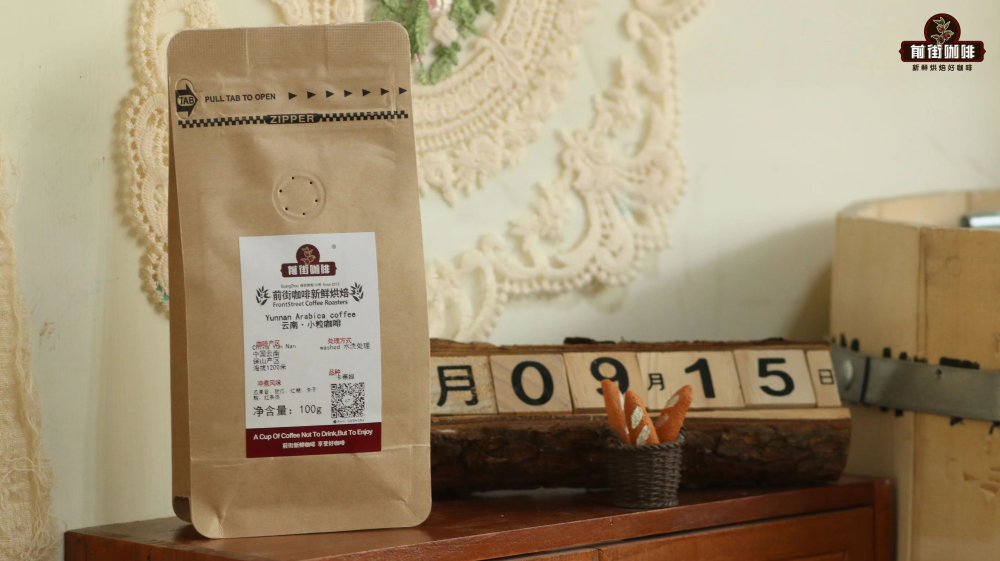
Front Street Coffee's Front Street 2013 Typica uses raw materials from Baoshan's old Typica variety. Baoshan Lujiangba is located between 24°08′ and 25°51′ north latitude, exactly within the suitable latitude band for coffee (most coffee-producing regions in the world are distributed in the tropical or subtropical areas between the Tropic of Cancer and the Tropic of Capricorn, that is, from 25 degrees north of the equator to 30 degrees south of the equator), with an elevation range from 640 meters to 3,510 meters. It has a dry-hot valley climate, with distinct dry and wet seasons and rain and heat occurring in the same period. Such natural geographical conditions are very suitable for the growth of Arabica (small-bean coffee). Baoshan has a long history of coffee cultivation, is recognized as one of the best small-bean coffee producing areas, and is also a region with relatively superior coffee quality nationwide and even globally. This batch uses washed processing, and the flavor presents brown sugar, plum acidity, and black tea.
Front Street Coffee: China · Yunnan Huaguoshan Coffee Beans
Region: China Yunnan Baoshan Producing Area
Altitude: 1,200 meters
Variety: Typica
Processing Method: Washed Processing
Typica's morphological characteristics are very distinct, and it may be the easiest variety to identify. The plant is conical, with the main trunk growing vertically upward and reaching a maximum height of 5 meters. This height means that Typica's branches, as well as the internode spacing on the same branch, are longer than those of other varieties. The angle between the side branches and the vertical main trunk is between 50 and 80 degrees. Neither the trunk nor the branches are particularly thick. The leaves, fruit, and green beans are usually slender in shape, and the tips of young leaf buds are bronze-colored; compared with other Arabica varieties, Typica's leaf surface is smoother and has fewer wavy edges. Typical Typica fruit is bright red when ripe.
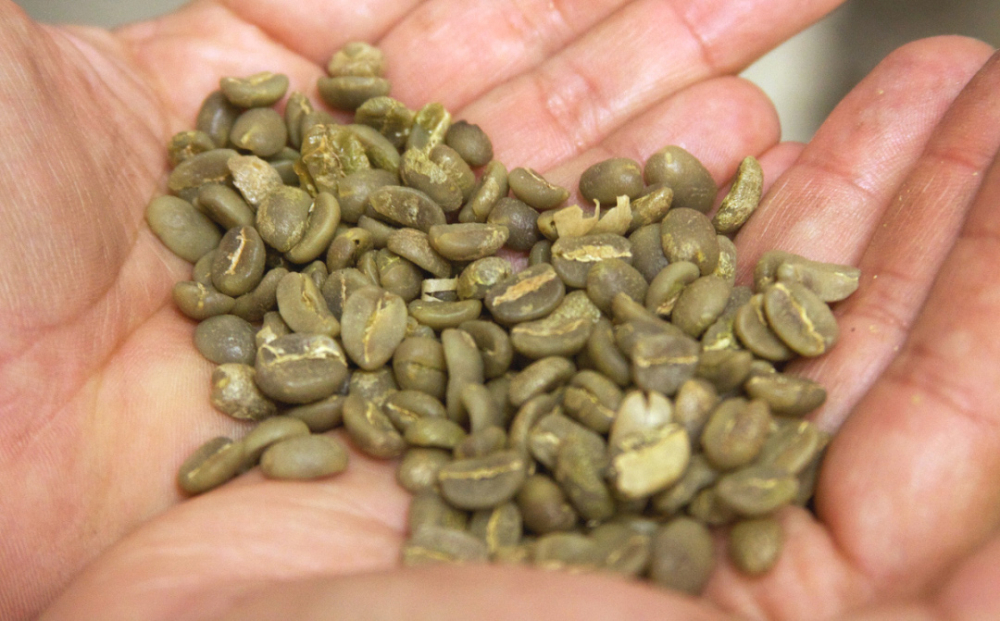
Front Street Coffee Roasting Analysis
Yangjia 800N (roasting capacity 300 grams): charge when the drum temperature rises to 200°C, adjust the damper to 3, lower the heat to 160°C after one minute, the turning point is 1 minute 32 seconds, roast until 5 minutes 40 seconds when it turns yellow at 149°C, the grassy scent completely dissipates, the dehydration stage ends, keep the heat unchanged, adjust the damper to 4; at the 6th minute adjust the heat to 140, at the 7th minute lower it again to 120, at the 8th minute wrinkles and dark patches appear on the bean surface, and the toast aroma clearly turns into coffee aroma, which can be regarded as the prelude to first crack. At this time it is necessary to carefully distinguish the sound of first crack. First crack begins at 8 minutes 37 seconds, adjust the heat to 90, open the damper fully to 5, at the 9th minute further reduce the heat to 20°C, first crack development lasts 2 minutes 00 seconds, and drop at 196°C.
Front Street Cupping
Front Street Coffee conducts cupping within 8 to 24 hours after the sample beans have finished roasting. Front Street Coffee's roasters usually use ceramic cupping bowls with a capacity of 200 milliliters, marked with 150-milliliter and 200-milliliter scale lines. According to SCAA standards, the TDS of the cupping water is controlled at around 150 ppm—if the TDS is too low, it easily causes over-extraction, while if it is too high, it affects the mouthfeel and easily causes under-extraction. The cupping water temperature is 94°C. The grind size follows SCAA cupping standards, controlled at a 70% to 75% passing rate through a No. 20 standard sieve (0.85 millimeters). The coffee-to-water ratio is 11 grams of coffee grounds to 200 milliliters of hot water, that is, 1:18.18, so that the extracted concentration falls exactly within the golden cup range of 1.15% to 1.35%. The steeping time is 4 minutes.
Front Street 2013 Typica Coffee Bean Cupping Record: The entry is full of fruity aroma, with melon and herbal plant notes, and a smooth mouthfeel; the mid-palate presents nutty and milk chocolate tones; the finish has lively and bright plum acidity, promoting salivation on both cheeks, with good balance, medium body, and a full body. During the process of the temperature changing from hot to warm, one can feel the layered changes in acidity and sweetness, first sweet then sour, accompanied by apricot and citrus-like acidity, with a black tea finish and a hint of brown sugar.
For more specialty coffee beans, please add the private WeChat Front Street Coffee, WeChat ID: kaixinguoguo0925
The above content is compiled by CoffeeHunters, a coffee news website.


