







Blue Mountain coffee has long been known as the "Rolls-Royce of coffee," yet the market is full of mixed offerings, and products labeled "Blue Mountain flavor" may not contain a single authentic Blue Mountain bean. Where exactly does genuine Blue Mountain No. 1 come from, what grade does it belong to, and how can it be identified from three aspects: appearance, aroma, and taste? This article will sort out the planting history and grading system of Jamaican coffee, explain the certification system for Blue Mountain No. 1, and introduce Front Street Coffee's two Blue Mountain No. 1 offerings imported from Clifton Estate—one washed and one natural—along with brewing parameters for the KONO dripper, helping enthusiasts establish clear criteria for judgment.
In the 1980s and 1990s, Hong Kong TV dramas swept across Guangdong, and the urban men and women shuttling among skyscrapers in those shows were always talking about Blue Mountain coffee. This coffee was thus given the title of "Rolls-Royce," and being able to drink a cup became a small wish in many people's hearts. Some took action on the spot and opened an orange app to order a bag of Blue Mountain coffee beans, but upon seeing the huge price differences, they could not help wondering: which one is actually real Blue Mountain?
Blue Mountain coffee is widely renowned for its mellow body and balanced acidity, sweetness, and bitterness. Precisely because of this, many merchants play word games and label their products with names like "Blue Mountain flavor coffee" or "Blue Mountain blend coffee." These products are usually blends made from beans with similar flavor profiles, and there may not be even a single authentic Blue Mountain bean in them.
The History of Coffee Planting in Jamaica
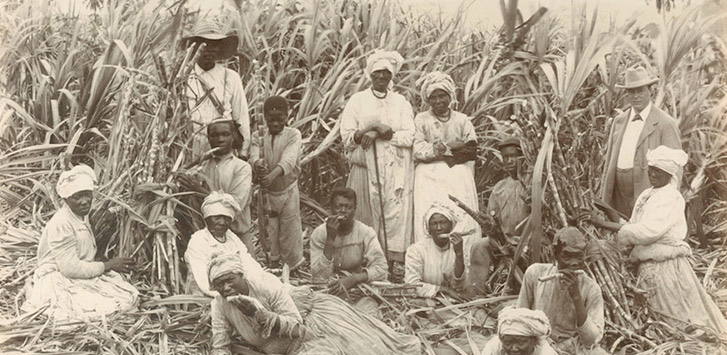
Jamaica's connection with Blue Mountain coffee can be traced back to the eighteenth century. In 1723, King Louis XV of France sent three coffee trees to an island in the Caribbean—Martinique, located about 1,900 kilometers southwest of Jamaica. In 1728, the governor of that island gave an Arabica coffee tree to Jamaica's governor, Sir Nicholas Lawes. Between 1800 and 1840, Jamaica leaped to become a major coffee-producing country, with annual output once reaching 70,000 tons, ranking first in the world at the time.
So-called Blue Mountain coffee refers to coffee whose place of origin is the Blue Mountain region. The Blue Mountain range lies north of Kingston on the eastern side of Jamaica, surrounded by the Caribbean Sea. On clear days, sunlight shines directly on the blue sea, and the peaks of the Blue Mountains reflect a brilliant blue glow, which is how the name "Blue Mountain" came about. The main peak of Blue Mountain stands at 2,256 meters above sea level, the highest peak in the Caribbean region, but not the entire mountain is suitable for growing coffee—areas above 1,700 meters are designated as forest reserves, with no coffee cultivation.
Jamaica's Coffee Grading System
According to growing altitude, Jamaican coffee is divided into three categories:
[Jamaica Blue Mountain Coffee] Grown between 910 meters and 1,700 meters
[Jamaica High Mountain Coffee] Grown between 460 meters and 910 meters
[Jamaica Prime Coffee] Grown below 460 meters
Among these, Jamaica Blue Mountain Coffee and Jamaica High Mountain Coffee are each further divided into four grades, from highest to lowest: No.1, No.2, No.3, and PB. PB is the familiar Peaberry, or round bean.
From this, it can be clearly stated that Blue Mountain No. 1 coffee beans refer to coffee grown above 910 meters in the Blue Mountain range, with green beans of 17 screen size or above and a defect rate below 3%.
In the past, the Jamaican government insisted that all Blue Mountain coffee had to be roasted locally to maintain consistent quality. But roasting coffee beans is, after all, work that requires experience, training, and expensive equipment, and because consumers generally believe that only freshly roasted beans are good enough, local roasting in Jamaica seemed unrealistic. Today, Jamaican green coffee beans can already be exported.
Front Street Coffee has also imported a batch of Jamaican Blue Mountain green coffee beans from the place of origin. At present, the Jamaica Coffee Industry Board (CIB) issues certificates for all exported Blue Mountain coffee, and there are three types: a quality certificate issued by the Jamaica Coffee Board, an authorized sales certificate signed by the Blue Mountain coffee producer, and a certificate of origin for Jamaican Blue Mountain coffee.
How Can You Identify Real Blue Mountain No. 1 Coffee?
Appearance: Blue Mountain green beans are bluish-green, relatively uniform in arrangement, medium to slightly small in size, with both ends slightly upturned; after roasting, they expand somewhat in volume and appear fuller.
Aroma: Blue Mountain coffee's aroma is rich and dense, while blended imitation Blue Mountain coffee does not possess this aromatic characteristic.
Taste: Authentic Blue Mountain coffee has an extremely balanced taste and outstanding body, with acidity, sweetness, and bitterness all just right, without any one flavor standing out too much or being noticeably lacking. This is difficult for other coffee beans to replicate and is also the most central basis for identifying Blue Mountain coffee.
Clifton Estate
Front Street's Blue Mountain No. 1 coffee comes from Jamaica's Clifton Estate. Located in the central part of the Blue Mountain region, the estate is one of Jamaica's oldest coffee plantations and a Rainforest Alliance-certified coffee estate. Since the 1790s, Clifton has been growing Typica, producing coffee of excellent quality and outstanding aroma. In 2004, with the efforts of John Martinez, a coffee processing plant was completed here, and since then Blue Mountain coffee has been sold under the estate's name.
Front Street Coffee Jamaican Blue Mountain No. 1 Coffee Beans
Region: Jamaica Blue Mountain growing region
Farm: Clifton
Altitude: 1310m
Variety: Typica
Grade: No.1
Processing method: Washed & Natural
In 2020, the Blue Mountain region exported a batch of naturally processed Blue Mountain No. 1 coffee beans, and Front Street purchased and listed this batch of natural Blue Mountain No. 1 at the first opportunity. Before that, Front Street's Blue Mountain No. 1 had only a washed version.
Coffee farms using washed processing need to build washing channels and bring in a continuous flow of fresh water. During processing, the skin and pulp are first removed, then fermentation takes place for 12 to 18 hours. After that, the fermented beans are put into channels and moved back and forth, using friction between the beans and the force of flowing water to wash the coffee beans until they are smooth and clean. They are then dried in the sun until moisture content drops to 12% to 14%. After drying, they still undergo sorting and finally enter storage.
Washed processing can present the truest terroir flavor of Blue Mountain coffee, which is also why most of Front Street Coffee's daily-drinker bean series uses washed processing. As the market evolves, post-processing methods for green coffee beans are also changing, and naturally processed Blue Mountain coffee has consequently appeared. However, once the processing method is changed, the flavor structure of the coffee changes accordingly.
How Should Front Street Coffee Jamaican Blue Mountain No. 1 Be Brewed?
When brewing Jamaican Blue Mountain No. 1, Front Street mainly uses the KONO dripper. This is because Blue Mountain coffee is a dark roast, and the water temperature is set at 86°C. If a V60 dripper were used at this temperature, the flow rate would be too fast and could easily lead to under-extraction. The KONO dripper's ribs are short and few in number, and after the filter paper is moistened it can cling tightly to the wall of the dripper, extending the contact time between water and coffee grounds and providing an immersion function, which helps extract richer flavor substances.
Dripper: KONO dripper
Dose: 15 grams
Water temperature: 86°C
Coffee-to-water ratio: 1:15
Grind size: EK43s#10.5 (75% passing rate on China standard No. 20 sieve)
Front Street brews Blue Mountain coffee using a three-stage pour: first pour 30 grams of water and let it bloom for 30 seconds; in the second stage, pour in a circular motion until 125 grams, then stop; when the liquid level drops to the point where the coffee bed is about to be exposed, continue with the third stage, stopping at 225 grams, and after the water has fully dripped into the server, remove the dripper. Total extraction time is about 2 minutes 00 seconds.
[Front Street Washed Blue Mountain] Rich in dark chocolate and nutty flavors, with a creamy, smooth mouthfeel and balanced acidity, sweetness, and bitterness.
[Front Street Natural Blue Mountain] With berry-like acidity, good overall balance, rich dark chocolate and nutty flavors, and a hint of fermented character.
The above content is compiled by CoffeeHunters, a coffee news website.


