








The key to an ideal latte lies not only in the quality of the espresso, but also in the fineness of the steamed milk and the control of temperature. Front Street Coffee will start from the basic principles of milk frothing to answer common confusions such as why the milk foam does not integrate and why it floats to the surface during latte art, and will deeply analyze the impact of steam pressure and milk foam fineness on integration. At the same time, through experimental comparisons at different temperatures, we reveal why the range of 50 to 70 degrees Celsius is the golden zone for persistent and stable milk foam, helping you master the core techniques for steaming perfect milk foam.
For more specialty coffee knowledge, please follow: Front Street Coffee (Frontsteet Coffee)
An operation guide for getting the best milk foam when steaming milk. Why does milk froth?
Front Street Coffee believes that steaming milk is a basic skill every barista must master, and it is also one of the important standards for measuring their professionalism. Taking latte as an example, its milk foam is usually relatively thin, and the sip is smooth and delicate. Therefore, when steaming milk for a latte, the milk foam should not be too thick. The ideal state is a glossy surface, without obvious large bubbles or fine bubbles, and an overall even and delicate texture.
The core principle of milk frothing is to impact the milk with steam, inject air into the liquid milk, and rely on the surface tension of milk proteins to form a large number of tiny bubbles, causing the milk to expand in volume and become foamy.
During the frothing process, lactose dissolves in the milk as the temperature rises and is wrapped inside the milk through the frothing action; milk fat is responsible for keeping these tiny bubbles stable. When drinking, these bubbles burst in the mouth, allowing the aroma and flavor to be better released and amplified, giving the milk a sweet, rich, and thick taste and mouthfeel. In addition, when integrating with coffee, the intermolecular binding force is stronger, and coffee and milk can fully combine, allowing their respective characteristics to stand out while also blending perfectly, achieving a complementary effect.
Front Street Coffee is here to answer some questions everyone often encounters when steaming milk!
Why does the steamed milk foam not integrate?
As soon as the milk foam is poured into the espresso, it immediately blends with the coffee. Forget making a pattern, there is not even a trace of one, and it just drifts away; or else there is nothing wrong during the initial integration, but when it comes time for latte art, the milk foam clumps and directly floats on top. Front Street Coffee will first explain the first situation to everyone: this is because the amount of aeration is small, the steamed milk foam is thin, and it is mainly just hot milk, so how could it form a pattern? So friends who encounter this situation should be bolder and aerate a bit more!
Then why, when there is clearly no problem with integration, does the milk foam float on top during latte art?
This is mainly because the integration between the milk and the milk foam is relatively poor, so the milk and milk foam separate, and in the end the milk foam floats on the coffee. At this time, the only way to adjust it is during the stage of texturing the milk and milk foam!
What determines the degree of integration between milk foam and milk? The degree of integration mainly depends on the following two points:
1. The size of the steam wand pressure. (The size of the steam wand pressure causes the milk foam to roll to different degrees during steaming. The greater the pressure, the higher the integration.)
2. The fineness of the milk foam. (The finer the steamed milk foam, the less air each individual foam bubble contains, the higher the density, and the smaller the buoyancy; the coarser the steamed milk foam, the more air each individual foam bubble contains, the lower the density, and the greater the buoyancy. If the steamed milk foam is relatively coarse, the milk foam will quickly float to the surface of the milk, and the integration will be lower; if the steamed milk foam is relatively fine, the milk foam will float to the surface of the milk more slowly, and the integration will be higher.)
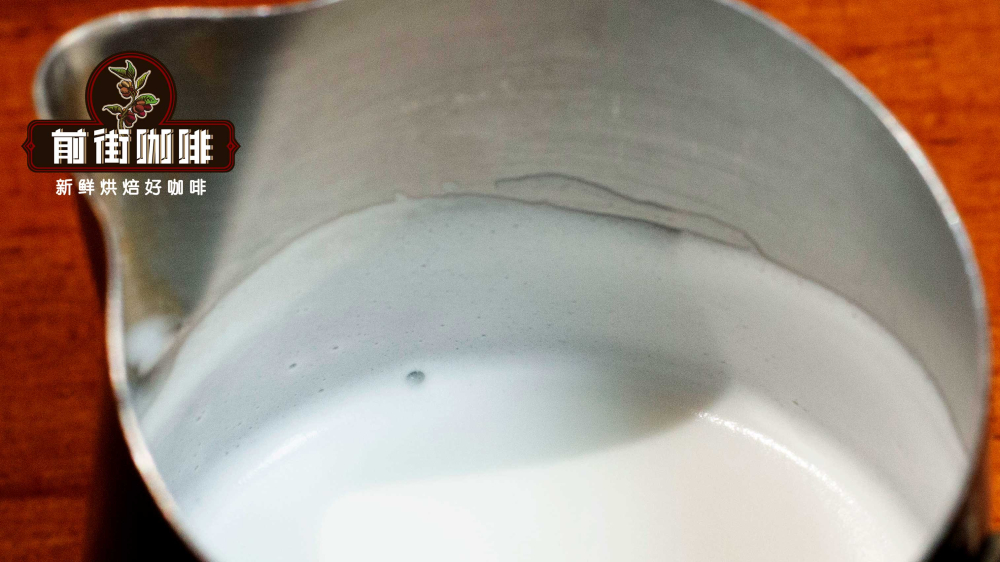
Why is a high degree of integration between milk and milk foam required? The higher the degree of integration between the milk foam and the milk, the clearer and more delicate the lines of the latte art pattern will be; conversely, the lines of the latte art pattern will be blurrier and rougher.
How should the degree of integration between milk and milk foam be judged?
Front Street Coffee teaches you how to judge the integration of milk and milk foam! Pour the steamed and integrated milk and milk foam into a glass and let it stand, observing the time it takes to separate. The length of the separation time indicates the degree of integration of the milk and milk foam!
If it separates within 30 seconds, it is poor; if within 30-60 seconds, it is medium; if after 60 seconds, it is excellent.
Also, do not ever leave the steamed milk foam sitting aside to use later, because this will also cause separation!
Perhaps some people will ask, why is there a requirement for the temperature of the steamed milk?
Generally, Front Street Coffee heats the milk to around 60 degrees, but it must not exceed 70 degrees, otherwise the protein structure in the milk will be destroyed.
Front Street Coffee previously conducted experiments, steaming milk to different temperatures:
The situation at 90°C is: when it exceeds around 70°C, even if the milk foam is not deliberately aerated, the foam will rapidly expand, and the high temperature keeps it rolling. By the time it was almost 90°C, the editor's milk had already overflowed the milk pitcher (as shown in the picture above), and it stopped at 94°C. Obvious signs of foam dissipation had already appeared at around 1 minute 30 seconds.
The situation at 60°C is: this is the temperature we use more often. Steaming the milk foam according to conventional operation, stopping when it feels hot to the touch, the temperature was 63°C. Obvious signs of foam dissipation appeared at around 10 minutes 50 seconds.
The situation at 30°C is: aerating according to conventional technique, the temperature felt by hand was warm, and the stopping temperature was 33°C. Obvious signs of foam dissipation appeared at around 4 minutes 20 seconds.
The situation at 12°C is: here we directly used milk from the refrigerator and a manual frother. The temperature when poured into the frother was 8°C, and the temperature after frothing was 12°C. Obvious signs of foam dissipation appeared at around 5 minutes 15 seconds.
Milk foam in the 50~70°C range has the best durability whether in pure milk or after being added to coffee, for two reasons: first, after steaming the milk foam, there is relatively sufficient time for mixing and texturing between the milk foam and the liquid milk; second, it is in the period when the milk has begun to denature but has not yet reached irreversible denaturation, so its stability is relatively high.
When the milk foam is steamed to around 80~90°C, irreversible denaturation occurs in the milk. There are two kinds of proteins in milk: whey protein and casein; whey protein begins to denature above 60°C. So when we steam to around 90°C, the protein elasticity is insufficient, so the foam dissipates relatively quickly.

When the milk foam is steamed to around 30~40°C, the reason the foam dissipates relatively quickly is insufficient mixing and texturing time between the milk foam and the liquid milk after the milk is frothed.
The reason frozen milk foam dissipates quickly is that we used a manual frother, and its degree of mixing cannot be compared with the integration achieved by the high-speed mixing of a steam wand. The integration is not high, and in addition, the period from low temperature to room temperature is a heating process for the milk foam. Under external heat pressure, the internal gas expands when heated, so the milk foam bursts relatively noticeably.
The above content is compiled by CoffeeHunters, a coffee news website.


