







Americano looks simple, yet it hides quite a bit of craftsmanship. It originated during World War II, when American soldiers diluted espresso with warm water, and today it has become a staple on cafe menus around the world. This article starts with the definition and origin of Americano, clarifies the difference between the two mainstream methods—Americano and Long Black—and discusses the controversy over extracting a weak coffee by running water through the espresso machine for a long time. In the practical section, it focuses on the specific ratios for iced and hot Americano, including Front Street Coffee's extraction parameters and recommended approaches, and finally explores an interesting question: if you skim off the crema, will Americano taste better?
What exactly does Americano refer to?
According to the English term Americano or the Italian Caffe Americano, it originally referred to black coffee made with a drip brewer. Drip extraction takes a long time, usually four to five minutes, so the flavor comes across as relatively mild. Americano is easy to make and emphasizes speed, casualness, and flexibility. Compared with espresso, it has a more refreshing mouthfeel and more readily brings out the coffee beans' original flavors. However, the Americano sold in coffee shops today is already different from the traditional definition—the common practice now is to use espresso as the base and dilute it with a large amount of water, making it a fixed option on almost every cafe menu.
We already know that Americano consists of only two things: espresso and water. The mainstream methods fall into two types: one is to add water to the espresso, and the other is to pour the espresso into the water. The former is usually called Americano, while the latter is often called Long Black.
The origin of Americano
Americano was born after the end of World War II. At the time, the U.S. military had finished the war in Europe, and large numbers of soldiers came to Southern Europe. They were not used to drinking espresso, so they diluted it with warm boiled water—only at that strength could they accept it. This shows that espresso was not something everyone loved from the start. Because this way of drinking it was mainly popular among American soldiers, people named it Americano.
At the time, most Americans were used to making relatively mild coffee by filter methods. Even today, most American households still use drip coffee makers, which is why drip brewers are also called American coffee makers. The spread of Americano made by diluting espresso with water, however, owes much to Starbucks' global expansion.
So, is it correct to make a weak coffee by running water through an espresso machine for a long time? There are two opinions on this. Purists of traditional espresso consider it unacceptable, because it causes over-extraction; especially in the later stage of extraction, off-flavors from the coffee grounds and excessive caffeine are also pulled out. These people are quite dismissive of this practice.
But in today's coffee market, for example in Australian cafes, this is done, and it is quite common. Their rebuttal is: if this counts as over-extraction, then aren't the extraction times for French press and siphon much longer? So what's the problem with doing it this way?
Let's not compare the taste differences between these two methods for now, because taste easily leads to disagreement. But what you need to know is that coffee extracted for a long time to make a weak brew will have a higher caffeine content than coffee made by diluting one standard shot of espresso with water. Even so, there are still two preparation methods: making espresso first and then adding water to dilute it, and adding water first and then pouring in the espresso.
How do you make Americano?
Americano can be said to be the simplest espresso drink, because it consists of only two parts: espresso and water, while iced Americano adds ice cubes. But don't let its simplicity make you careless—the simplest things often test technique the most, and Americano is often a checkpoint for judging a barista's espresso extraction level.
Compared with milk coffees like lattes, Americano lacks milk's interference with the coffee's flavor, so it best reveals the flavor of the coffee beans themselves. Many baristas order Americano when they visit other cafes: first, because it is convenient and quick; second, because it lets them judge the other shop's quality.
Back to the point: earlier we said Americano is simple to make, with only water and espresso as its two parts, so you just need to pour the espresso into the water. The espresso part needs to be extracted according to the characteristics of the beans, and different beans have different extraction parameters.
For friends who prefer a rich, full-bodied taste, Front Street Classic Espresso Blend is recommended. This blend is composed of beans from three origins: Brazil, Indonesia, and Vietnam. The espresso it extracts is not only rich and aromatic, but also has abundant, dense crema. Considering the portafilter capacity, Front Street uses 20 grams of coffee beans to extract 40 grams of coffee liquid, with the time controlled at around 25 to 30 seconds.
When making hot Americano, first preheat the cup with hot water, then pour in hot water, and finally pour in the extracted espresso. The ratio for Americano is generally between 1:6 and 1:8. After repeated testing, Front Street Coffee (FrontStreet Coffee) chose 1:6, that is, 40 grams of coffee liquid mixed with 240 grams of hot water.
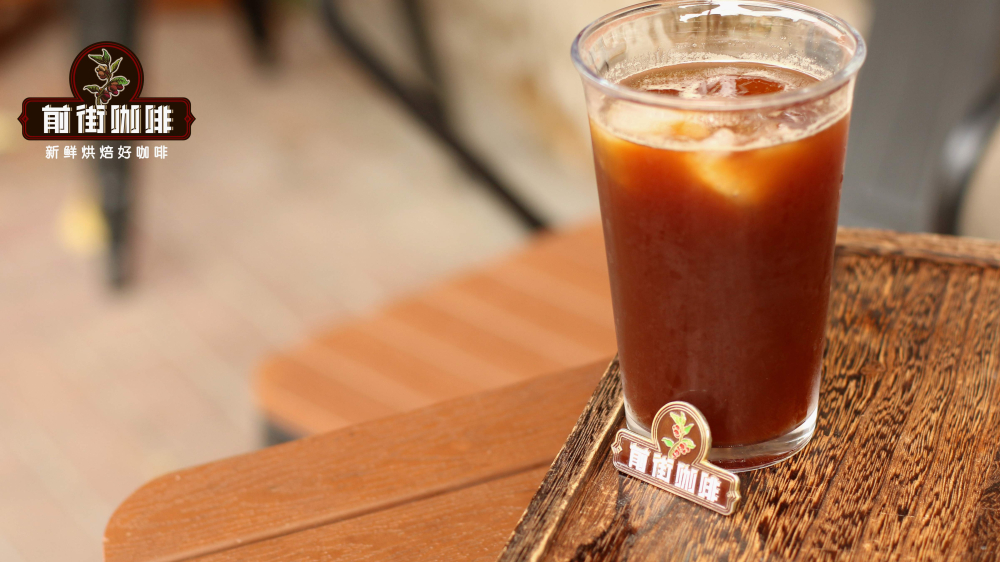
Similarly, when making iced Americano, first pre-chill the cup with ice cubes, then pour in water, and finally pour in the espresso. Because ice cubes need to be added, Front Street Coffee (FrontStreet Coffee)'s iced Americano uses a 1:7 ratio: 40 grams of coffee liquid mixed with 280 grams of ice-water mixture, of which 180 grams is ice and 100 grams is water.
For Americano, does removing the crema make it taste better?
When making hot Americano, you will notice a layer of foam floating on the surface—that is what we often call crema. This crema comes from the crema produced when making espresso. We know that espresso is divided into three parts: the core, the body, and the crema. The crema of espresso comes from the fact that, under the high pressure of the coffee machine, carbon dioxide in the coffee grounds is incorporated into the liquid. Then, when extraction ends and the pressure returns to normal, the carbon dioxide in the coffee liquid begins to return to the air, and at the same time it encounters the fats in the coffee and is wrapped by them. This is why crema forms.
What happens if you skim off this layer of crema? Front Street Coffee (FrontStreet Coffee) tried making two cups of Americano, one of which had the crema skimmed off as a control group. Taking Front Street Coffee (FrontStreet Coffee)'s Warm Sun Blend coffee beans as an example, the cup with the crema skimmed off was cleaner and smoother in mouthfeel, while the cup with the crema retained was fuller-bodied. Both cups had obvious dark chocolate flavors and a slight whisky oak barrel aroma, with soft acidity, and the difference was actually not very large. If you like a clean taste, skimming off the crema is recommended; if you need to serve continuously, retaining the crema is more recommended.
The above content is compiled by CoffeeHunters, a coffee news website.


