








Many people are familiar with Americano, yet feel unfamiliar with Lungo. Lungo, along with Espresso and Americano, belongs to the Italian-style black coffee family, but they differ in extraction method, concentration, volume, and caffeine content. This article will start from the Italian meaning of Lungo and clarify its core differences from Espresso, Americano, and Long Black, including extraction time, liquid volume, taste performance, and suitable drinkers. At the same time, combined with Front Street Coffee's espresso blend bean products, it introduces the selection approach, blending logic, and freshness recommendations for coffee beans when making drinks such as Lungo and Americano, helping coffee lovers gain a more complete understanding of this "stretched version of espresso."
For more specialty coffee knowledge, please follow: Front Street Coffee (Frontsteet Coffee)
Today, Americano has long become the everyday first choice for the general public, especially iced Americano, which can be seen almost everywhere. However, have you ever heard of Lungo? What kind of coffee does it actually belong to? In fact, Americano and Lungo both fall under the category of Italian-style black coffee. Both use espresso as the base and are obtained by adding water or changing extraction parameters. The biggest difference between them lies in the operating method and time control.
Americano
Americano, commonly known in Chinese as "meishi coffee." Its origin can be traced back to World War II: American soldiers in Europe were not used to the extremely strong taste of Espresso, while drip black coffee was more popular back in the United States, so they added water to espresso to reduce the concentration to the level Americans were accustomed to at the time. Therefore, the original meaning of Americano was to dilute coffee to a palatable strength. Later, Italian immigrants opened espresso cafés in the United States, and Americano with espresso as its base gradually became popular. Regarding the order of "adding water," there was also a practice of pouring coffee first and then water, used to express the idea of diluting strong coffee. Today, Americano no longer has many hard-and-fast rules regarding preparation order; the main difference is simply whether the crema is retained or broken up.
So what exactly is Lungo coffee? "Lungo" in Italian means "long, extended." As the name suggests, it is regarded as a lengthened version of espresso. In fact, discussing flavors in espresso specifically is something that only emerged in recent years. In the past, coffee beans were generally roasted extremely dark, and trying to find rich flavors in those almost black beans was like looking for brilliant colors within blackness. A good espresso was more about satisfaction in mouthfeel and stimulation in concentration, with no bitter aftertaste and a lingering roasted aroma in the mouth—that was all.
The way to make Lungo is to adjust the grinder setting so that the espresso flows faster, without adding extra water. Lungo is Italian, corresponding to "long" in English and "café allongé" in French. Its Chinese meaning is "long," referring to a coffee beverage made with an Espresso machine using twice the normal amount of water. A Lungo is basically a "stretched Espresso." If it must be expressed in Chinese, it can be called Italian-style strong coffee.
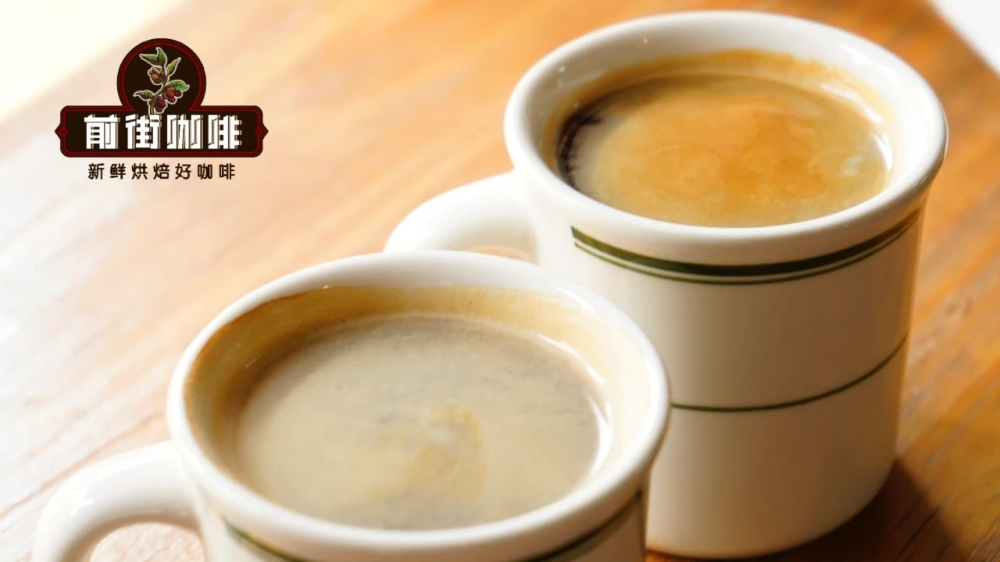
Lungo is very popular in Italy. A single serving is only about 60–85 ml, and a double is 120–170 ml. Because less water is used, Lungo brings a fuller body than Americano. A regular Espresso requires 18–30 seconds of extraction and has a volume of 25–30 ml; if the extraction time of Espresso is extended to about one minute, the amount of extracted coffee liquid is about 50–60 ml, and this beverage is called Lungo. Therefore, Lungo is neither what we commonly call Americano nor Long Black. Americano and Long Black are easy to distinguish: the former is "Espresso + water," while the latter is "water + Espresso." The order in which they are added to the cup is different. Lungo, by contrast, extends the extraction time of Espresso by nearly double, increasing the volume of the extracted liquid by about double.
Because the extraction time of Lungo coffee is nearly double that of Americano, Lungo has a larger volume than Espresso but a lower concentration than Espresso. Because Lungo has a longer extraction time, its caffeine content is also higher. For people who drink coffee simply to ingest caffeine, it is more effective; and because it extends time and water flow on the basis of an espresso recipe, its concentration is not as high as espresso and is correspondingly milder. More importantly, the serving size is larger and it is easier to keep drinking.
Making Americano, Long Black, and Lungo all requires espresso beans. And espresso coffee is basically dominated by blends. Why blend? There are three reasons: price, stability, and flavor. These three form an "impossible triangle," meaning all three cannot be achieved at the same time; one must be sacrificed and two pursued.
Take Front Street's four espresso bean options as an example. Blending coffee beans was initially intended to stabilize and balance coffee flavor. For example, Front Street's Specialty Blend uses a blend of Colombian and Brazilian coffee beans. Brazil and Colombia are both major coffee-producing countries, and their quality is very stable every year. In addition, the balance of Brazilian coffee beans and the richness of Colombian coffee beans make this bean perform well. Its priority is to balance stability and flavor equally. Its rich mouthfeel and nutty main tone with a slight fruity aroma make it suitable for specialty coffee shops.
Front Street's blend beans include: the espresso beans recommended by many baristas—Front Street Dark Cocoa Blend, Specialty Blend, Commercial Blend, and Sunflower Warm Sun Blend. Americano uses medium-dark roasted coffee beans. Why? Because, as Front Street just said, Americano will have a layer of crema, and whether the crema looks beautiful and whether there is more or less of it reflects whether the Americano is good or not. Medium-dark roasted coffee beans produce more crema. Of course, there are also some single-origin Americanos (SOE).
Front Street Coffee brewing suggestions
To brew a good cup of coffee, in addition to the coffee variety, the freshness of the coffee beans is equally crucial. Front Street believes that the freshness of coffee beans is a very important part of brewing. The coffee beans shipped by Front Street Coffee are all within 5 days of roasting, because Front Street deeply understands that the freshness of coffee beans has a great impact on flavor. Front Street's roasting principle is "freshly roasted good coffee," so that every customer who places an order receives the freshest coffee when it arrives. The resting period for coffee is about 4–7 days, so when customers receive it, it is exactly at its best flavor.

Of course, some customers need Front Street to help grind the beans, and that is no problem either, but Front Street must remind you: once coffee beans are ground in advance, they no longer need to be rested, because during transportation the pressure generated by carbon dioxide inside the package can also make the coffee flavor rounder, so once you receive the ground coffee, you can immediately brew a cup and drink it. However, ground coffee needs to be brewed promptly, because after ground coffee contacts air, it oxidizes relatively quickly. In other words, the coffee's flavor will dissipate relatively quickly, and the coffee will not taste as good. Therefore, Front Street recommends buying whole beans and grinding fresh before brewing, so that you can better taste the coffee's flavor.
The above content is compiled by CoffeeHunters, a coffee news website.


