








Blue Mountain coffee, as a globally renowned representative of specialty coffee, owes its unique flavor to Jamaica's exceptional growing environment and strict quality control system. This article will systematically outline the cultivation history, terroir, grading system, varietal characteristics, and washed processing methods of Blue Mountain coffee, and provide a detailed introduction to the brewing method for Blue Mountain No. 1 coffee beans recommended by Front Street Coffee. From the selection of the KONO dripper to the three-pour technique, Front Street baristas will share how precise pour-over parameters can fully express the classic flavors of Blue Mountain coffee—its nutty sweetness and balanced, full-bodied richness—offering coffee lovers a complete guide to tasting and brewing.
Even if you don't normally touch coffee, you've surely heard the name Blue Mountain coffee. To help everyone truly understand where the flavor of Blue Mountain coffee comes from, Front Street will now unfold it one by one from multiple angles—cultivation, grading, variety, and processing methods—to see how those refined Blue Mountain flavors are formed step by step.
When did coffee cultivation begin in Jamaica?
The island of Jamaica is located in the northwestern part of the Caribbean region in Central America, with the equator passing nearby. It has a typical tropical rainforest climate, abundant rainfall, and temperatures that remain between 22 and 32 degrees Celsius year-round—ideal conditions for growing crops like coffee.
In 1728, then-Governor Sir Nicholas Lawes brought the first coffee seed to the island of Jamaica from Martinique. It was initially grown only on a small experimental scale at the private estate Temple Hall, and later gradually promoted for cultivation in the St. Andrew area. Before long, coffee trees were being planted in large tracts across the fertile Blue Mountain region.
As Jamaica's coffee production continued to climb, in order to ensure the quality consistency of exported coffee, the local government established the Jamaica Coffee Industry Board in 1950. This body formulated extremely strict coffee quality standards and was responsible for supervising the implementation of all guidelines, making it the highest-level national coffee regulatory authority. All green beans and roasted beans produced in Jamaica and exported must carry a certificate issued by the CIB.
Growing Conditions of the Blue Mountains
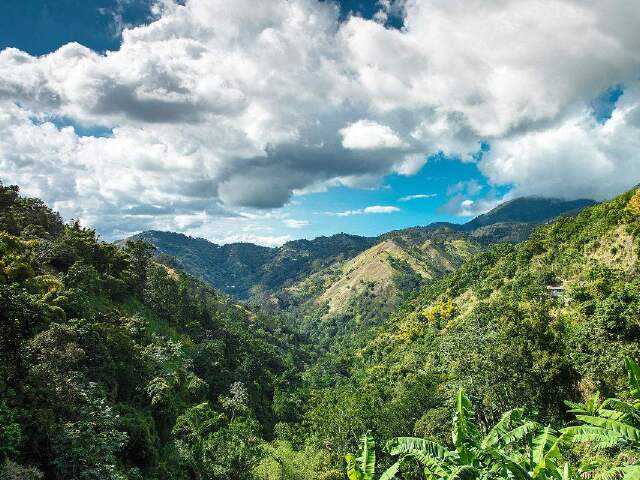
As an island nation, Jamaica has very little industrial pollution, abundant natural resources, and beautiful scenery. The Blue Mountain range contains the highest peak in the Caribbean, reaching 2,256 meters in elevation, which makes Jamaica a rare tourist resort destination. Areas of the Blue Mountains above 1,700 meters are designated by the government as protected zones where no crops may be planted, so all coffee trees are cultivated below 1,700 meters.
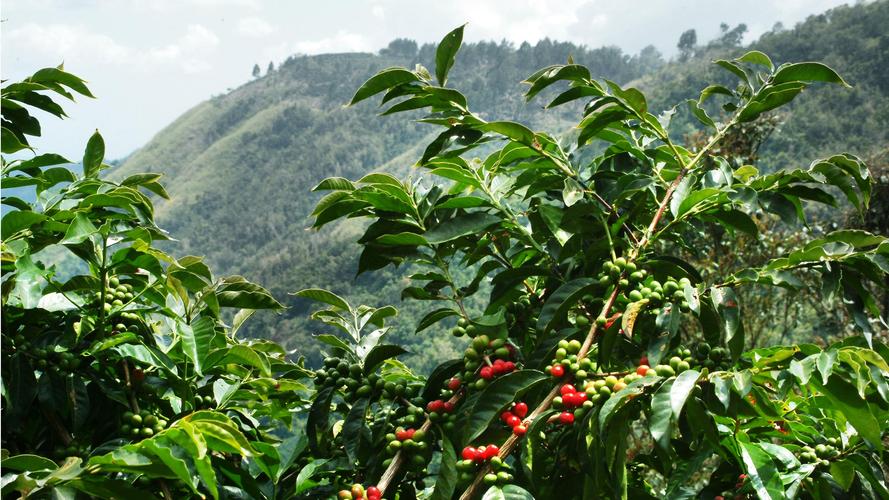
The Blue Mountains lie on the coffee-growing belt at 25 degrees north latitude. Volcanic eruptions brought fertile soil rich in nitrogen and phosphorus to this land. Combined with regular rainfall and year-round mist and clouds in the high-altitude mountains, coffee trees can grow healthily even without much shade. Locally, coffee trees are often intercropped with banana trees. Besides premium coffee, bananas are also one of the region's important economic industries.
Coffee cherries grown in the high-altitude areas of the Blue Mountains ripen successively from June to November each year. Coffee trees are mostly cultivated on steep slopes, and the higher the elevation, the greater the difficulty of harvesting. Therefore, experienced workers familiar with the terrain are arranged to go up the mountains to pick the cherries. Judging ripeness is equally crucial—once underripe or overripe cherries are picked, the quality of the resulting coffee will be affected.
Grading of Blue Mountain Coffee
As Front Street mentioned earlier, crops in the Blue Mountain region can only be planted below 1,700 meters, and coffee trees are naturally no exception. But not all coffee within this range can bear the Blue Mountain name—after all, different elevations give coffee different flavors. For this reason, the CIB introduced a grading system for coffee beans from the Blue Mountain region, divided into three categories: Blue Mountain Coffee, High Mountain Coffee, and Jamaica Coffee. Among these, Blue Mountain Coffee and High Mountain Coffee are each further divided into two grades, ranked from highest to lowest as: Blue Mountain No. 1, Blue Mountain No. 2, High Mountain No. 1, High Mountain No. 2, and Jamaica Coffee.
The highest-grade Jamaica Blue Mountain No. 1 coffee is selected from four production areas at elevations of 910 to 1,700 meters: St. Andrew, St. Mary, St. Thomas, and Portland. The total coffee-growing area of these four production areas is only 6,000 hectares, and their output accounts for only 15% of total Blue Mountain coffee production.
Varieties of Blue Mountain Coffee
Like many well-known coffee origins, Jamaica initially introduced the ancient Arabica variety—Typica—which has an elegant aroma and rich acidity and sweetness. While many growers switched to high-yield hybrid varieties to increase production, Blue Mountain consistently insisted on large-scale cultivation of Typica.
Because the Blue Mountain region is surrounded by the Caribbean Sea and has very little man-made pollution, the locally grown Typica has been able to fully adapt to the terroir, gradually evolving into a variant with stronger disease resistance than ordinary Typica and bearing the unique flavor imprint of Blue Mountain.
Washed Processing Method
The classic Blue Mountain flavor profile is characterized by rich roasting aroma, a balance of acidity, sweetness, and bitterness, and a smooth, full-bodied mouthfeel. To maintain this high-quality flavor, the vast majority of Blue Mountain coffee is processed using the washed method.
Coffee cherries with the skin and pulp removed are placed in tanks to ferment for 12 to 18 hours. After fermentation is complete, the beans are moved to clean tanks and pushed back and forth; through the friction between the beans and the washing force of the water, the coffee beans are cleaned to a smooth, pristine state. Finally, the parchment beans are sun-dried until the moisture content drops to 12% to 14%. Because the pulp and mucilage are removed before drying, reducing interference from excessive fermented acidity, the aroma of the Blue Mountain beans themselves comes through in a more balanced, clean way.
Blue Mountain No. 1 Coffee Beans
Front Street's bean list has always kept a Blue Mountain No. 1 coffee available for customers to choose. This Blue Mountain No. 1 comes from Jamaica's historic Clifton Mount Estate. The estate has extremely strict requirements for the production process of Blue Mountain coffee, from harvesting and green bean processing to the estate's environmental philosophy—all reflecting high standards.
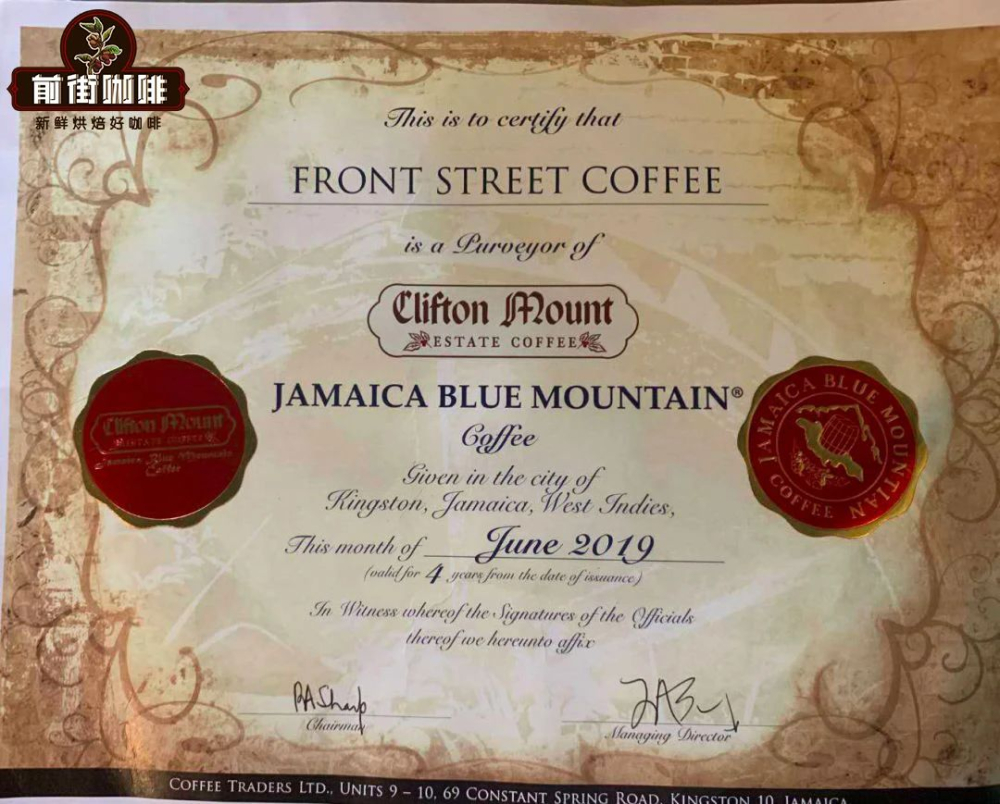
The Blue Mountain No. 1 green beans purchased by Front Street come with a certificate of origin for Jamaican Blue Mountain coffee beans issued by the coffee estate. The Blue Mountain wooden barrels containing the green beans are printed with the "Rainforest" tree frog logo, indicating that Clifton Mount Estate has obtained Rainforest Alliance certification. The estate owner protects the ecosystem within the estate, limits excessive use of pesticides during cultivation, and sorts and processes waste.
The Blue Mountain No. 1 green beans in the wooden barrels are all above screen size 17, uniform and translucent, with a defect rate below 3% and a moisture content of about 13%—almost no defective beans can be seen. To restore the most classic Blue Mountain flavor, Front Street's roaster compared flavor performance at different roast levels through cupping and ultimately chose a medium-dark roast, which highlights the nutty sweetness while retaining some sweetness and acidity, achieving an overall balanced flavor.
How Should Blue Mountain Flavor Be Brewed?
Front Street has always believed that the refined flavor presented by Blue Mountain coffee is inseparable from careful handling at every stage, so the brewing step is equally crucial. As is customary in most articles, here we will still use pour-over black coffee to experience Blue Mountain's unique aroma and flavor layers.
Front Street believes that if you want to taste that familiar Blue Mountain flavor, you must use fresh coffee beans for brewing. If coffee beans are stored too long, their aroma will dissipate at an accelerating rate over time, so the freshness of the beans is crucial. Coffee beans shipped by Front Street are all freshly roasted within 5 days, and the pour-over parameters and flavor descriptions are also based on the brewing performance of fresh beans.
To highlight the full-bodied richness of the Blue Mountain flavor, Front Street baristas use the KONO dripper, which produces a fuller mouthfeel and a more solid flavor.
The upper part of the KONO dripper is a smooth curved surface, which allows the filter paper to fit better. Compared with the V60 dripper, its extraction method is mainly immersion-based, which helps increase the overall concentration of the coffee and thereby enhances body. Similarly, the KONO dripper is also suitable for brewing Brazil Queen Estate coffee beans and Golden Mandheling coffee beans. In addition to KONO, common Kalita trapezoid drippers and slow-flow devices such as cloth filters are also suitable.
For grind size, Front Street chooses a medium-coarse grind with a 75% passing rate on a standard No. 20 sieve, to release as much flavor material as possible while avoiding over-extraction caused by too fine a grind. The water temperature is set at 88 degrees Celsius. For 1 to 2 servings, use 15 grams of coffee powder, with a coffee-to-water ratio of 1:15, using three-stage extraction.
Front Street's method is to first rinse the KONO dripper, then align and place the filter paper so it fits the dripper more closely. After pouring out the water in the server, add 15 grams of coffee powder, bloom with 30 grams of water for 30 seconds, then begin pouring in a circular motion with a small stream from the center. Once the water reaches 125 grams, begin the stages. When the coffee bed drops to the halfway point of the dripper, pour the second stage in the same manner until 225 grams. Once all dripping is complete, remove the dripper.
The aroma of Blue Mountain No. 1 coffee begins to show from the grinding stage and is very full. On the palate, you can feel the sweetness of roasted nuts, chocolate, and caramel. The acidity is soft and elegant, all the flavors are balanced, and the mouthfeel is smooth and rich, presenting a very typical Blue Mountain flavor.
For professional coffee knowledge exchange and more coffee bean information, please follow Coffee Workshop (WeChat official account: cafe_style)
For more specialty coffee beans, please add the private WeChat of Front Street Coffee (FrontStreet Coffee), WeChat ID: qjcoffeex
The above content is compiled by CoffeeHunters, a coffee news website.


