







Colombia is one of the few single-origin coffee-producing countries that sells worldwide under its national name, and the complex terrain along its Andes Mountains creates a flavor spectrum with distinct characteristics from north to south. This article, from the bean-selection perspective of Front Street Coffee, sorts out the flavor differences among Colombia's three major growing regions—north, central, and south—focusing on the dark chocolate and caramel notes of the Huila daily-drinker beans, and offers an in-depth analysis of Finca El Paraiso Sakura, a double anaerobic washed bean with its unique spice aroma and strawberry jam finish. At the end, the V60 pour-over parameters and staged pouring steps used by Front Street Coffee baristas are included to help enthusiasts recreate at home this cup of Colombian flavor that combines floral-fruity acidity with a full body.
That hint of bitterness in coffee has become a fixed ritual for office workers to experience life every day, and this taste, which requires gradual cultivation to appreciate, has nonetheless accumulated a large and loyal following over centuries. Different origins express bitterness in different ways. If someone asks Front Street: which region's coffee can you drink with dark chocolate notes? Front Street would most likely blurt out: Colombia.
Colombian coffee is one of the very few single-origin coffees sold globally directly under a country's name. In terms of quality, Colombian coffee has long been known for its rich, aromatic taste. Local people's persistent pursuit of coffee quality, combined with meticulous cultivation, has earned the coffee beans here the reputation of "green gold."
Global coffee is broadly divided into two major systems: one is the "soft" coffee represented by Brazil, with an intense taste; the other is the "hard" coffee represented by Colombia, with a relatively delicate flavor. The difference between the two stems from altitude and cultivation methods—Brazil mostly grows coffee on hilly red soil with relatively extensive management, while Colombia cultivates intensively in black-soil mountain areas.
Colombian coffee has a full, substantial aroma, bright premium acidity, and an overall balanced flavor, sometimes with specific notes of nuts and dark chocolate that linger in the memory. However, coffee is ultimately an agricultural product with strong regionality. Colombia's coffee-growing belt is distributed around the Andes Mountains, where the terrain is intricate and climatic and soil conditions differ significantly, which also gives Colombian coffee rich and captivating layers of flavor.
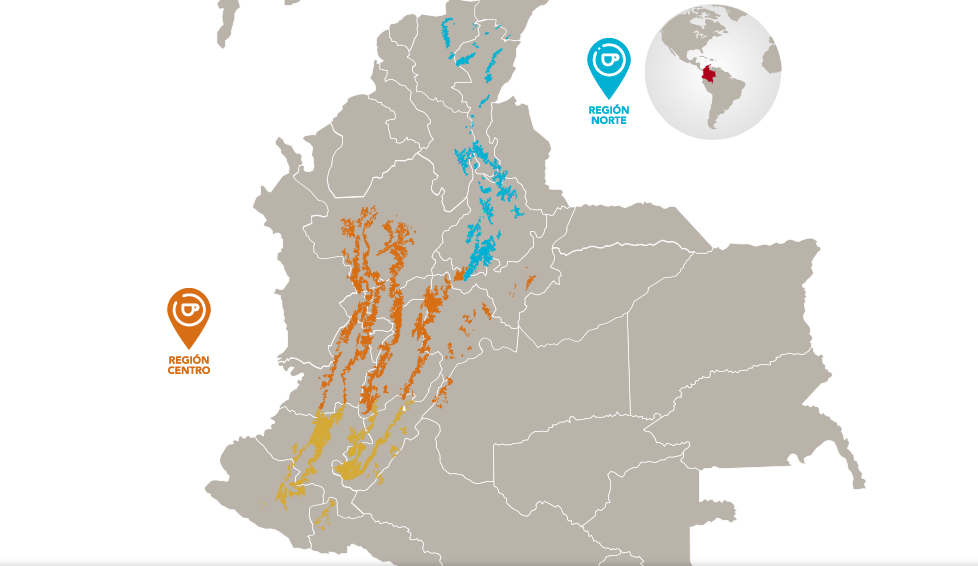
Twenty departments in Colombia grow coffee, mostly concentrated in the northwest of the country, and by basic flavor they can be roughly divided into three sections: north, central, and south.
The north covers La Guajira, Magdalena, Cesar, and others. The growing environment here is similar to that of many Central American producing countries, with lower latitude and higher temperatures, and coffee trees grow under shade trees to avoid direct sunlight. Northern coffee has weaker acidity and a prominent body.
The central region includes Antioquia, Valle del Cauca, Tolima, Quindio, and others. This area is Colombia's largest coffee-producing region, home to many traditional growing areas. Central coffee has moderate acidity, with fruity charm and fresh herbal notes.
The south includes Cauca, Huila, Narino, and others. This region is closer to the equator, and coffee farms are mostly located in high-altitude mountain areas, with vivid acidity and unique floral and fruity aromas. Therefore, coffee from the southern region is more favored by enthusiasts.
On the bean list of FrontStreet Coffee, a considerable proportion of Colombian coffee beans come from the southern region. Among them, the one representing Colombia in the signature daily-drinker series of Front Street's regional offerings comes precisely from the Huila region. After washed processing, this Huila daily-drinker bean lets many coffee novices experience the local terroir for the first time. Its rich dark chocolate flavor, soft fruit acidity, and clear caramel sweetness are in no way inferior to those beans labeled by estate.

As the fourth wave of specialty coffee sweeps the globe, FrontStreet Coffee also keeps a keen sense of touch. Enthusiasts' interest in "fruit bomb" style coffee beans is growing, and their understanding of varieties and post-processing methods is becoming deeper. After comparing multiple Colombian beans with different processing methods, FrontStreet Coffee found that anaerobic processing can make the fruity sweet-and-sour sensation stronger and the mouthfeel fuller.
On the bean list of FrontStreet Coffee, the Colombia country column includes several well-known estates: Finca White Mountain, Finca Hope, Finca El Paraiso, Big Tree Estate, and others. Among them, one bean from Finca El Paraiso has attracted the attention of many Front Street fans.
FrontStreet Coffee Colombia Finca El Paraiso Sakura Coffee Beans
Region: Cauca, Colombia
Estate: Finca El Paraiso
Altitude: 2050 meters
Variety: Castillo
Processing method: Double anaerobic washed processing
The Colombian Finca El Paraiso coffee beans obtained by FrontStreet Coffee are called Sakura. The name sounds elegant, and the flavor is quite special. When setting the roasting curve, Front Street's roaster used a medium roast in order to retain more fruit acidity and enhance sweetness.
During cupping, the baristas at FrontStreet Coffee found that this Colombian Sakura displays distinct and unique notes of Thai basil, mugwort, and rosemary, with rounded acidity and a hint of strawberry-jam-like sweetness hidden in the finish.
Many friends who are tempted as soon as they see the word "Sakura" want to give it a try, and Front Street usually uses the following parameters and steps when serving it.
Dripper: Hario V60
Water temperature: 90 degrees Celsius
Dose: 15 grams
Coffee-to-water ratio: 1:15
Grind size: 80% passing through China standard No. 20 sieve
What Front Street ships is coffee beans freshly roasted within 5 days. After logistics and transport, by the time they arrive, they have恰好 passed the 4-to-7-day resting period, right in the best tasting stage. However, after roasting is completed, a large amount of carbon dioxide remains inside the coffee beans. To reduce the coffee's "harsh" sensation, Front Street recommends adding a blooming stage.
First pour 30 grams of hot water and bloom for 30 seconds, then pour in a thin stream from the center point while slowly circling to 125 grams. When the water level in the dripper drops to the point where the coffee bed is about to be exposed, continue pouring in circles to 225 grams. The total extraction time is about 2 minutes.
As for why Finca El Paraiso Sakura does not have a sakura flavor but instead carries unique spice notes such as mugwort, the reason is that when the estate owner named it, he smelled a faint aroma and associated it with sakura. And after the coffee beans are roasted by Front Street, the aroma presents a different appearance again.
For professional coffee knowledge exchange and more coffee bean information, please follow Coffee Workshop (WeChat public account: cafe_style)
For more specialty coffee beans, please add the private WeChat of FrontStreet Coffee, WeChat ID: qjcoffeex
The above content is compiled by CoffeeHunters, a coffee news website.


