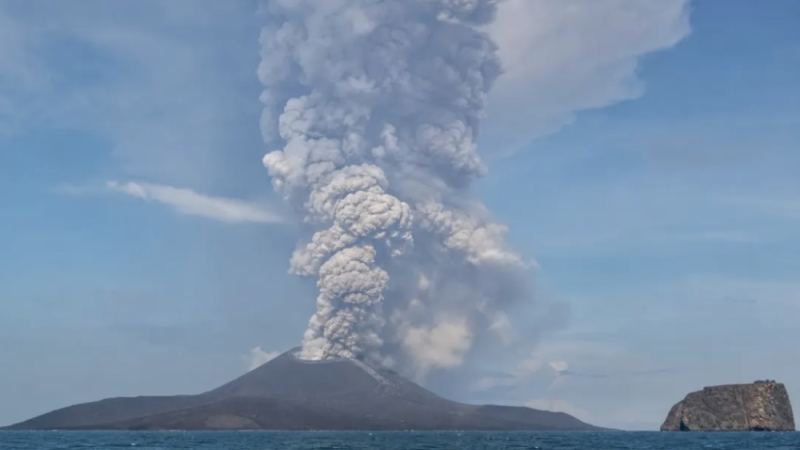
Around September 7 local time, Anak Krakatau (commonly known as the "Child of Krakatau") in Indonesia remained highly active, with ash plumes once surging to about 50,000 feet (about 15,000 meters), entering the cruising altitude of commercial airliners. The ash drifted south with high-altitude winds, covering the southern tip of Sumatra and the western tip of Java on both sides of the Sunda Strait, and spread north into the airspace over Singapore and southern Peninsular Malaysia. As a result, Singapore Airlines, Scoot, China Southern Airlines, XiamenAir and several other carriers successively canceled flights to and from major Indonesian cities such as Jakarta, Bali, Yogyakarta and Surabaya starting September 6, and seven airports in Indonesia, including Jakarta's Soekarno-Hatta International Airport, were temporarily closed or suspended operations. According to Reuters, as of the afternoon of September 7, more than 2,300 flights had been canceled across Southeast Asia; Wan Shi Tong, citing airline announcements from multiple carriers, reported that the latest tally of canceled/delayed flights had risen to about 2,700, affecting more than 270,000 passengers.
Child of Krakatau: One of the World's Most Closely Watched Active Volcanoes Is Active Again
Anak Krakatau is located in the center of the Sunda Strait between Sumatra and Java in Indonesia. Since it "grew" in 1927 from the site of the massive 1883 eruption, it has risen to about 400-plus meters above sea level and is regarded as the successor to the late-19th-century "Great Krakatau Eruption," which killed more than 36,000 people and sent tsunamis reaching coastlines worldwide. The volcano has long been on the high-priority list of Indonesia's volcanic monitoring network, and in the past three years it has recorded significant eruptions almost every year. On September 6, the volcano erupted twice within 24 hours, and eruption columns captured by multiple satellite observation platforms reached up to about 50,000 feet—a height comparable to the cruising altitude of commercial jetliners and a key threshold for determining whether an aviation hazard exists.
The latest bulletin issued by Indonesia's Geological Agency (PVMBG) on September 7 stated that the continuous eruption phase of Anak Krakatau has ended, but the alert level remains at Level III (Siaga, one notch below the highest level, Level IV/Awas). Officials warned that the probability of another eruption in the short term remains high, and it is difficult to determine when flight suspensions can be lifted. In addition to Anak Krakatau, Mount Semeru (the highest peak in Java) also erupted noticeably during the same period, and with five other volcanoes across the country on alert, Indonesia's current volcanic activity is distributed across multiple points, putting considerable pressure on emergency coordination.
Why Volcanic Ash Can Ground Large Numbers of Flights
The threat volcanic ash poses to aviation operations is not simply "poor visibility." At its core: volcanic ash consists of glassy fragments, mineral crystals and rock particles, and the silicate particles it is rich in can be melted by the temperatures above 1,000°C inside jet engines, then deposited on turbine blades after cooling, causing engine surge or even flameout; at the same time, these tiny particles can also erode the nose windshield, clog pitot tubes and distort airspeed indications, and adhere to the aircraft surface, affecting its aerodynamic shape. It is precisely for this reason that ICAO (International Civil Aviation Organization) and national civil aviation authorities apply a "zero tolerance" principle to ash-contaminated airspace—whenever a certain concentration of volcanic ash is forecast or observed, the relevant airspace is designated a no-fly zone, and airports also stop issuing departures.
After the eruption column rose to 50,000 feet on September 6, the ash cloud was quickly carried by high-altitude winds to northern Java and southern Kalimantan, eventually covering the busy routes of Singapore—Riau Islands—southern Peninsular Malaysia. This corridor concentrates one of the world's densest flows of narrow-body aircraft, and Jakarta's Soekarno-Hatta Airport, Bali's Ngurah Rai Airport, Yogyakarta Airport, Sorong Airport, Semarang Airport, Surabaya's Juanda Airport and Bandung Airport were successively announced temporarily closed.
Singapore Changi Airport: Passengers Stranded for Over 12 Hours, "Surabaya" Becomes a Keyword
Changi Airport showed obvious congestion early on September 7. Long lines formed in front of the ground service counters of multiple airlines, with transfer passengers and local passengers mixed together; the airport temporarily added staff to open rebooking windows and provided basic supplies such as bottled water and snacks. Some passengers posted scenes from the boarding gates on social media, saying they had already waited at Changi Airport for more than 12 hours; others chose to fly first to Kuala Lumpur, Malaysia, and then enter Indonesia overland.
Singapore Airlines' (SIA) response plan is: passengers originally scheduled to travel to Jakarta can be rerouted free of charge via Surabaya, with SIA operating temporary extra flights on the Singapore—Surabaya sector. Surabaya's Juanda Airport is located at the eastern end of Java, far from the main coverage area of the ash cloud, making it a key alternate gateway under this round of Indonesian airspace restrictions. SIA is also offering affected passengers two options: "rebooking to any flight within 7 days before or after the original flight" and "a full refund." Scoot, meanwhile, is applying more flexible rebooking and refund policies to affected flights, allowing passengers to change dates or obtain refunds directly through the original purchase channel without handling fees.
Chinese Travelers' Itineraries Disrupted, Flights of Multiple Chinese Airlines Affected
On social media, many Chinese travelers posted cancellation text messages and rebooking links for China Southern and XiamenAir flights from Guangzhou, Fuzhou and Xiamen to Jakarta and Bali. Originally planned 5–7 day vacations were compressed; some were forced to reroute via Kuala Lumpur, while others temporarily diverted to Bangkok or Singapore and waited for further notice. At Changi Airport, some passengers described "grayish-white dust sticking to suitcases and coats" in the terminal, while others said they were leaving Jakarta by train instead—Indonesia's state railway company (KAI) temporary timetable showed that high-speed and intercity trains between Jakarta—Bandung—Surabaya added multiple services on September 6–7 to absorb part of the air passenger flow.
Consular Missions of Multiple Countries Issue Reminders
Singapore's Ministry of Foreign Affairs (MFA) has upgraded the Indonesia travel page on its official website as a whole to include "volcanic risk advisories," advising Singapore citizens active near volcanoes in Indonesia to raise their vigilance, follow local government instructions and closely monitor local news. The Singapore Embassy in Jakarta and the Consulate-General in Medan also issued reminders, advising Singaporeans to minimize outdoor activities and stay indoors; those needing consular assistance can call +62 21 5091 5400 (24 hours) or +65 6379 8800 / 6379 8855 (MFA duty line).
The Chinese Embassy in Indonesia also issued a consular reminder on September 6, reminding Chinese citizens in Indonesia to pay attention to personal and property safety, avoid traveling to volcanic alert areas, and publishing multi-level consular protection and assistance channels: Indonesia police emergency number +62-110, Indonesia ambulance emergency number +62-119, the Ministry of Foreign Affairs global consular protection and service emergency hotline +86-10-12308 / 65612308, the consular protection and assistance phone number of the Chinese Embassy in Indonesia +62-21-5764135, the Consulate-General in Surabaya +62-31-5678284, the Consulate-General in Medan +62-8116137652, and the Consulate-General in Denpasar +62-361-239902.
What's Next: Still No Timetable for When Flights Can Resume
Indonesia's Geological Agency and Ministry of Transportation have not given a clear window for lifting the flight suspension measures, saying only that they will conduct dynamic assessments based on the actual spread of the ash cloud, satellite observations and volcanic activity indices. Airlines generally recommend that passengers check in real time through the "flight status" page on their official websites or apps before traveling, to avoid heading to the airport rashly. In the short term, if Anak Krakatau remains at Level III alert and ash continues to be transported south-north, then September 7–9 will be a key window for observing progress toward resuming flights; if another eruption on the scale of September 6 occurs, it cannot be ruled out that the suspension scope may further expand or last longer.
Travel and Pitfall-Avoidance Tips
For travelers already in Singapore and planning to fly to Indonesia, it is recommended to prioritize Surabaya (Juanda Airport) as the entry and exit point and allow at least one day of flexibility; entering and leaving Indonesia overland from Kuala Lumpur, Malaysia, is also a relatively stable backup option during this period. For travelers who have booked itineraries but have not yet departed, they can watch for airlines' "voluntary rebooking" windows; postponing the departure date by 3–7 days can usually help avoid this peak period. For travelers already in Indonesia, it is recommended to stay away from the volcanic alert areas along the Sunda Strait coast, western Java and southern Sumatra, wear masks or mask-level protection for outdoor activities, pay attention to drinking water hygiene, and keep an eye on real-time bulletins issued by local governments through BMKG (Meteorological Agency) and PVMBG (Geological Agency).
The above content is compiled by CoffeeHunters, a coffee news website.