







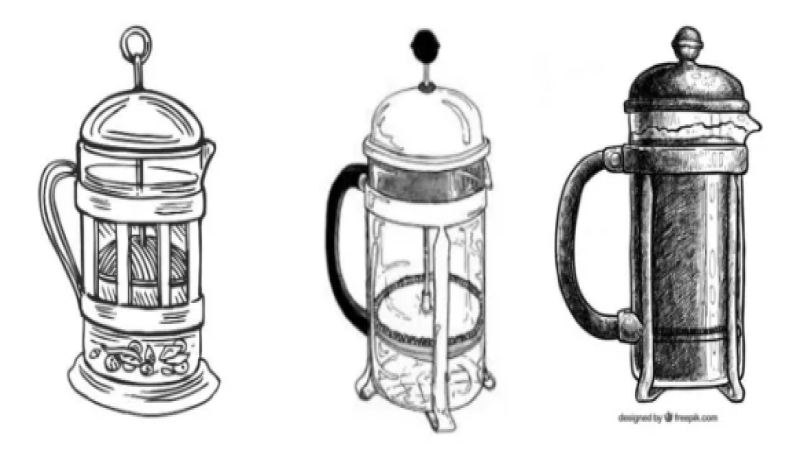
What kind of coffee can you brew with a French press?
The French press is a full-immersion brewing device with a metal filter. This gives the brewed coffee a distinctive characteristic: because the water and coffee grounds are in direct contact, the resulting coffee retains more oils and therefore has a heavier, fuller mouthfeel. For those who dislike the texture of coffee grounds or fine particles, a French press may not be for you.
When brewing with a French press, you can control several variables (such as water temperature, grind size, and brew time) to refine your method according to personal preference. Most importantly, if you brew correctly, you can look forward to enjoying the aroma and flavor of every coffee you make.
How do you brew coffee with a French press?
Before brewing coffee, there are some important variables to consider
1. Grind size
No matter what grind size you use, always use a high-quality flat burr or conical burr grinder rather than a blade grinder, and this brewing method is very likely to cause over-extraction. So what grind size is actually correct?

Here we recommend a coarser grind setting, somewhat like small gravel rather than fine sand. If you grind too fine, the water may extract the coffee grounds too quickly. For other immersion brewing devices this may not be a problem, but if you use a French press and grind too fine, fine coffee particles may pass through the metal filter, resulting in a large amount of sediment in the brewed coffee.
Usually when we look at French press tutorials, coarse grinding is generally recommended. Front Street recommends choosing a grind size with a 70% pass rate on the Chinese No. 20 standard sieve, which is about the size of coarse granulated sugar. Coarse grinding not only improves the fault tolerance of the extraction process but also reduces the ultrafine particles produced by grinding. French press metal filters generally range between 80-300 microns, and the filter holes are visibly large, so fine particles easily pass through and end up in the coffee liquid, making it cloudy. Of course, if you want to pursue more layered flavor and mouthfeel, you can also use a finer grind, but remember to reduce the immersion time accordingly to avoid over-extraction.

2. Coffee dose and coffee-to-water ratio
The coffee-to-water ratio is a simple formula, meaning how much water is paired with how much coffee. A common ratio is 1:15 (for example, 15 grams of coffee to 225 grams of water). You can start with this ratio and adjust the coffee dose or water amount in your next brew according to preference until you find your favorite ratio. The coffee extracted with it will have a concentration in the 1.1-1.2% range. If you, like Front Street, prefer a richer coffee, then by all means try this 1:15 coffee-to-water ratio; the extracted coffee will taste even more intense and full-bodied.

3. Water temperature
Water temperature is another variable you can experiment with to affect coffee flavor. If you don't have a thermometer, you can boil hot water and let it sit for 45 seconds (adjust according to air temperature), then brew at about 90 degrees. If you want to control the flavor of the brewed coffee, it's recommended to buy a temperature-controlled pour-over kettle, or use a thermometer.
Because the French press is filled with water all at once, there is no stirring action during the immersion process to increase the extraction rate, so we sometimes need to raise the water temperature slightly to make up for this extraction rate—just 1-2°C higher than a regular pour-over temperature will do. For medium-light roasted coffee beans, the recommended water temperature is 92-94°C; for medium-dark roasted coffee beans, the recommended water temperature is 89-90°C.

4. Brew time
Since there is no manual stirring, extracting the substances from the coffee requires increasing the extraction rate in other ways, and immersion time is another factor that needs to be increased! Brew time generally falls between 3 and 5 minutes. If you are brewing a darker roast, 5 minutes may be too long and easily become bitter and astringent; if it is a light roast, 3 minutes may be too short to release the coffee's flavor, so Front Street recommends starting with a 4-minute immersion time when you first try.

5. Brewing process
Pour the ground coffee into a preheated French press, then slowly pour in the hot water, making sure all the coffee grounds are saturated. First, use about twice the coffee dose in water to pre-infuse and bloom the grounds (for example, for 15 grams of coffee, use 30 grams of water to bloom).
At 30 seconds, stir gently a few times, pour in the remaining hot water, and place the plunger on top. At this point, do not press down yet. Wait until the coffee has been immersed for 4 minutes, then slowly press the plunger all the way to the bottom, and carefully pour out the coffee liquid, avoiding disturbing the coffee grounds at the bottom of the press.
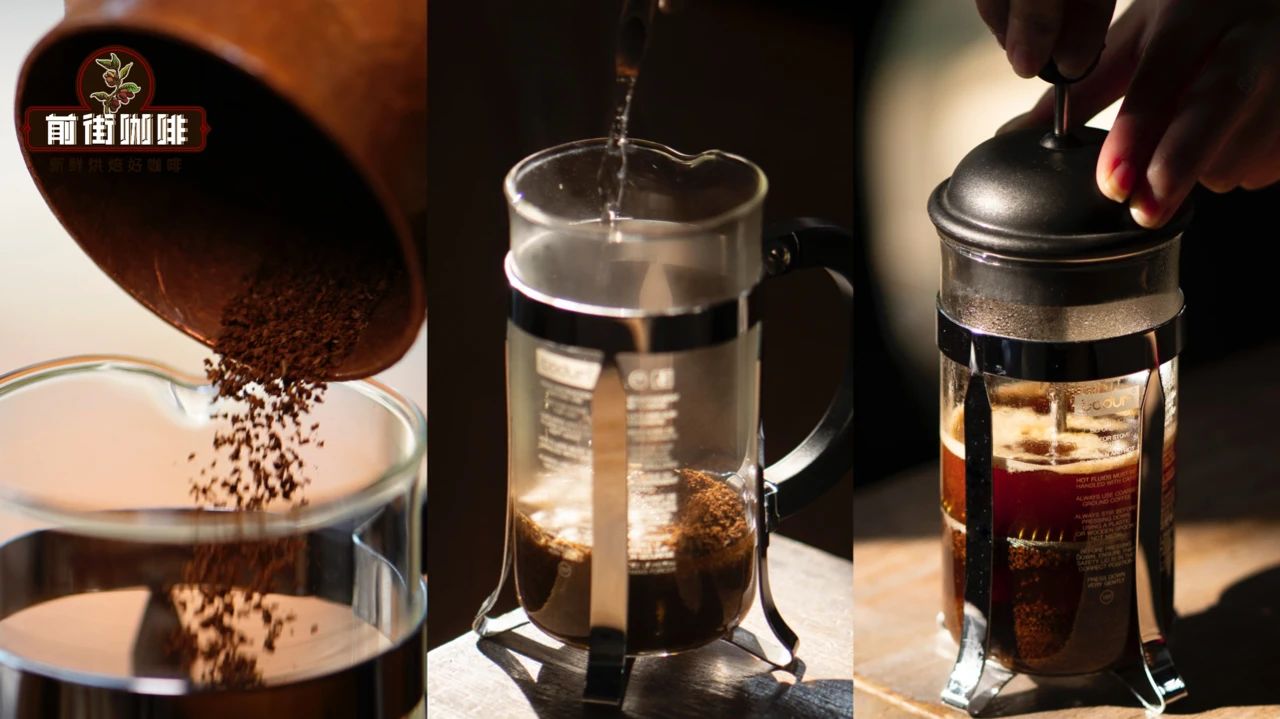
- If the plunger is a bit hard to press down, it means the coffee is ground too fine; if the coffee grounds sink and there is too little resistance when pressing down, it means the grind is too coarse.
French press brewing tips
- Once brewing is complete, pour out the coffee immediately. If you don't pour it out right away, the coffee grounds will continue to contact the water, causing bitterness to be released. If you don't plan to drink it all immediately, it's best to pour it into another container.

- Make sure the French press is thoroughly cleaned. Even fresh coffee can have its flavor ruined by coffee grounds left on the filter. Most filters should be easy to clean.
- If the coffee you brew still never satisfies your palate, try changing all the variables. Brewing coffee should be fun and experimental. Once you brew your favorite cup, it will definitely give you even more motivation to delve into coffee brewing techniques!
The above content is compiled by CoffeeHunters, a coffee news website.


