








Why does coffee for coffee shops need grind adjustment?
Espresso needs regular grind adjustment because it is a pressurized, highly sensitive extraction. A very fine grind and roughly 9 bar of pressure pull many flavor compounds out in a short time, so small shifts in the beans or the grind change the taste. Coffee shops recalibrate to keep each shot consistent.
Bean condition is a major variable. Carbon dioxide and aroma leave the beans over time, and shops often mix batches of different dates and roast levels, so flow rate and extraction time drift. Drawing on Front Street Coffee's shop experience, the article explains how extraction time and taste judgment guide parameter changes.
Espresso extraction is completely different from pour-over or French press. It relies on an extremely fine grind and 9 bar of high pressure to concentrate the extraction of flavor compounds in a short time. It is highly efficient but also extremely sensitive. The degassing state of the coffee beans, batch differences, roast level, and even weather changes can all cause the extraction result to deviate from expectations. For this reason, many coffee shops regularly calibrate the espresso taste to ensure consistency in what they serve. Based on Front Street Coffee's practical experience, this article explains the necessity of grind adjustment, the factors that affect extraction, and how to decide whether to adjust parameters based on extraction time and taste judgment.

For coffee shops, it is necessary to regularly adjust the grind size for espresso. There are two main reasons. First, espresso uses a rather "extreme" pressurized extraction method. The reason for saying this is that it needs to extract a large amount of flavor compounds from coffee in a very short time with a very small amount of water, so it uses an extremely fine grind size and relies on pressure as high as 9 bar to assist extraction.
Although this highly efficient extraction allows flavor compounds to be released quickly and in large quantities, it also makes the entire extraction process very sensitive. It is not as stable as pour-over or French press, and any slight change in a single factor can affect the final taste. Therefore, in order to ensure consistency in what they serve, besides the routine morning adjustment, many coffee shops also regularly calibrate the espresso taste during business hours.
There are many factors that affect espresso extraction, and the state of the coffee beans is one of them. The aroma and carbon dioxide in coffee beans are both volatile and will be released continuously. The amount of these substances retained will all affect extraction. For example, when the carbon dioxide content is relatively high, the flow rate of the coffee may be slower, and the extraction time will be correspondingly longer; conversely, it will be shorter.
In addition, the coffee beans we use daily are often a mix of beans from different dates and different batches. The carbon dioxide content among these batches itself differs, and even the roast level may be slightly different. When the roast level and carbon dioxide content differ, the parameters for extracting espresso need to be changed accordingly; otherwise, the taste of the extracted coffee will change.
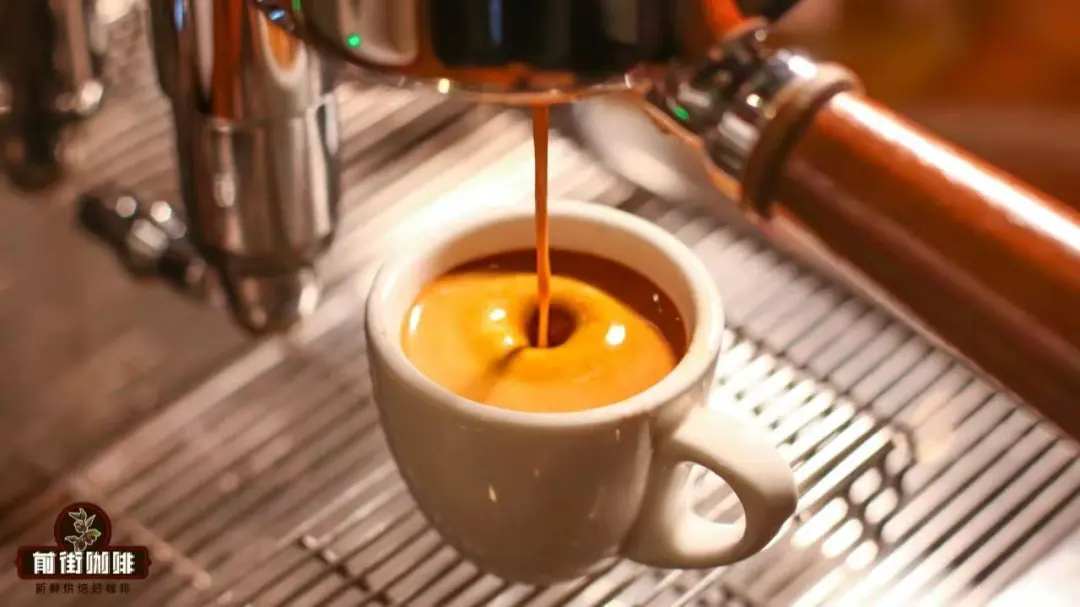
Of course, Front Street Coffee will not elaborate here on the effects brought by weather or environmental factors. Simply put:
Because the extraction efficiency of espresso is very high, its extraction process and taste are prone to fluctuation due to bean condition, batch, and weather changes. In order to maintain consistency in what they serve, some coffee shops calibrate the taste of espresso at intervals.
Of course, this does not mean that calibration must be done rigidly according to a fixed cycle. As long as you find that the extraction parameters differ greatly from those during the morning adjustment, it means the espresso taste needs to be calibrated. And there is really only one parameter that needs to be examined, which is extraction time.
Take Front Street Coffee as an example. Although Front Street Coffee's store does not serve coffee, it is also equipped with an espresso machine. The coffee beans used by Front Street Coffee for espresso are Front Street Black Cocoa · Basic Espresso Blend, which is used by many coffee shops. It is blended from coffee beans from two producing regions, Brazil and Yunnan, adopts a medium-dark roast, and has a rich chocolate aroma and a soft mouthfeel. It is a very cost-effective espresso blend.
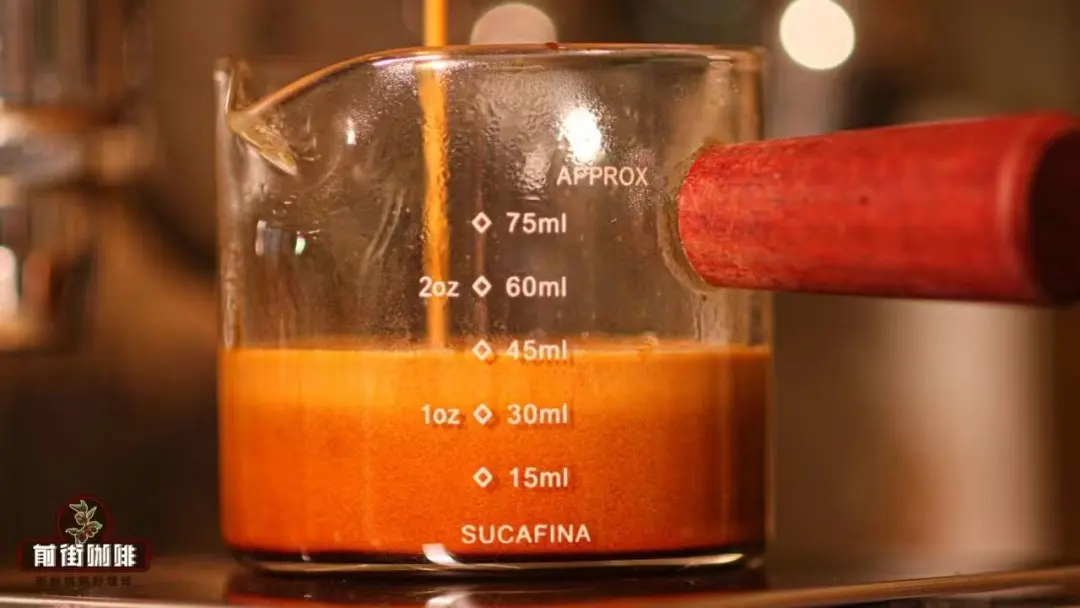
Assume that Front Street Coffee uses Front Street Black Cocoa · Espresso Moka Pot Coffee Beans Recommended by Many Baristas - Front Street Black Cocoa Blend, and the morning adjustment parameters are 20 g of grounds yielding 40 ml of liquid with an extraction time of 30 seconds. The espresso extracted with these parameters has a balanced taste, extremely high sweetness, rich chocolate and nut flavors, and a soft mouthfeel.
With the dose and liquid weight kept unchanged, if you find that the extraction time has changed from about 30 seconds to 24 seconds or 38 seconds, and this happens for several consecutive cups, then it is very likely that the state of the coffee beans has changed, or that the freshness and roast level of the beans are different from those during the morning adjustment, or that the weather has changed, or similar situations.
In this case, we need to extract a shot of espresso to check the taste and see whether the parameters need to be adjusted. If the espresso shows sharp acidity, a thin mouthfeel, or obvious bitterness, then it means the extraction has already deviated, and the coffee may be somewhat under-extracted or over-extracted. At this point, the parameters need to be adjusted. If these problems do not appear, then even if there is a certain difference in time, it does not matter. It means this time is exactly suitable for extracting the current batch of coffee beans, so no adjustment is needed.
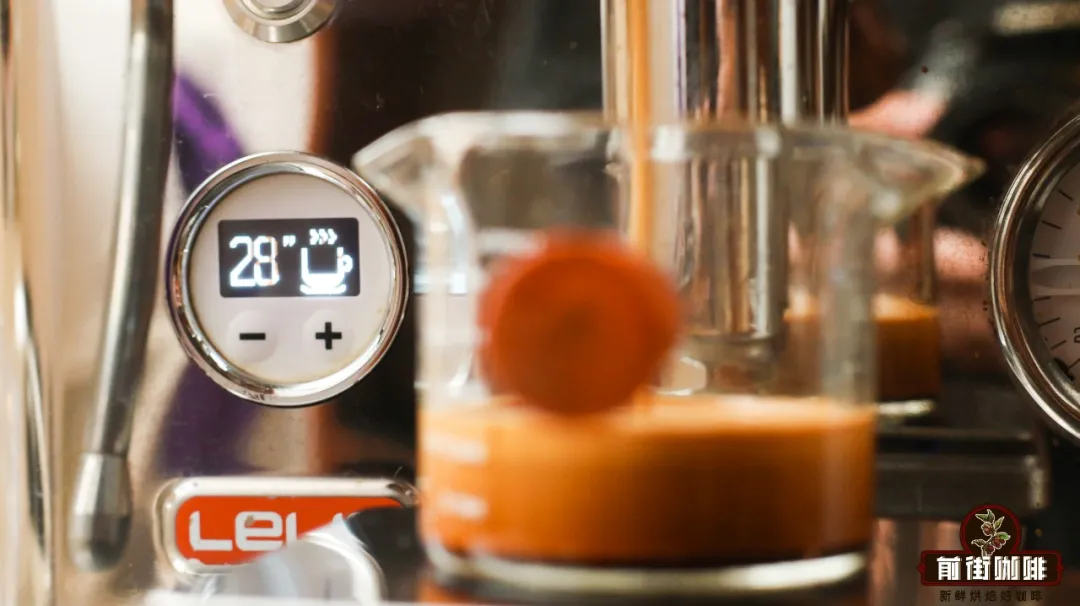
That is all for this sharing from Front Street Coffee. It is worth noting that, as mentioned earlier, different batches of coffee beans are suited to different times. So even if the espresso you extract 4 hours later still has the same time as during the morning adjustment, the taste is not necessarily correct. This is why some coffee shops need to calibrate the coffee taste from time to time.
- END -
The above content is compiled by CoffeeHunters, a coffee news website.


