







Is Starbucks specialty coffee responsible for knocked-over display cups?
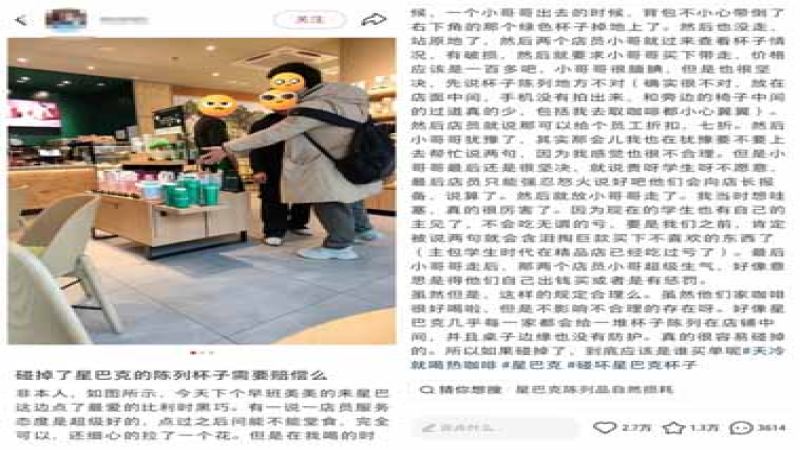
A customer at a Starbucks store watched a passerby's backpack knock over a green display cup. Staff asked the person to buy it at full price; she refused and left, and the loss was reportedly borne by employees. The post sparked debate over whether the shopper or the store should carry the cost when a display has no guardrail or protective panel in a busy aisle.
Opinions split: some argue whoever damages goods should pay, while others say the display placement created the risk and the store should absorb it. An offer of a 30 percent employee discount did not resolve the dispute. The case highlights how is starbucks specialty coffee brands balance product display and customer experience, and what handling coffee merchandise in open aisles actually requires.
Recently, a Starbucks customer witnessed the following scene inside a store: a passerby's backpack accidentally knocked over a green cup on a display table. The staff demanded that the person buy it at full price. After the person refused, she left, and it was said that the loss ultimately had to be borne by the employees themselves. This post quickly sparked heated discussion—the display cabinet is placed in the aisle and has no guardrail or protective panel, so when a cup is knocked over by a backpack or the edge of someone's clothing, who exactly should be responsible? Some believe that whoever damages something should pay for it, while others feel that the store's display method itself has hidden risks, and the risk should therefore be borne by the store. This debate about accidents and responsibility reflects the difficult balance brands face between product display and customer experience.
▲
Click to follow | Daily specialty coffee culture magazine Coffee Workshop
Recently, a Starbucks customer posted on social media an article titled "Do You Need to Compensate for Knocking Over a Starbucks Display Cup?" recording an experience witnessed in a store, which unexpectedly attracted a large number of netizens to watch and discuss.
The poster emphasized that she was not the person involved, but merely happened to see another customer passing through the aisle next to the display cup area while she was consuming in the store, and the customer's backpack accidentally knocked over a green cup in the corner of the display table. After the incident, staff immediately stepped forward to check the cup's condition. After confirming there was damage, they demanded that the customer buy the cup at full price.
The customer pointed out on the spot that there was a problem with the cup's display position. Even when the staff offered to let her buy it at a 30% employee discount, she still refused to pay for a cup she had accidentally knocked over. In the end, the two staff members could only let her leave the store. The poster guessed that the damaged cup was most likely bought by the employees themselves.
The poster believed that Starbucks placed its product display area in the middle of a passage with frequent customer traffic, and the cabinet had no protective devices installed, which made the displayed merchandise very easy to knock over with passing customers' backpacks or coats. However, the poster also felt that the customer's refusal to pay, which ended up making the staff bear the loss, was somewhat inappropriate, and at the same time wondered who should ultimately be responsible for this kind of accident.
In response to the poster's question, netizens expressed their views one after another in the comments section. Many netizens with similar experiences said that when staff hold damaged items and demand compensation, they usually pay for their own mistakes. "If you break it, you should pay," "After all, I knocked it to the floor and broke it, so I think I should pay." Therefore, out of a sense of responsibility for an unintentional mistake, customers who knock over display cups will negotiate with the staff and buy the damaged product at full price or a discounted price.
Interestingly, however, more people in the comments section believed that accidentally knocking over display products while walking around inside a Starbucks store has long been commonplace, and the fundamental reason such accidents happen frequently is that the brand always places display cabinets without protective panels and other safeguards on the routes customers take when entering and leaving the store, invisibly greatly increasing the probability that displayed products will be knocked over.
They pointed out that Starbucks store display cabinets basically have no railings, panels, or glass covers, so once the glass cups and ceramic cups on display are scraped by a passerby's clothing edge or backpack, they fall. Therefore, they believe the store is at fault in the placement and method of displaying products, and also failed to properly protect the products on the cabinet.
In addition, some netizens said that the cups, thermos bottles, and other items displayed to the public in Starbucks stores should be considered sample displays, and that accidental knocking over and damage during such display is a normal situation. Just like supermarkets and shopping malls that display products on shelves, when customers accidentally knock over fragile items such as glass or ceramics, staff mostly first care about whether the customer is injured and say that the damaged product will be counted as store loss, and will not ask the customer to compensate.
Therefore, in most people's view, since Starbucks has not installed protective devices in the product display area and the display cups on the cabinet are easily knocked over by passing customers, the risk arising from this should be borne by the store that placed them improperly, rather than making customers who did not intentionally damage the items responsible for paying.
Image source: Internet
Disclaimer: Some images in this article are from the Internet, and for some content on the website such as images, we will respect the original author's copyright and indicate the source. However, due to the large quantity, there may be individual images or texts that have not yet been credited. Please understand. If the original author has any dispute, they may contact the website for handling. Once verified, we will correct it immediately. Compiled and edited by "Coffee Workshop." Please indicate the source when reprinting. If there is infringement, please inform us for deletion. Thank you ~ !
The above content is compiled by CoffeeHunters, a coffee news website.


