








Hot vs. Cold: The Pour-Over Coffee Debate
In pour-over coffee, the choice between hot and cold brewing often sparks discussion. Many baristas recommend hot pour-over, not because iced pour-over tastes bad, but because hot brewing delivers a more complete flavor experience. At Front Street Coffee, the flash chilling method for iced pour-over adds ice directly to the coffee, which dilutes concentration and lowers extraction efficiency. To compensate, you must use less water, reducing the flavor compounds extracted from the grounds.
The difference between hot and iced pour-over lies in extraction. Hot brewing uses more water and dissolves a wider range of flavor compounds, allowing you to taste a coffee bean's full flavor layering. Iced pour-over, while refreshing, often lacks complexity due to dilution. For coffee enthusiasts, understanding these trade-offs helps you choose the right method for your needs. As Front Street Coffee emphasizes, the goal is to capture the bean's character, whether you prefer hot or cold.
In the world of pour-over coffee, the choice between hot and cold brew often sparks discussion. Many baristas recommend hot pour-over, not because iced pour-over tastes bad, but because hot brewing delivers a more complete flavor experience. Drawing on the practices at Front Street Coffee, this article explains the principles behind how iced pour-over, by adding ice to cool the coffee, leads to dilution of concentration and reduced extraction efficiency, and uses comparative experiments to demonstrate the actual gap between hot and iced pour-over in aroma and flavor. At the same time, the article also explores the possibility of adjusting parameters to improve iced pour-over flavor and the risks involved, helping coffee enthusiasts understand the characteristics of different brewing methods so they can make choices better suited to their own needs.

Objectively speaking, the reason baristas tend to recommend hot pour-over is not because hot brewing necessarily tastes better than iced. As Front Street Coffee has always emphasized, the key is that hot pour-over allows us to capture the flavor layers of a coffee bean more comprehensively.
Why can hot pour-over coffee reveal a more complete flavor?
Most cafés, including Front Street, commonly use a "flash chilling" method when making iced pour-over — that is, dropping ice cubes directly into the coffee liquid to bring the temperature down rapidly and produce a chilled pour-over in a relatively short time.
However, the ice cubes gradually melt during the cooling process, which inevitably dilutes the coffee's concentration. To avoid ending up with a bland-tasting cup, you need to increase the coffee's concentration in advance to offset the dilution caused by melting ice.
But this approach is not without its costs. Its drawback is that to raise the concentration, you must reduce the amount of brewing water. Take Front Street Coffee as an example: with the same 15 grams of coffee beans, hot brewing uses 225 milliliters of water, while iced brewing uses only 150 milliliters.
The sharp reduction in water volume directly lowers extraction efficiency, and once extraction efficiency drops, the flavor compounds that hot water dissolves from the coffee grounds naturally decrease as well. As a result, it becomes difficult to taste a pour-over coffee with a complete flavor profile.
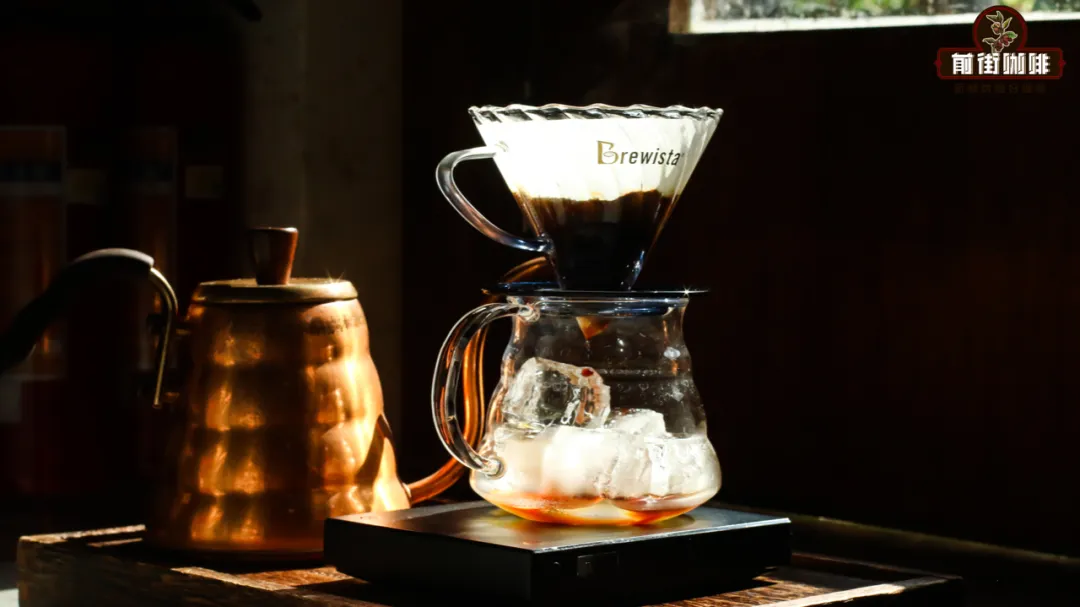
So the problem is not that iced pour-over tastes bad, but that when you want to savor a coffee's flavor in detail, hot brewing is the more ideal choice. So how big is the flavor difference between the two? Let's look at a set of comparison experiments that Front Street frequently conducts.
Next, Front Street will brew one pot of coffee using iced pour-over parameters and another using hot pour-over parameters, then replace the ice cubes in the iced pot with hot water. The goal is to dilute that pot to the same liquid volume as the hot brew while keeping the temperature from dropping, so both pots end up at the same temperature. With temperature eliminated as a variable, we can more easily and directly discern the differences in aroma.
For this brewing session, Front Street selected the Front Street Ethiopia·Hambela from its bean list. This bean is one that customers buy fairly often, so it should be easier to relate to. As for the parameters, they are the settings used in Front Street's daily café brewing, as follows:
Hot pour-over parameters: 15 grams of coffee, Ek43 setting of 10, 92°C water temperature, 1:15 coffee-to-water ratio (i.e., 15 grams of coffee with 225 milliliters of hot water) Brewing time approximately 2 minutes.
Iced pour-over parameters: 15 grams of coffee, Ek43 setting of 9.5, 92°C water temperature, 1:10 coffee-to-water ratio (i.e., 15 grams of coffee with 150 milliliters of hot water) Coffee-to-ice ratio of 1:6 (in this comparison, all ice cubes were replaced with 70°C hot water) Brewing time approximately 2 minutes.

We'll skip the brewing process and go straight to the results:
Hambela coffee brewed with hot pour-over parameters: Measured extraction yield was 20.5%. The aroma clearly presents a fairly rich berry fragrance, and on the palate the flavors include citrus, strawberry, pineapple, cream, blueberry, and a hint of floral notes, with an overall smooth, full-bodied mouthfeel and a long-lasting finish.
Hambela coffee brewed with iced pour-over parameters: The Hambela brewed with iced pour-over parameters had an extraction yield of 18.6%. Whether smelled or tasted, this pot's aroma was somewhat weaker, with discernible flavors of citrus, berries, and a faint floral note. The finish was also relatively short, though overall it was still a pleasant cup of coffee.
Likewise, Front Street also divided these two pots into small cups and let customers choosing coffee beans in the shop taste and compare them. The results were as expected — everyone agreed that the coffee brewed with hot pour-over parameters had a richer aroma. This shows that the gap in aroma between hot and iced pour-over really does exist. So when we want to appreciate a coffee's complete flavor, hot brewing is a very good choice.

At this point, some friends might ask: according to Front Street's previous brewing tutorials, couldn't we adjust extraction parameters or brewing methods in this situation to achieve a higher extraction yield and thus make a full-flavored iced pour-over?
Indeed we can. We can further improve extraction efficiency by grinding finer, extending extraction time, raising water temperature, and so on, giving the coffee a higher extraction yield. But doing so also carries the risk of over-extraction — bitterness and off-flavors in the coffee can easily be dissolved along with everything else, making the drink hard to stomach. Therefore, most cafés adopt a "know when to stop" strategy for iced pour-over parameters: reduce water volume, add ice cubes, and then push the other parameters as far as possible without causing over-extraction.
Although other solutions exist, for the vast majority of coffee shops these methods are unpopular — they either add time costs or material costs. So nowadays most cafés use the approach described above to make iced pour-over coffee.

Finally, as Front Street mentioned earlier, iced pour-over coffee doesn't taste bad — its flavor expression is simply less complete compared to hot brewing. Therefore, if you want to taste a pot of coffee's complete flavor, hot brewing remains the more suitable choice.
- END -
The above content is compiled by CoffeeHunters, a coffee news website.


