







Why Did Luckin Coffee Singapore Reprimand an Employee?
A Luckin Coffee employee in Singapore was reprimanded after making a mint thick coconut milk drink with the espresso removed, as the customer had requested in the order notes. The customer received the drink but later learned the staff member was called in by management for violating the standard recipe, and she questioned the outcome.
The case split opinion: some argue that people sensitive to caffeine need low-caffeine or caffeine-free options and that chains should be flexible, while others say only a unified coffee making process keeps output consistent and prevents management chaos. The dispute has also renewed discussion about whether Luckin should add a decaf option to its menu.
A cup of mint thick coconut milk with the espresso removed actually got a Luckin employee in Singapore reprimanded by their superiors. The customer who posted about it felt puzzled and dissatisfied: a consumer making a request, and the staff doing their best to fulfill it, should have been a win-win situation — so why did it turn into a worker being held accountable? Supporters argue that people sensitive to caffeine need low-caffeine or caffeine-free options, and chain brands should be flexible; opponents stress that only a unified recipe can ensure consistent output and avoid management chaos. This controversy reflects the deep contradiction facing chain coffee brands between standardized processes and personalized service, and it has also sparked discussion about whether Luckin should introduce a decaf option.
Recently, a discussion post on social media about whether Luckin drinks can have the espresso removed attracted quite a bit of attention from netizens.
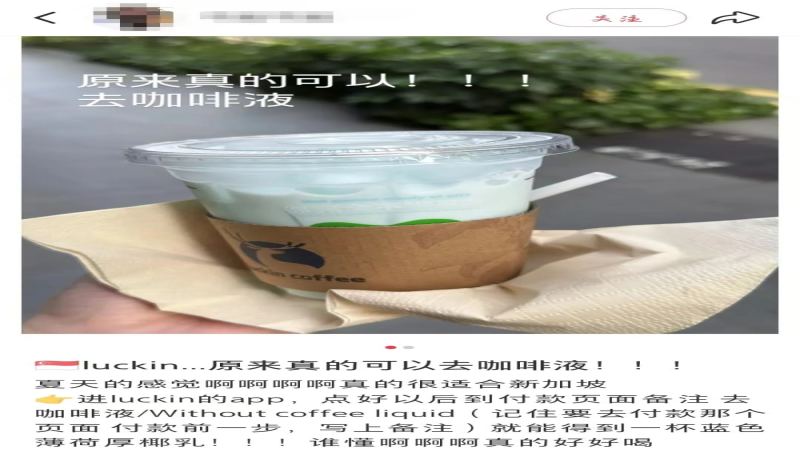
According to the poster, she learned that some Luckin stores in China can make drinks for customers without espresso, so when she placed an order at a Luckin store in Singapore, she wrote a "remove espresso" request in the order notes. In the end, she successfully received a light blue mint thick coconut milk, and even took a photo and posted it on social media to record the experience.
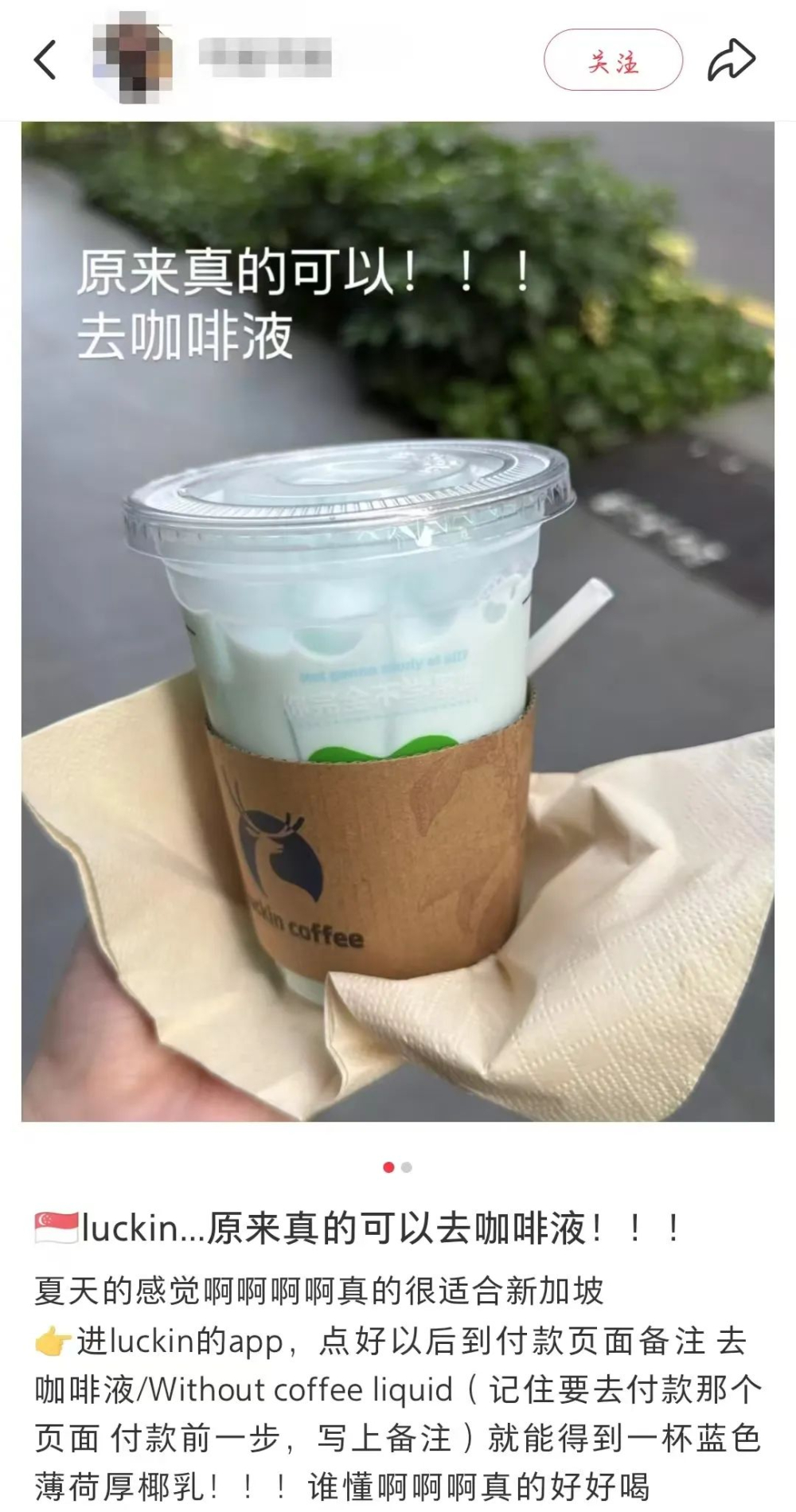
Unexpectedly, this share was noticed by Luckin Singapore's management, which directly led to the person who made that drink being called in for a talk by their superiors. After learning about the aftermath from the store, the poster felt both angry and helpless. She believed that she, as a consumer, made a request to the staff, and the staff delivered a drink that satisfied the customer — it should have been a win-win situation, but instead it ended with Luckin's frontline employee being held accountable for violating the rules.
At the same time, the poster also expressed confusion about how Luckin Singapore's management handled the matter. She pointed out that many people today are quite sensitive to caffeine and want to drink low-caffeine or even caffeine-free beverages. As a large chain brand, Luckin should pay attention to the demands of this group of consumers and allow customers to reasonably request "no espresso."
What's more, Luckin has always promoted itself as "user-centered," so letting employees satisfy customers' personalized needs within a reasonable scope is itself a practice of that service philosophy. The poster said bluntly that management's one-size-fits-all prohibition amounts to pushing store employees into a dilemma between "customer satisfaction" and "process restrictions," which clearly contradicts the brand's claimed "customer-first" stance.
After the post was published, many netizens who also showed Singapore IPs left comments supporting the poster's position. "Honestly, if Luckin had a decaf option, I really would visit more often," "I don't understand why the espresso can't be removed??" "Support having a decaf option! As someone super sensitive to caffeine, I really want to order Luckin at noon every time but then end up giving up..."
These netizens said that among Singapore's coffee-consuming crowd, a considerable number of people want the caffeine content in their drinks to be lower, which is why chain brands such as Starbucks offer a "decaf option" based on local market demand, so that people sensitive to caffeine can also buy suitable drinks. By contrast, in some people's eyes, Luckin, by clinging stubbornly to its drink-making process, not only appears inflexible but also ignores consumers' real needs.
As one user put it, if Luckin could add a "decaf option" in its mini-program, then on the one hand it could satisfy some customers' needs, and on the other hand staff would have one less step to do when making the drink. Moreover, for Luckin itself, it could both lower the cost of making the drink and effectively amount to adding a new product — it could be called killing several birds with one stone, and it could also attract more people to choose Luckin.
However, some people hold the opposite view. They believe there is nothing wrong with a chain brand implementing unified management across stores and requiring all stores to produce drinks according to the recipe process to ensure customers get a consistent taste and flavor. "If this store can remove the espresso and that one can't, won't the whole company end up in chaos?"
In addition, they pointed out that if every customer demanded that drinks be made according to their own notes, it could increase the workload of store employees. And Luckin's frontline employees worry that some customers may leave bad reviews for a store because a customized drink does not suit their personal taste, so they feel that producing drinks according to the brand's requirements can, to a certain extent, avoid customer complaints and disputes.
Image source: Xiaohongshu
Disclaimer: Some images in this article come from the internet. For some content on the website, such as images, we will respect the original author's copyright and indicate the source. However, due to the large volume, there may be individual images or texts that have not yet been credited in time; please understand. If the original author has any dispute, they may contact the website for handling, and once verified, we will correct it immediately. Compiled and edited by "Coffee Workshop"; please indicate the source when reposting. If there is infringement, please inform us for deletion. Thank you~!
The above content is compiled by CoffeeHunters, a coffee news website.


