







Can You Brew Iced Coffee With Dark Roast Beans?
Yes, dark roast beans can make a good iced pour-over, but the recipe changes. Ice melting dilutes the cup, so the common fix is using less water. That cut reduces how much soluble material gets extracted, which is why a dark roast iced pour-over often tastes weak, watery, and bitter when brewed like a light roast.
Front Street Coffee's approach for its PWN Golden Mandheling uses a coffee-to-water-to-ice ratio of 1:10:6, water at 86-89°C, and five pours. The extra pours extend extraction time, raising dissolution efficiency without pulling out the harsh bitterness that comes from over-extraction, so the cup stays sweet with a fuller body.
The long, hot summer makes iced coffee the go-to choice for cooling down. Many coffee enthusiasts, after getting used to light-roast iced coffee, want to try something different with a dark-roast iced pour-over, only to end up disappointed—the result is weak, watery, and even bitter and hard to swallow. Where exactly does the problem lie? This article, drawing on Front Street Coffee's brewing experience, analyzes the root causes of why dark-roast iced pour-over tends to fail, and offers a complete solution covering bean selection, parameters, and pouring technique. The core idea is to extend the extraction time through multiple pours, improving dissolution efficiency while avoiding the bitterness that comes from over-extraction. The article also shares the specific brewing parameters for Front Street Coffee's PWN Golden Mandheling, including a coffee-to-water-to-ice ratio of 1:10:6, a water temperature of 86–89°C, and a five-pour technique, helping you brew a cup of dark-roast iced coffee at home that is rich without being bitter and has a prominent sweetness.
According to the meteorological department, the high-temperature weather in Guangdong is expected to last until around November. In other words, for nearly two months to come, iced coffee will remain an essential beverage for beating the heat.
Like everyone at Front Street Coffee, many of you have grown tired of light-roast iced coffee with its bright acidity, and occasionally want to switch things up by trying a dark-roast iced coffee with heavier caramel aromas and a fuller body. So you naturally grab a bag of dark-roast beans and start brewing.
Yet the actual result is disappointing: even though the brewing approach is identical to what you'd use for a light roast, this cup of dark-roast iced coffee not only has weak flavor but also tastes watery, falling noticeably short of the hot-brewed version. Some customers come to Front Street Coffee's store with their questions, wanting to figure out exactly which step went wrong.
Front Street Coffee actually anticipated this situation. The reason is that making iced pour-over requires ice to rapidly cool the coffee, and as the ice melts, it inevitably dilutes the coffee liquid. To compensate for this dilution, we typically reduce the amount of water poured during brewing, thereby increasing the coffee's concentration.
However, when the amount of water is reduced, the total amount of soluble substances that can be extracted also decreases. This is because this parameter doesn't just affect concentration—it directly influences extraction efficiency. So in addition to reducing water, we also need to adjust other variables to make up for the shortfall caused by the reduced water volume. This is the general logic for adjusting when switching from hot brew to iced brew.
The problem is that the reduction in water volume tends to be quite significant, which means many people can only extract the small-molecule, fast-dissolving sweet and acidic compounds, while the slower-dissolving large-molecule components make up only a tiny proportion of the final cup.
For light-roast beans that showcase sweetness and acidity, this isn't a big issue, because the flavors you want from a light roast happen to be concentrated in the early-to-mid stages of extraction, released in large amounts. But dark-roast beans are completely different—their body, sweetness, and aftertaste, which are their core characteristics, depend precisely on those slower-dissolving large molecules. This is exactly why many people's iced coffee turns out watery and weak. So, is there a way to make dark-roast iced coffee taste good?
The answer is yes! Since the problem is insufficient dissolved solids, we simply need to find a way to push extraction efficiency higher.
But note that dark-roast beans have a key difference from light-roast beans: their internal structure is looser and inherently easier to extract. If parameters like water temperature and grind size are adjusted too aggressively, it's easy to drag out a large amount of bitter compounds, making the coffee noticeably bitter. Therefore, rather than adjusting water temperature or grind size, Front Street Coffee recommends focusing on the pouring method.
This is precisely the point that many people tend to overlook—because they've reduced the brewing water, they think about compensating for extraction efficiency by grinding finer, without realizing that reducing the water volume also affects extraction time.
When the amount of water decreases, assuming the brewing technique stays the same, the total extraction time naturally shortens. Take Front Street Coffee's approach as an example: when making a hot pour-over with 15 grams of coffee, we pour 225 milliliters of hot water using a three-pour technique, for a total time of about 2 minutes. For an iced brew, the water volume is only 150 milliliters—if you still use three pours, the time drops to around 1 minute 30 seconds.
The shortened time has a twofold consequence: on one hand, extraction efficiency is further reduced; on the other hand, those slower-dissolving large molecules don't get fully released. So we must find a way to control the extraction time during brewing.
Front Street Coffee's approach is to reduce the flow rate, but beginners often find it hard to control the flow rate consistently. Therefore, Front Street Coffee recommends that beginners split the hot water into more pours. As Front Street Coffee has shared before, increasing the number of pours can effectively lengthen the extraction time—the more pours, the longer the total time. Four pours, five pours, or six pours all work; decide flexibly based on the actual flow rate. Below, Front Street Coffee demonstrates the specific steps through an actual brew.
Coffee's flavor ultimately comes from the ingredient itself. To brew a good pot of coffee, the first step is to choose a bean of solid quality. Many people don't like coffee with prominent acidity, so they should prioritize medium-dark roasts. Front Street Coffee recommends beans with rich roasting aromas like Front Street Coffee Queen's Estate, Front Street Coffee Bird of Paradise, and Front Street Coffee Mandheling—these brew with a naturally rich, full-bodied taste.
This time, Front Street Coffee chose Front Street Coffee PWN Golden Mandheling, the darkest-roasted coffee bean in Front Street Coffee's Taobao/Tmall store. The beans are large, plump, and uniform in size, making it easier to maintain consistent particle size after grinding. The flavor performance is also quite outstanding, and the brewed coffee tastes even better.
Once the beans are selected, the next step is to determine the extraction parameters. The parameters Front Street Coffee uses for iced brew are exactly the adjustments mentioned earlier made on top of the hot brew baseline: reducing the water volume, grinding finer, and using a slow flow rate to stabilize extraction time.
If you're a beginner who hasn't quite mastered pouring technique yet, you can use more pours to lower the difficulty, while appropriately increasing the coffee dose and total water volume to improve your margin for error. It's best to pair this with a slower-flow dripper, such as a Kono or a cake cup. The specific parameters are as follows:
Coffee dose: 20 grams
Grind size: 80% passing a No. 20 sieve, Ek43 setting 10, fine granulated sugar coarseness
Coffee-to-water-to-ice ratio: 1:10:6 (20g coffee, 200ml hot water, 120g ice)
Brewing water temperature: 86–89°C
Dripper used: Kono
Brewing method: five-pour
Water distribution: 40ml + 40ml + 40ml + 40ml + 40ml
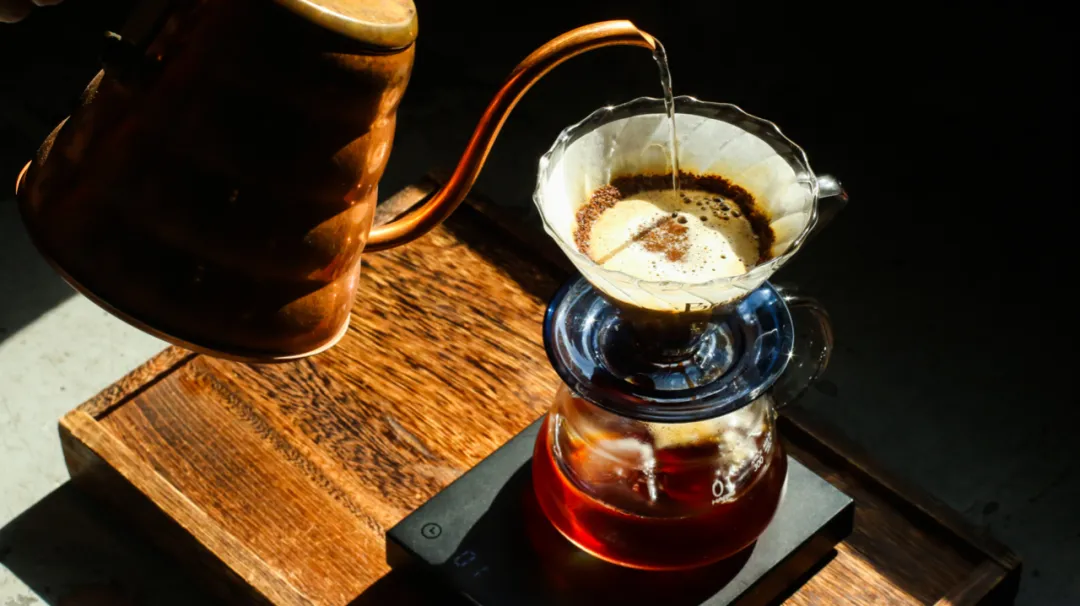
First comes the bloom: pour 40 milliliters of hot water and let it bloom for 30 seconds. When pouring, circle from the center outward to ensure all the coffee grounds are saturated.
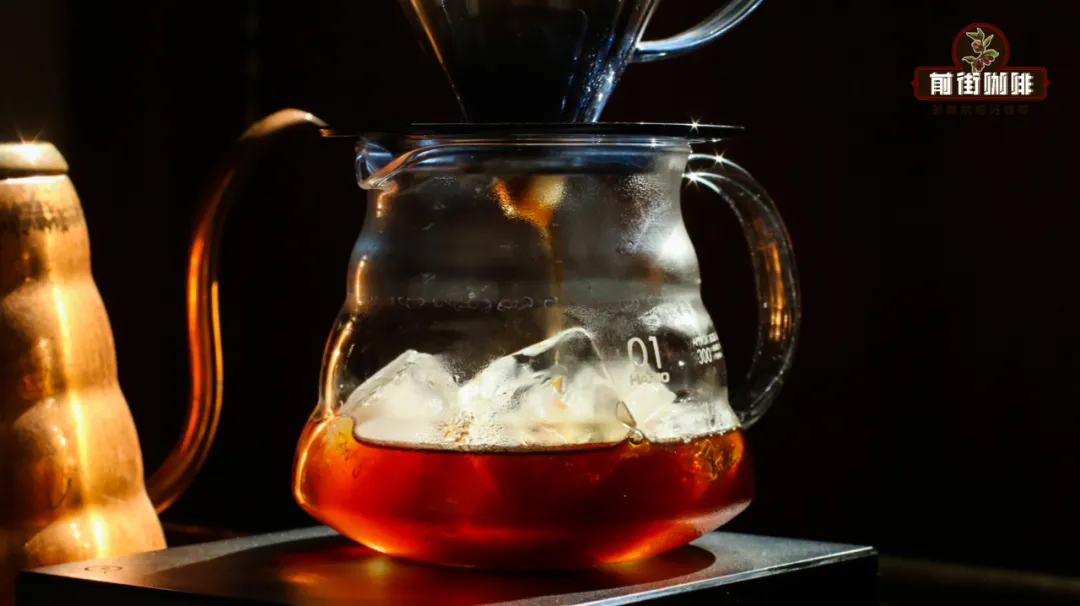
After the bloom, the remaining four pours are done in exactly the same way. For each pour, slowly circle with a small stream, adding 40 milliliters, and wait until the hot water has fully drained through before starting the next pour, until all the target water has been poured. Once the final pour has drained through, you can remove the dripper and extraction is complete.
Total time: 2 minutes 10 seconds! But you can't drink it yet—you need to first swirl the server to even out the coffee's concentration and temperature.
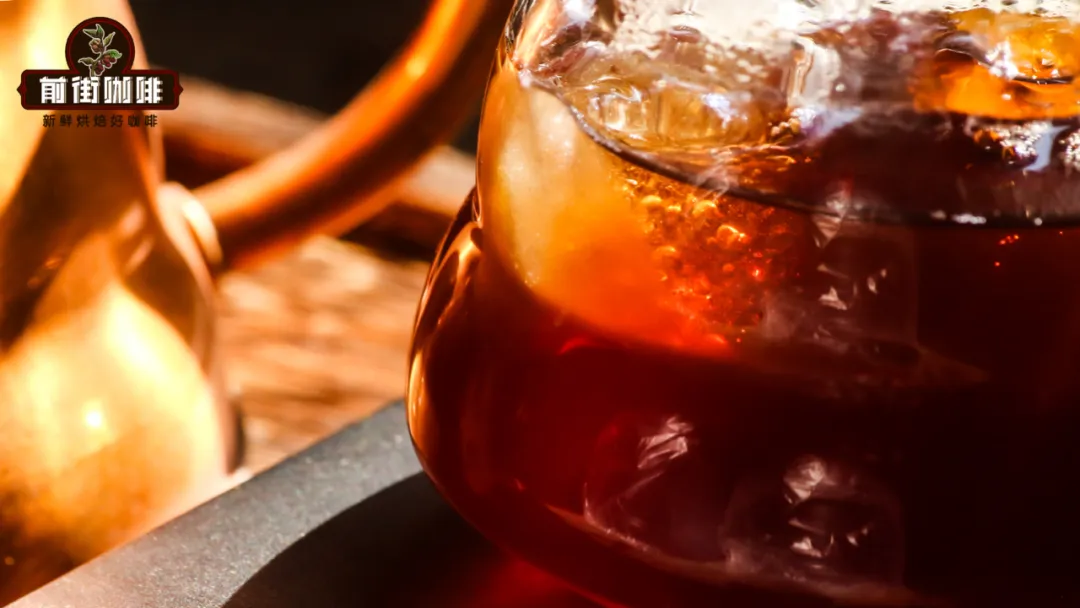
Once you feel the coffee is sufficiently chilled, you can pour it into a cup and start enjoying it.
You can tell from the color of this pot of coffee that it should taste quite rich. And indeed it does—the coffee is strong without being bitter! What's more, at low temperature, the sweetness is even more prominent than the hot-brewed version. Besides the chocolate, nut, and spice notes characteristic of dark roasting, Front Street Coffee also picked up caramel sweetness and a pine-like freshness in the aftertaste. The body is very solid—quite excellent!!
The above content is compiled by CoffeeHunters, a coffee news website.


