







How does the Origami dripper change geisha coffee brewing?
The Origami dripper, designed by Yasuo Suzuki of Japan's TRUNK COFFEE BAR, accepts both conical and cake filters. Each pairing changes extraction uniformity, so the dissolved compounds shift and the flavor and mouthfeel differ. The same dripper therefore produces noticeably different cups, and the filter you pick should follow the style of coffee you want to drink.
A side-by-side brew using the same Panama Boquete geisha coffee beans shows how the two paper types diverge in the cup. Conical filters tend to give a different flow and bed depth than cake filters, which alters contact time between water and grounds. Comparing both with one batch of geisha coffee beans keeps the variable controlled and makes the differences easier to taste.
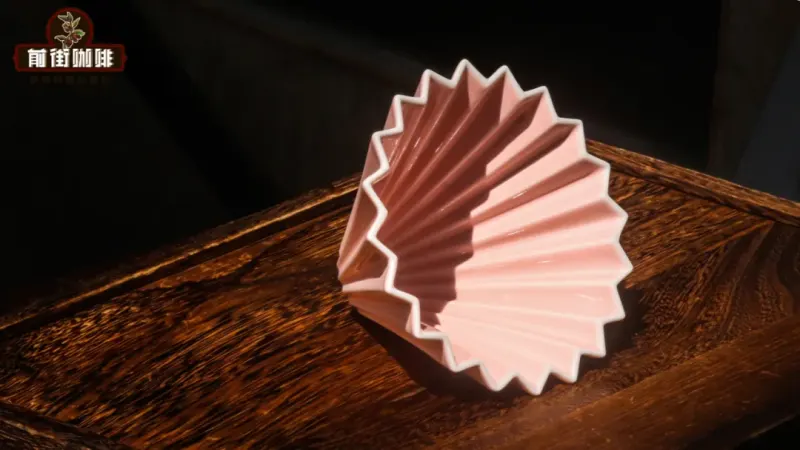
Among the many coffee drippers, one product stands out for its unique appearance and high compatibility: the Origami dripper, designed by Yasuo Suzuki, one of the founders of Japan's TRUNK COFFEE BAR. Its name comes from the Japanese word "折り紙," meaning origami. What makes this dripper most special is that it can be paired with both conical filters and cake filters, resulting in completely different extraction effects. So, what are the characteristics of each filter combination? And what differences are there in the flavor and mouthfeel of the brewed coffee? In this article, Front Street will use the same Panama Boquete Geisha coffee beans for a comparative brew to help you find the filter pairing that suits you best.
Among the dazzling array of drippers, there is one design that offers compatibility with both conical filters and cake filters: the "Origami," created by Yasuo Suzuki, one of the founders of Japan's TRUNK COFFEE BAR.
The name Origami comes from the Japanese word "折り紙," which means paper folding, so in Chinese it is usually called the "origami dripper." To be honest, this is one of the few drippers that caught Front Street's interest purely because of its appearance. Its shape is uniquely designed, and its color combinations are quite attractive. But what is most praiseworthy is still its ability to fit different types of filters. (Not an ad.)
The same dripper can be paired with multiple types of filters, which brings more possibilities to coffee brewing. Mr. Yasuo Suzuki's original intention in designing this dripper was to make it as light as paper while also giving coffee brewing the kind of variety found in origami.
But this also leaves many friends confused when using it: "For this origami dripper, should I use a conical filter or a cake filter?"
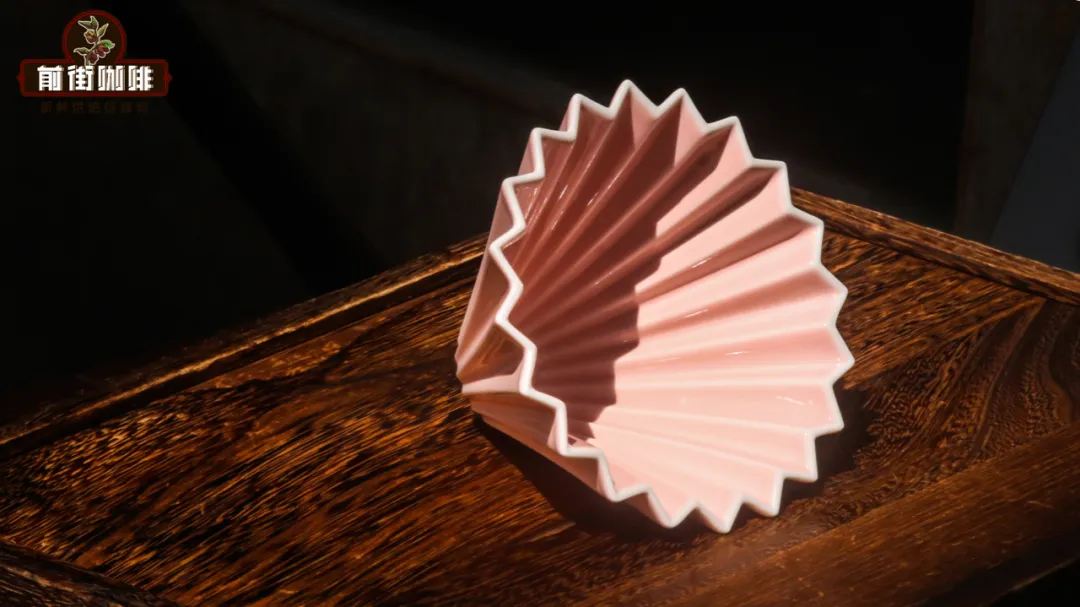
Front Street's answer may sound a little vague, but that is indeed the truth—which filter you choose mainly depends on what kind of coffee you want. Because different filters change the degree of extraction uniformity, causing the substances dissolved from the coffee to change, which in turn affects flavor and mouthfeel.
So today, Front Street will talk with you about the characteristics of the origami dripper paired with cake filters and the origami dripper paired with conical filters, and what differences there are in the body of the coffee brewed with them.
Origami dripper paired with conical filters
Differences in filter pairing mainly affect two aspects: first, the flow rate, and second, the structure of the coffee bed. When the origami dripper is paired with a conical filter, the brewing water can pass through the coffee bed more quickly, meaning the flow rate is relatively fast, because the conical filter does not fit the dripper very closely.
The raised ridges of the dripper lift the filter paper, forming relatively deep grooves. These grooves provide more channels for gas to escape during brewing, so the resistance to water flow is reduced and the flow rate naturally increases.
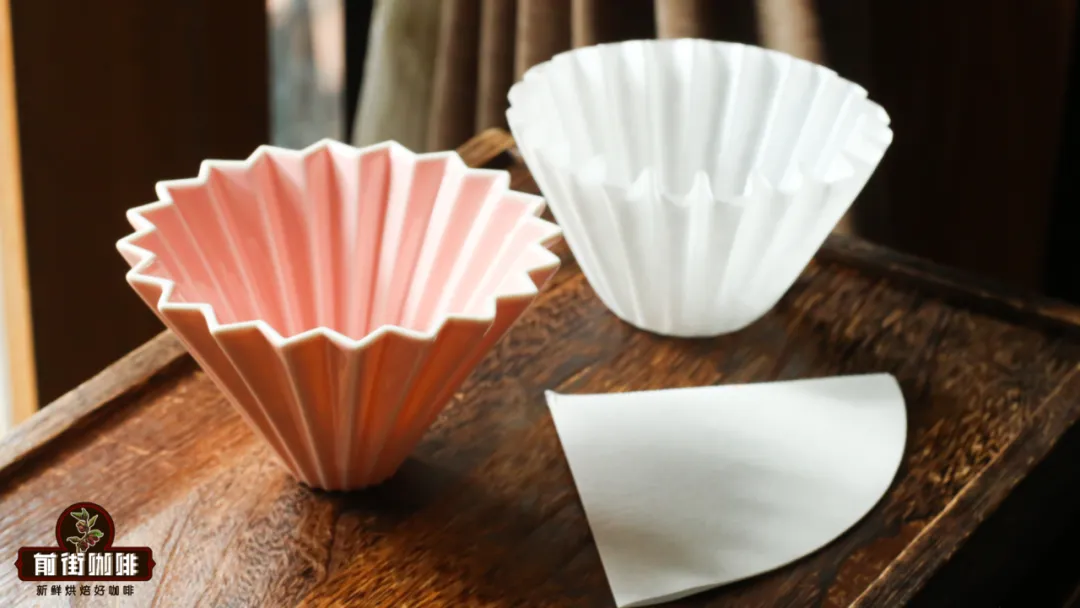
At the same time, the conical filter causes the coffee grounds to pile up into an inverted-triangle bed structure, and the coffee bed as a whole is relatively thick. Especially toward the center, the bed becomes thicker; toward the edges, it becomes thinner.
Because the thickness of the coffee bed varies from area to area, during brewing the coffee grounds in different positions show different rates of substance dissolution. Combined with the fast flow rate, using a conical filter makes extraction relatively less uniform, so the brewed coffee has richer layers and more distinct, prominent flavors.
Origami dripper paired with cake filters
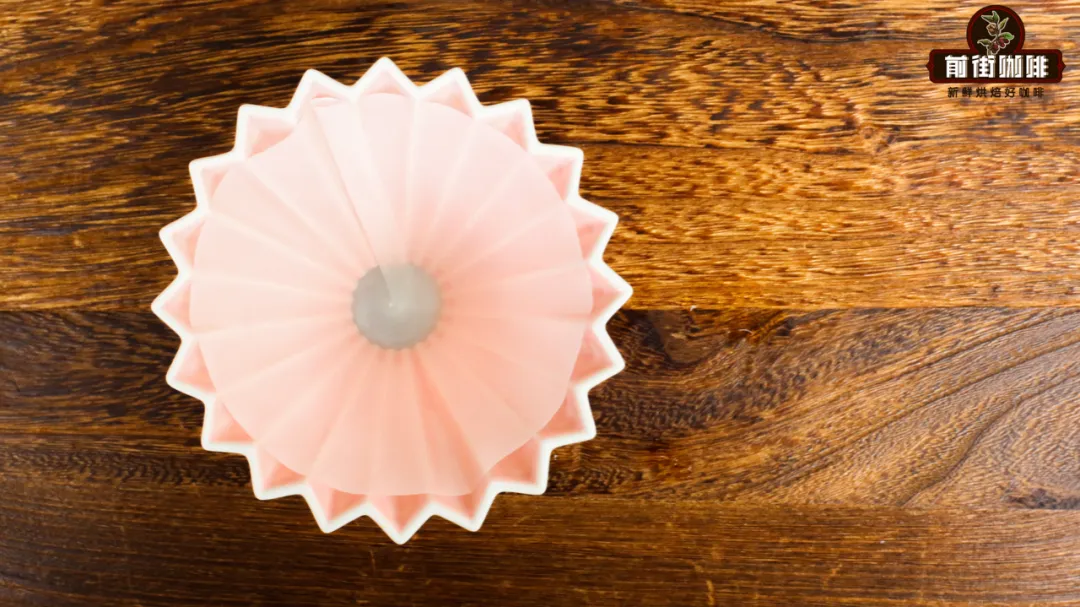
Although it does not fit perfectly either, compared with a conical filter, a cake filter matches the dripper more closely. As can be seen in the picture below, the folds of the cake filter fit exactly into the twenty folds of the dripper. Based on Front Street's explanation above, you should be able to infer that the speed at which water passes through the coffee bed will therefore slow down, because the high degree of fit reduces gas-escape channels and water-flow resistance increases accordingly.

In addition, the cake filter has a flat-bottom structure. Its coffee bed is not shaped like a cone, narrow at the bottom and wide at the top, so the coffee grounds are distributed more evenly and the bed is relatively thinner.
This allows the coffee grounds to achieve more consistent extraction efficiency—the coffee bed is not thick and is uniform, so the poured water can quickly reach the bottom of the bed for extraction. Combined with the filter's high degree of fit and relatively slow flow rate, it is easier to form an immersion effect during brewing, and extraction uniformity is further improved.
Therefore, when we use the origami dripper paired with a cake filter to brew, it is easy to produce coffee with a solid mouthfeel, balanced taste, and prominent sweetness.
But talking only about concepts may be hard to understand, so next Front Street will use the same coffee beans to compare exactly what differences there are in coffee brewed with the origami dripper paired with different filters.
Brewing comparison of different "forms" of Origami
For this brew, Front Street selected Front Street Panama Boquete Geisha from the bean list for comparison, using exactly the same parameters: 15g dose, 1:15 coffee-to-water ratio, Ek43 setting 10 grind, No. 20 sieve with 75% pass-through rate (caster sugar coarseness), 92°C water temperature, three-pour brewing, and total time controlled at 2 minutes.
The Boquete Geisha brewed with a conical filter showed relatively prominent jasmine floral notes, bright citrus acidity, honey sweetness, and an oolong tea finish. The overall mouthfeel was smooth, clean, and transparent, with rich yet distinct layers;
The Boquete Geisha brewed with a cake filter also had jasmine floral notes, but compared with the former it seemed calmer and less sharply prominent. The citrus acidity was rounder, the honey sweetness more prominent, and the finish was still oolong tea, but the aroma was more lasting. Overall body and sweetness were relatively higher, the taste was balanced, and the aftertaste was long.
Overall, if you prefer coffee with prominent flavors and rich layers, you can choose a conical filter paired with the origami dripper for brewing; if you prefer coffee with high body and high sweetness, you can choose a cake filter pairing.
In addition to choosing the filter pairing based on the coffee's body, we can also decide which filter to use according to brewing difficulty. For beginners who have just started, Front Street would recommend pairing the origami dripper with a cake filter, because the flat-bottom filter's coffee bed structure is friendlier to beginners, has a higher margin for error, and makes it easier to brew a delicious cup of coffee~
- END -
The above content is compiled by CoffeeHunters, a coffee news website.


