







How Much Water Goes Into an Americano, American Style?
There is no fixed water amount for an Americano. The water only dilutes an already-pulled espresso, so it changes concentration rather than extraction. Add more water for a softer, milder cup; add less for a stronger, fuller one. Front Street Coffee's measured data gives reference ranges for both hot and iced versions, and the bean's roast level decides the flavor direction.
Dark roasts lean toward caramel, chocolate, and nutty notes, while light roasts bring floral and fruity notes, so each needs a different water amount to taste balanced. A practical way to find a preferred cup is split extraction: pull one espresso, split it into two or three cups, add different water amounts, and compare. This tests ratios at low cost without guessing.
A cup of Americano in the morning wakes you up and reduces puffiness, but how much water should you actually add to make it taste smooth? This question puzzles quite a few coffee lovers. There is no universal fixed value for the water amount in Americano—the key lies in concentration adjustment: more water means a milder taste, less water means a stronger taste, and the roast level of the coffee beans you choose directly determines the flavor direction. Dark-roasted beans lean toward caramel, chocolate, and nutty notes, while light-roasted beans are known for floral and fruity notes, and the water amounts they need are completely different. This article starts from the principle of concentration, combines it with Front Street Coffee's measured data, gives reference ratio ranges for hot and iced Americano, and shares how to use split extraction of espresso to test out the cup that best suits your taste at low cost.
Many people make themselves a cup of Americano in the morning. For one thing, they value its practical effects of refreshing the mind and reducing puffiness; for another, it is really convenient to make—extract a shot of espresso, add water, stir, and a cup of Americano that both wakes you up and helps reduce swelling is done.
The core role of water in it is to lower the concentration of the espresso and make the coffee smoother. However, the question "how much water should actually be added to an Americano" troubles many friends. Most of the time, online bloggers only give a rough range and do not explain the specific parameters clearly. So beginners often come to ask Front Street: "How much water should be added to Americano to make it taste best?"
How much water should actually be used to make the best-tasting Americano?
In fact, there is no unified standard for the water amount in Americano, because the amount of water added essentially affects the concentration of the coffee. Unlike pour-over coffee, Americano is made by pouring water directly into already-extracted espresso to dilute it, so the water amount does not change the coffee's extraction yield, only the level of concentration.
The more water added, the lower the coffee concentration, and the softer the taste and flavor on the palate; conversely, the less water added, the higher the concentration, and the more concentrated and fuller the taste and flavor.
For this reason, the water amount in Americano is influenced both by personal taste preferences and by the coffee beans used. The taste of a cup of Americano ultimately comes from the beans themselves, and the roast level directly determines the strength of the taste.
For example, dark-roasted beans mainly feature flavors such as caramel, chocolate, and nuts, and the espresso extracted is relatively heavy. If you like this style, you can give priority to Front Street Classic Blend, Front Street Dark Cocoa Base Blend, Front Street Specialty Blend, and Front Street Commercial Blend;

the flavors of light-roasted beans, on the other hand, center on floral and fruity notes. If you prefer this direction, you can choose Front Street Huakui SOE, Front Street Granada SOE, and Front Street Strawberry Candy Espresso Blend. The espresso they extract is less intense than that from dark-roasted beans, tending overall toward acidity and a fresh style.
It can be seen that the character of these two types of beans is completely opposite. Therefore, you cannot directly apply the ratio that makes one cup of Americano taste good to other beans, otherwise it is easy to end up with a taste that is too weak or too strong. So how do you find the optimal Americano water amount for the beans you currently have?
The method is simple—drink. As long as you try Americanos made with different ratios in sequence, you can find the parameters that best suit your taste and best match the beans in your hands. Of course, there is no need to make the testing range too wide. Front Street can give everyone some reference values.
Front Street's daily production uses Front Street Classic Blend, a medium-dark roasted espresso bean. The extraction parameters are usually 20g of grounds extracted into 40ml of liquid weight, with the time controlled between 28 and 35 seconds. After repeated testing at Front Street, hot Americano was finally settled at a ratio of 1:4.5, that is, 40ml of coffee mixed with 180ml of water.
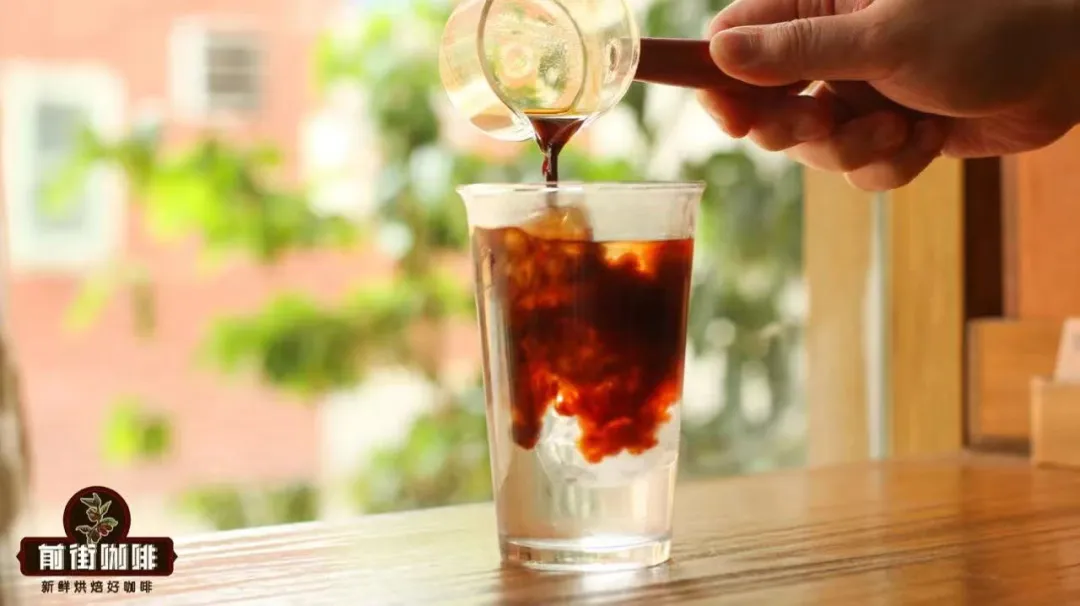
A hot Americano made at this ratio can fully release unique flavors such as whiskey aroma, vanilla, cream, and butter cookies, while still retaining a certain concentration, making it taste fuller. The ratio for making iced Americano is 1:2:4, that is, 40ml of coffee paired with 80g of ice cubes and 160ml of room-temperature water. Likewise, iced Americano made at this ratio shows the flavor without losing concentration, and both the mouthfeel and taste are just right.
After that, everyone can use the above ratios as a reference to narrow the range during evaluation. For example, if you are using single-origin beans or beans with a lighter roast, when testing hot Americano you can keep the ratio between 1:3.5 and 4.5; if it is dark-roasted beans, the ratio can be kept in the range of 4.5 to 5.5. The testing approach for iced Americano is the same, except that the speed at which the ice melts also needs to be taken into account.
If there are not many people during testing, we can also follow the piccolo approach and reduce testing costs by splitting the espresso. For example, divide the extracted espresso evenly into 2 to 3 portions, then add different amounts of water to each. In this way, one coffee can be used for multiple test groups, saving materials and avoiding waste.
The above content is compiled by CoffeeHunters, a coffee news website.


