Origins & Estates · In-Depth Visits
Coffee cultivation in Kenya began in 1893 with the Bourbon variety brought by French missionaries, but what truly shaped Kenyan coffee into today's style—"bracing acidity, full body, dark fruit aromatics"—were the SL28 and SL34 varieties bred by the Scott Agricultural Laboratories in the 1930s. These two varieties were originally by-products of drought-resistance breeding experiments, yet their cup performance far exceeded expectations—especially SL28, which today is synonymous with high-end Kenyan coffee.
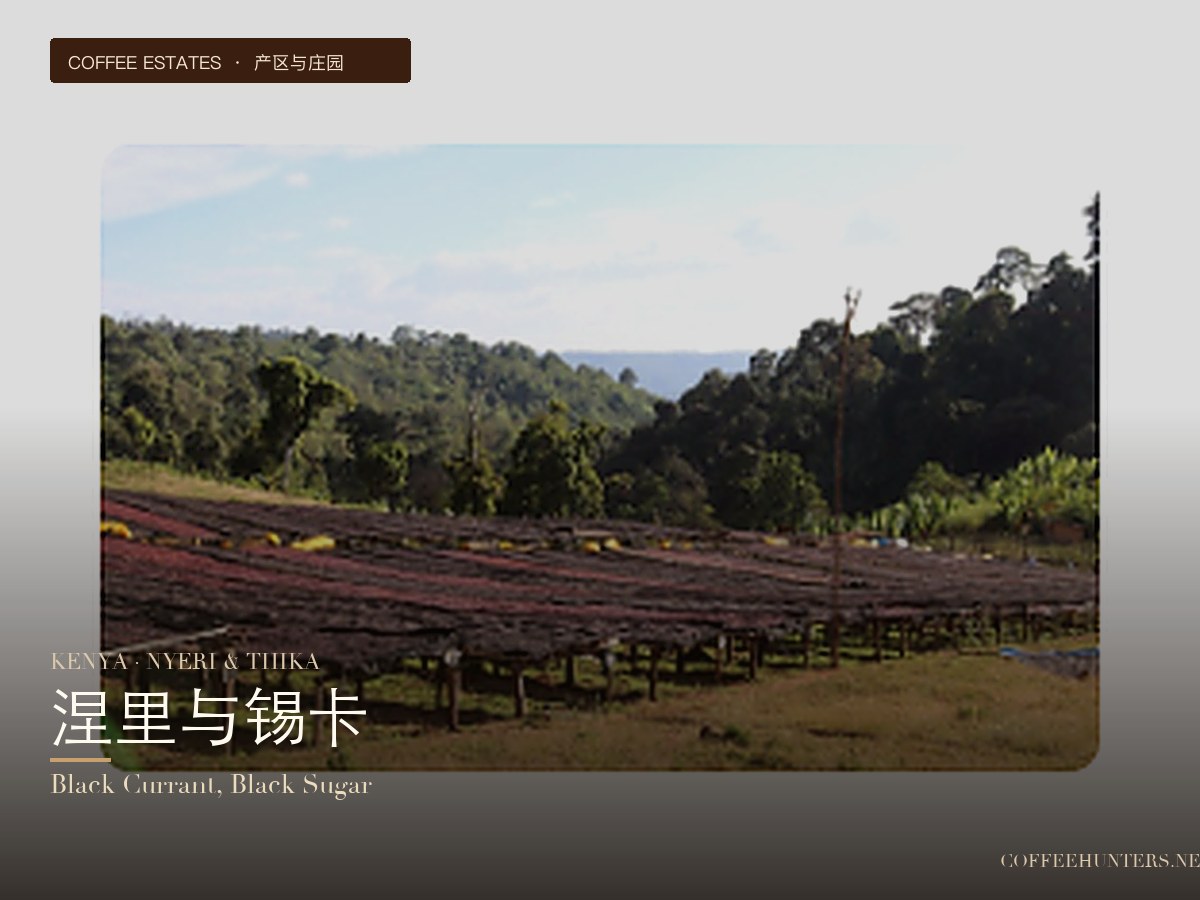
II. The Nyeri Region: Kenya's "Coffee Heart"
Nyeri is located in Kenya's Central Highlands, at elevations between 1,500 and 2,000 meters, and is the most prestigious coffee region in Kenya. Nyeri is surrounded by Africa's second-highest peak, Mount Kenya (5,199 meters), and the Aberdare Range, with fertile volcanic soil, abundant rainfall, and dramatic day-night temperature swings. Famous towns such as Nyeri Hill, Karatina, and Tetu all produce top-tier Kenyan AA.
III. The Thika Region: A Rising Star of Specialty Coffee
Thika is located southeast of Nyeri, adjacent to the capital Nairobi, and forms part of Kenya's Central Highlands. Thika's elevation is slightly lower than Nyeri's (1,400–1,800 meters), but it likewise has volcanic soil and ample rainfall. Coffees from the Thika region are known for a rounder mouthfeel and more pronounced sweetness, and are often recommended as "entry-level Kenya" to enthusiasts new to Kenyan coffee.
IV. Varieties: SL28, SL34, and Ruiru 11
The main varieties in Nyeri and Thika are SL28 and SL34, accounting for over 70% of the planted area. SL28 has Bourbon lineage, with bright acidity and solid sweetness; SL34 is more disease-resistant and often carries a slight herbal note. After the 1990s, in response to the CBD (coffee berry disease) epidemic, Kenya introduced the disease-resistant variety Ruiru 11, but Ruiru 11's cup performance is considered slightly inferior to the SL series and is often discounted on the specialty market.
V. The K7 Process: The Key to Kenya's Unique Terroir
Kenya's unique K7 double wash process (Kenyan Double Wash) is the key technique behind this distinctive flavor profile. First stage: ferment for 12–72 hours after pulping; second stage: soak in fresh water for another 12–24 hours. This process leaves the green beans with an extremely high concentration of tartaric acid, producing in the cup a bright blackcurrant, tomato, and lime acidity—a flavor signature that no other region can replicate.
VI. Representative Estates and Cooperatives
Nyeri's Tegu Factory and Karatina Cooperative have long been representatives of Kenyan AA. Thika is known for processing stations such as Kiandu and Chania. Worth noting is Kenya's auction system—the NCE (Nairobi Coffee Exchange) holds auctions once a week, making it one of the most transparent specialty coffee auction systems in the world.
VII. Brewing Recommendations
Kenyan coffee is best suited to brewers that highlight acidity and sweetness. A V60 or Origami dripper is recommended, with a water temperature of 90–92°C, a coffee-to-water ratio of 1:15, and a medium-fine grind. Three-pour method: first pour for a 30-second bloom, second pour to 60%, third pour with a fine stream to finish. When brewing, note: Kenyan coffee has a relatively narrow extraction window, and over-extraction produces noticeable astringency, so keeping the total time between 2:30 and 3:00 is the safest approach.
Conclusion: Why Kenya Is the "Litmus Test" of Specialty Coffee
In global coffee competitions and cupping training, Kenyan coffee is almost always one of the standard answers—its acidity is bright enough, its flavors three-dimensional enough, and its layers complex enough to most directly test a brewer's skill. To understand Nyeri and Thika in Kenya is to understand the true meaning of the word "acidity" in the world of specialty coffee.
— CoffeeHunters Editorial Team
The above content is compiled by CoffeeHunters, a coffee news website.