








What is Black Label geisha coffee from Hacienda La Esmeralda?
Black Label is a newer grade of geisha coffee beans from Panama's Hacienda La Esmeralda, the estate that brought Geisha to market in 2004. It sits alongside the familiar Red Label, Green Label and auction lots, but is pricier, produced in very small amounts and documented far less than the other grades.
The estate once split its Geisha into Red Label, Green Label and Blue Label, then dropped the most affordable Blue Label, leaving two main grades plus auction lots. Black Label draws on specific source plots and experimental processing methods, which helps explain its scarcity and its standing in the specialty coffee market.
In recent years, the popularity of Geisha in the specialty coffee world has continued to rise, and as the core estate that pushed this variety to its peak, Panama's Hacienda La Esmeralda has always drawn much attention for its grading system. In addition to the familiar Red Label, Green Label, and auction lots, a new grade called "Black Label" has quietly appeared on the market. It is not only expensive and extremely low in production, but also quite mysterious in terms of available information. This article will systematically sort out the Geisha grading lineage of Hacienda La Esmeralda and take a deep look at the definition of Black Label Geisha, its source plots, degree of scarcity, and the experimental processing methods behind it, helping coffee lovers fully understand the true nature of this brand-new grade.
If one were to ask who is the most talked-about figure in today's specialty coffee world, Geisha undoubtedly sits firmly at the top. Since Hacienda La Esmeralda brought Geisha to market in 2004 and shot to fame with it, the estate has continued to carry out refined cultivation management of this variety while establishing a dedicated grading system, allowing Geisha coffee beans to become increasingly high-end in positioning.
For coffee fans passionate about Geisha, terms such as "Red Label," "Green Label," and "Best of the Best" in Hacienda La Esmeralda's grading system should already be very familiar. But some may have noticed that starting at some point last year, a completely new grade suddenly appeared on the market—"Black Label." Compared with Hacienda La Esmeralda's previous labeled Geishas, Black Label is not only more expensive but also appears far less often. There is very little information about it online, and even its product form and pricing strategy seem especially mysterious. So what exactly is the background of this Black Label?
Before breaking down "Black Label" in detail, Front Street will first briefly review the several existing grades of Hacienda La Esmeralda.

In the early years, Hacienda La Esmeralda divided its Geisha beans into three levels from high to low quality: Red Label, Green Label, and Blue Label. Later, Blue Label, which was the most affordable, was discontinued, so in recent years this famous Panamanian estate's Geisha product line has basically remained at two main grades, Red Label and Green Label, plus the costly auction lots.
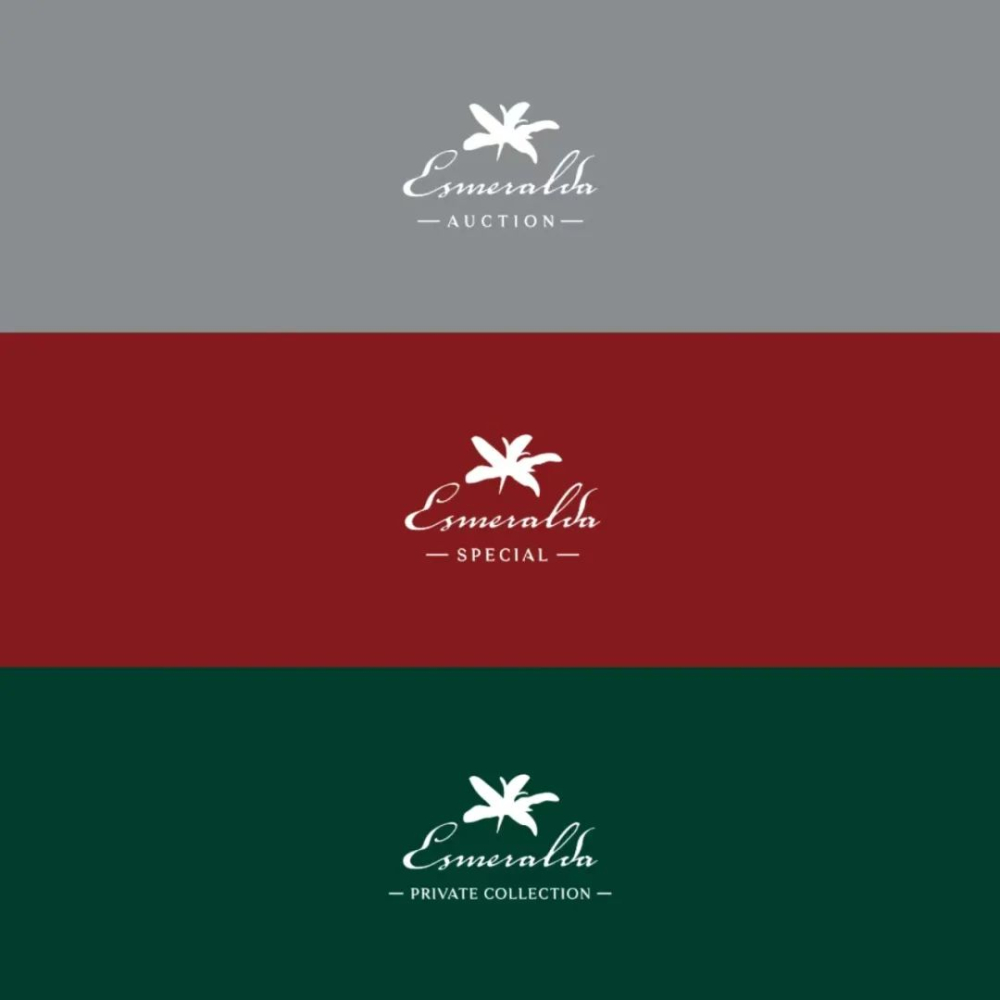
As consumers, we usually identify grade levels by the color scheme of the product label: the one with a red background and a coffee flower printed on it is Esmeralda Special (Red Label); if the coffee flower is on a green background, it represents Private Collection (Green Label); and Esmeralda Auction, which can only be obtained through bidding, often uses a gray background.
For a long time, Red Label has always been the symbol of Hacienda La Esmeralda's highest quality. Its standards are a growing altitude of no less than 1,600 meters, a cupping score of 91 or above, and complete traceability information. Fans familiar with it know that each lot of Red Label comes with a lot number that can be used to look up detailed information such as the growing plot, altitude, latitude and longitude, tree age, harvest date, processing method, and cupping flavors.
(The sun-dried Red Label Geisha that Front Street purchased in 2022)
The more affordable Green Label is a blend of harvested Geisha lots, with an altitude requirement of between 1,600 and 1,800 meters, and it is offered only in the two traditional processing methods: sun-dried and washed. If you are interested in more details about different sub-estates and various small plots, you can refer to articles previously published by Front Street, so we will not elaborate on them one by one here.
As for the newly appeared "Black Label," after checking Hacienda La Esmeralda's official website, Front Street noticed that it has not yet been incorporated into the fixed Geisha product series, and the estate owner has promoted it quite sparingly, making it difficult to find detailed background introductions about it online.
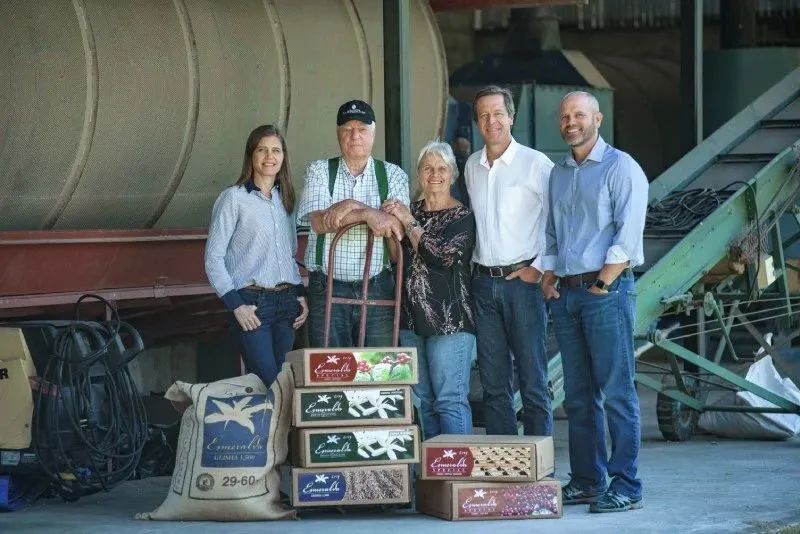
Only through the limited information disclosed officially, combined with shares from buyers across the trade, did Front Street learn that Hacienda La Esmeralda's newest Geisha grade is called "Esmeralda Nano," also known as "Nano Lot." It is a lot launched by the Peterson family last year to celebrate the 20th anniversary of Geisha's debut, and there is currently no direct Chinese translation. Because the Peterson siblings designed the identifier for this grade as a black coffee flower (or with a black background), Chinese buyers followed past naming habits and called it "Black Label."
The so-called "Black Label," simply put, is a micro-lot further selected from Red Label Geisha. It must meet at least one of the following conditions: either it comes from a small plot in a special location, or it has been processed using an experimental processing method.
From the current situation, most of the newly released Black Label Geishas are harvested from new plots at higher altitudes with extremely low yields. For example, in the highly popular sub-estate Cañas Verdes, Geisha from two small plots has been made into Black Label for sale: one is Nido, planted at 2,050 meters, and the other is Gigante, at over 1,900 meters. In addition, two small plots in Veil have also been included in Black Label lots, namely Pinto at an altitude as high as 2,200 meters and Valle at 2,000 meters.
In addition, each individual Black Label lot usually has a production of only a few kilograms or slightly more than ten kilograms, and some lots are said to be even less than 1,000 grams, pushing scarcity to the extreme. Therefore, the price is much higher than ordinary Red Label, so Front Street has not yet had the chance to taste it
. However, this also explains why, even though it debuted last year, it has always remained "mysterious" in the market.
Finally, the practice of releasing experimental processing lots should originate from Hacienda La Esmeralda's investment one or two years earlier in renovating temperature-controlled rooms and a microbiology laboratory. They hoped to conduct various more detailed experiments to contrast with traditional processing methods and better understand the effects of different environmental and biological factors on coffee quality.
For example, low-temperature fermented raised-bed dried washed processing is more refined and cumbersome in its steps than traditional washing. After harvest, the ripe coffee cherries are first washed to remove the outer skin and pulp completely, then placed into a sealed steel tank in a temperature-controlled cold storage room to ferment for 3 days. After fermentation is completed, the parchment beans are taken out and spread flat on raised beds to dry for 18 days, allowing the Geisha to develop a richer floral and fruity aroma.
- END -
The above content is compiled by CoffeeHunters, a coffee news website.


