







How does a split coffee bed affect coffee quality in pour-over?
A coffee bed that splits into upper and lower sections, like a crater cut in half, usually means hot water struck the wall of grounds and washed them away. An ideal bed stays bowl-shaped with an even wall of grounds. The fault does not always ruin the cup, but uneven contact between water and grounds can lower coffee quality and extraction consistency.
To limit this, pour slowly and steadily near the center, use a gooseneck kettle for control, and avoid aiming at the paper edge. A medium-fine grind and fresh, well-rinsed paper also help the bed hold its shape. If you want to know how to drink coffee properly after brewing, check whether the bed stayed level, since that pattern is a quick signal of even extraction.
After pour-over coffee is finished, the state of the coffee bed often reveals whether the pouring was done properly during brewing. An ideal bed should look bowl-shaped, with an intact and evenly thick wall of grounds, but many coffee lovers find that the bed has been "cut in half," split into an upper and lower section. How exactly does this faulting phenomenon occur? And what impact does it have on the flavor of the coffee? This article will start from Front Street's practical experience and explain in detail the two causes of coffee bed faulting, and provide two adjustment approaches: narrowing the pouring range and reducing water flow intensity, to help everyone optimize their pouring technique and make extraction more even and complete.
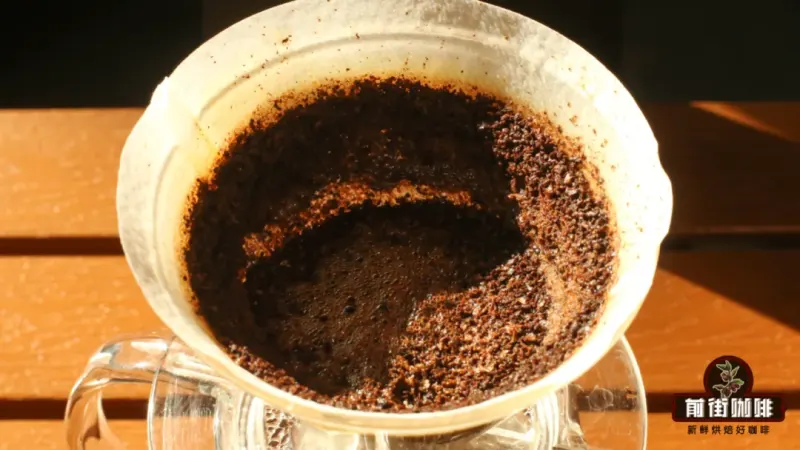
If, after brewing, the coffee bed appears bowl-shaped, with the wall of grounds remaining intact and its thickness fairly consistent throughout, this shows that the pouring was relatively proper and basically needs no special adjustment. But once the bed shows "abnormalities"—such as an uneven surface or an irregular wall—then the pouring technique is not yet standard enough and may need some correction. After all, improper pouring does not necessarily make the coffee taste bad, but it does carry the possibility of lowering coffee quality. The coffee bed in the image below is a typical example.
You can clearly see that although the wall of grounds in this bed has built up to a sufficient height, there is a fault line where the wall meets the bottom of the pit. The entire bed looks as if it has been sliced apart, divided into an upper and lower section.
This is a situation many friends often complain about to Front Street! Even if they brew and pour entirely according to the tutorial, the coffee bed that finally forms still shows this "cut in half" appearance. And the coffee they make also falls short—not undrinkable, but simply not up to the ideal standard.
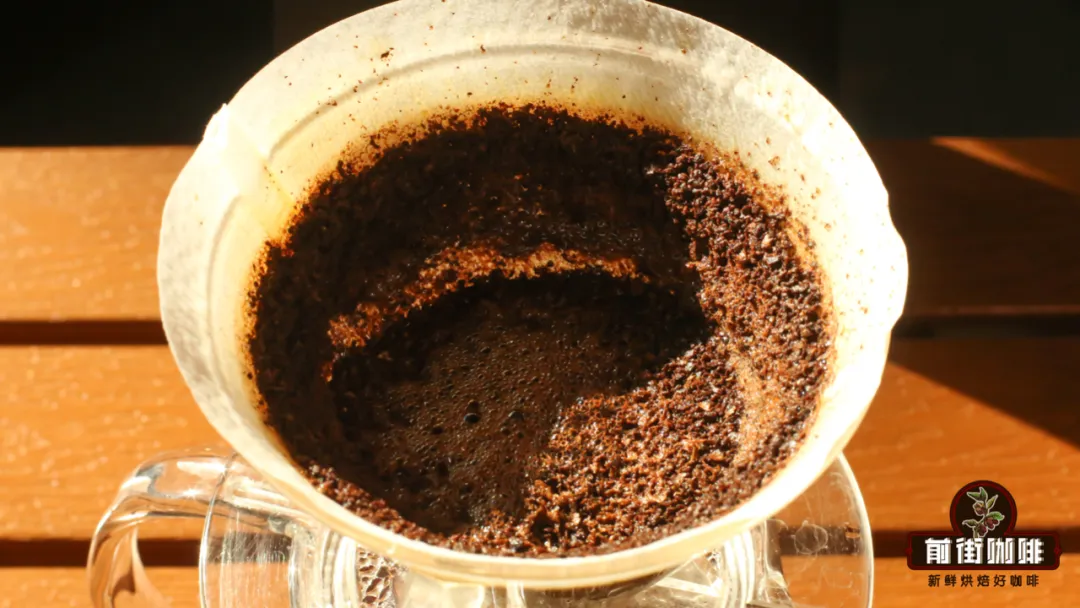
Generally speaking, this kind of fault occurs because hot water directly strikes the wall of grounds, and naturally no coffee grounds remain where it was hit. But this is exactly where many people get confused—clearly they did not pour water directly onto the wall of grounds, so why does this still happen?
Why does the coffee bed split in two after brewing?
This is a rather interesting phenomenon. In the previously published "Complete Guide to Pour-Over Coffee Beds" by Front Street, this shape of coffee bed wall was also included. There are two causes of this kind of bed wall, usually appearing in the final stage of multi-pour brewing. One is what was just mentioned: hot water poured directly onto the wall of grounds, washing the coffee grounds on the wall downward; the other is that the water stream has too strong penetration.
When the pouring position is too high, or the pouring flow rate is too large, the water stream gains very strong penetration. In this situation, even if you do not pour water onto the edge of the dripper, the water stream will, because its penetration is too strong, directly break through the wall of grounds hidden below the water surface, causing the coffee bed to be split cleanly in two.
The appearance of this kind of coffee bed causes both the extraction yield and the concentration of the coffee to drop (there is a probability, and it is not small) , because the portion of hot water that breaks through the wall of grounds flows directly into the server, forming bypass water. This not only reduces the extractable substances, but also directly dilutes the concentration of the already extracted coffee. So this kind of bed wall both indicates that the pouring method is not reasonable enough and means that coffee quality may be compromised as a result.

How can coffee bed faulting be avoided?
The adjustment methods are actually very simple; there are two options to choose from, and you can decide based on the brewing situation at hand. The first is to narrow the pouring range. In this way, even if the pouring force is somewhat strong, there is no need to worry about the wall of grounds being broken through, because the hot water strikes the thickest part of the coffee bed.
Take Front Street as an example. When using three-stage brewing, Front Street concentrates the hot water of the final stage in the center. You still need to pour in circles, but the circling range is only the size of a coin. Besides ensuring that hot water will not break through the wall of grounds to form bypass water, this also increases the extraction rate of the coffee grounds at the bottom, making extraction more even and the flavor expression more complete.
The other method is to reduce the intensity of the poured water stream. Since the wall of grounds is broken through because the water stream's penetration is too strong, then you only need to lower the water flow intensity. Front Street mentioned earlier that the penetration of the water stream is affected by pouring height and pouring speed—the higher the pouring position and the greater the water flow, the stronger the penetration force. Conversely, to reduce penetration force, you only need to lower the pouring height or reduce the water flow.

When brewing coffee, Front Street usually controls the water stream height at around 3~4 cm (about the height of one fist) , but this is not because coffee brewed at that height tastes the best, but because brewing at this height has the lowest probability of accidents—in other words, it is more reliable! This height can both ensure that the water stream provides enough agitation and avoid excessive penetration force that causes bypass water. It is relatively easy to master and very suitable for beginners.
Finally, Front Street wants to emphasize one more point: whether the coffee bed looks beautiful cannot directly prove whether the coffee tastes good ; it can only roughly reflect your pouring path during brewing. Therefore, everyone had better not judge the taste of the coffee solely by the appearance of the coffee bed. However, when we find that the brewed coffee does not taste as good as usual, the coffee bed can become another detail besides the parameters to help determine where the problem lies. So Front Street's suggestion is: drink the coffee first, and when the taste is not ideal, then combine the parameters and the appearance of the coffee bed to troubleshoot the cause~
- END -
The above content is compiled by CoffeeHunters, a coffee news website.


