







What Does a Coffee Ingredients List Really Contain?
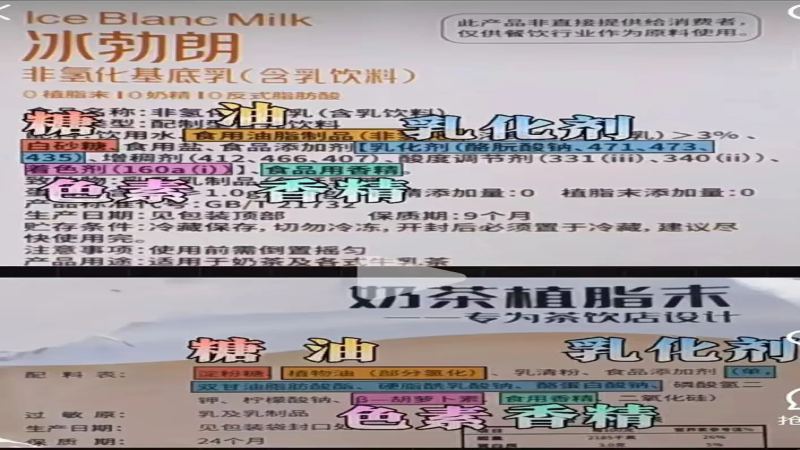
A review video claiming that Bingbolang, a bubble tea ingredient, resembles non-dairy creamer pushed Chagee into a public controversy. The video said Bingbolang contains no trans fatty acids but has a composition similar to creamer, with high sugar and fat content after dehydration. Zhejiang Shengmana Dairy, which supplies the ingredient, denied it is liquid non-dairy creamer and stated the product is compliant.
The episode matters because it shows how loosely the term creamer is used. Domestic non-dairy creamer production shifted to zero trans fatty acid formulas years ago, so composition overlap alone does not settle whether an ingredient is harmful. Reading any coffee ingredients list, or a bubble tea one, means checking fat, sugar, and additive details rather than relying on a single label claim.
Recently, a review video about the bubble tea ingredient "Bingbolang" sparked widespread discussion on social media. The video pointed out that although Bingbolang does not contain trans fatty acids, its composition is similar to non-dairy creamer, and after dehydration, its sugar and fat content are relatively high. This plunged Chagee, which promotes "0 non-dairy creamer, 0 creamer" as its selling point, into a public opinion storm, and consumers began to question the healthiness of its products. Industry insiders pointed out that Bingbolang and non-dairy creamer cannot be simply equated, and domestic non-dairy creamer had long since shifted to "0 trans fatty acid" production. Subsequently, Zhejiang Shengmana Dairy, a leading Bingbolang company, issued a statement denying the claim of "liquid non-dairy creamer" and emphasizing that its product is compliant. This article sorts out the ins and outs of the incident and presents the views of all parties to help coffee and bubble tea lovers view this controversy rationally.
▲
Click to follow | Daily specialty coffee culture magazine Coffee Workshop
Recently, a review blogger posted a review video on social media about "Bingbolang," a commonly used ingredient in the bubble tea industry, which quickly attracted a large number of netizens' attention and triggered heated discussion.
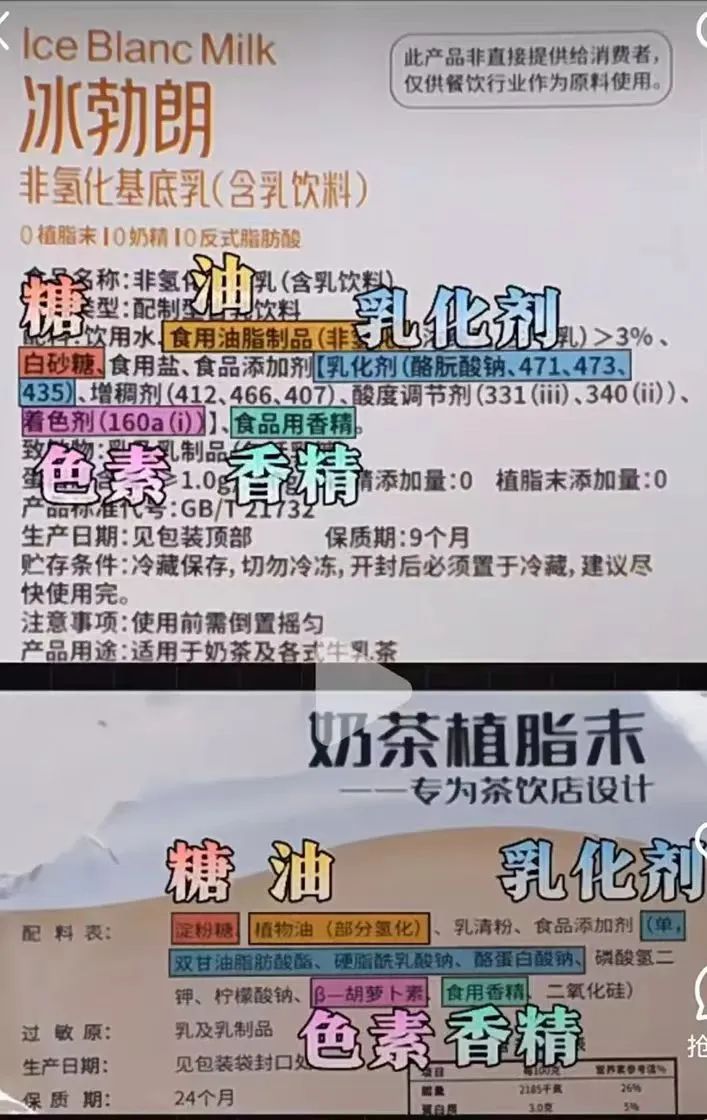
The video mentioned that although test results showed that "Bingbolang" indeed does not contain "trans fatty acids," its composition has similarities to "non-dairy creamer," commonly known as "creamer." After being sent for testing, it was also found that dehydrated Bingbolang has relatively high sugar and fat content, with its fat content even exceeding that of non-dairy creamer.
As soon as the video was released, the well-known Chagee was pushed to the forefront of public opinion because it uses Bingbolang. Many consumers were very shocked after learning about this. In their view, Chagee had previously always promoted its bubble tea as "healthier" and advertised "0 non-dairy creamer, 0 creamer, 0 hydrogenated vegetable oil," making it one of the representatives of healthy bubble tea in people's minds.
However, now that the brand has been exposed as using "Bingbolang," whose composition is similar to non-dairy creamer, fans cannot help but doubt the ingredients in Chagee's bubble tea and worry whether the drinks they previously consumed were all full of "technology and hard work."
In response to this situation, some industry insiders analyzed and pointed out that the reason consumers turn pale at the mention of "non-dairy creamer" is that non-dairy creamer contains trans fatty acids that can easily induce cardiovascular and cerebrovascular diseases. But the review video had already clearly pointed out that Bingbolang does not contain "trans fatty acids," which are not beneficial to human health.
On the other hand, although Bingbolang's composition is close to that of non-dairy creamer, Bingbolang cannot be approximately equated with or regarded as equivalent to non-dairy creamer. "Oranges and apples both contain vitamin C, but they are not the same kind of fruit." Professionals said that hastily drawing an equals sign between Bingbolang and non-dairy creamer is actually inappropriate.
In fact, as early as around 2017, China had already fully shifted to producing "0 trans fatty acid" non-dairy creamer, and the creamers used by most chain brands also generally do not contain trans fatty acids. Some brands have even directly abandoned non-dairy creamer and turned to fresh milk and base milk with higher-quality ingredients, thereby dispelling consumers' concerns.
However, to say that Bingbolang is a healthy and harmless additive is not necessarily how some netizens see it. From Bingbolang's ingredient list, this base milk contains fat, sugar, and other components, and excessive intake may cause weight gain and elevated blood sugar, which does not conform to the "low-calorie, low-fat, low-sugar" pursuit of today's young people. Therefore, they believe that if consumers are trying to reduce fat and sugar, perhaps the only option is to give up bubble tea.
As the Bingbolang incident continued to ferment, today Zhejiang Shengmana Dairy Co., Ltd., a leading Bingbolang company, issued a solemn statement on its official Weibo, formally responding to the matter.
The statement refuted some recent online remarks about Bingbolang, saying that the raw materials of Bingbolang and non-dairy creamer are essentially clearly different and that it is not the "liquid non-dairy creamer" circulating online. It also emphasized that Bingbolang does not contain harmful trans fatty acids and that its fat content is not high, making it a product that meets national standards certification.
In addition, the statement mentioned that although the review blogger has now deleted the relevant video, the spread of the video has already caused serious damage to the company's goodwill, greatly misled consumers, and caused unnecessary social and public panic. The brand will pay attention to subsequent public opinion and safeguard its legitimate rights and interests through legal means.
Image source: Internet
Disclaimer: Some images in this article are from the Internet. For some content on the website, such as images, we will respect the original author's copyright and indicate the source. However, due to the large quantity, some images and texts may not have been credited in time. Please forgive us. If the original author has any dispute, they may contact the website for handling. Once verified, we will correct it immediately. Compiled and edited by "Coffee Workshop." Please indicate the source when reprinting. If there is infringement, please inform us for deletion. Thank you~!
The above content is compiled by CoffeeHunters, a coffee news website.


