








Why Is the Coffee Industry Facing a Closure Wave?
The coffee industry absorbed a heavy shakeout over the past year. Roughly 53,000 new shops opened, but net growth reached only about 6,000, meaning more than 45,000 coffee shops closed. The closures spread across independent cafés and chains alike, from small neighborhood spots to larger brands adjusting their store layouts.
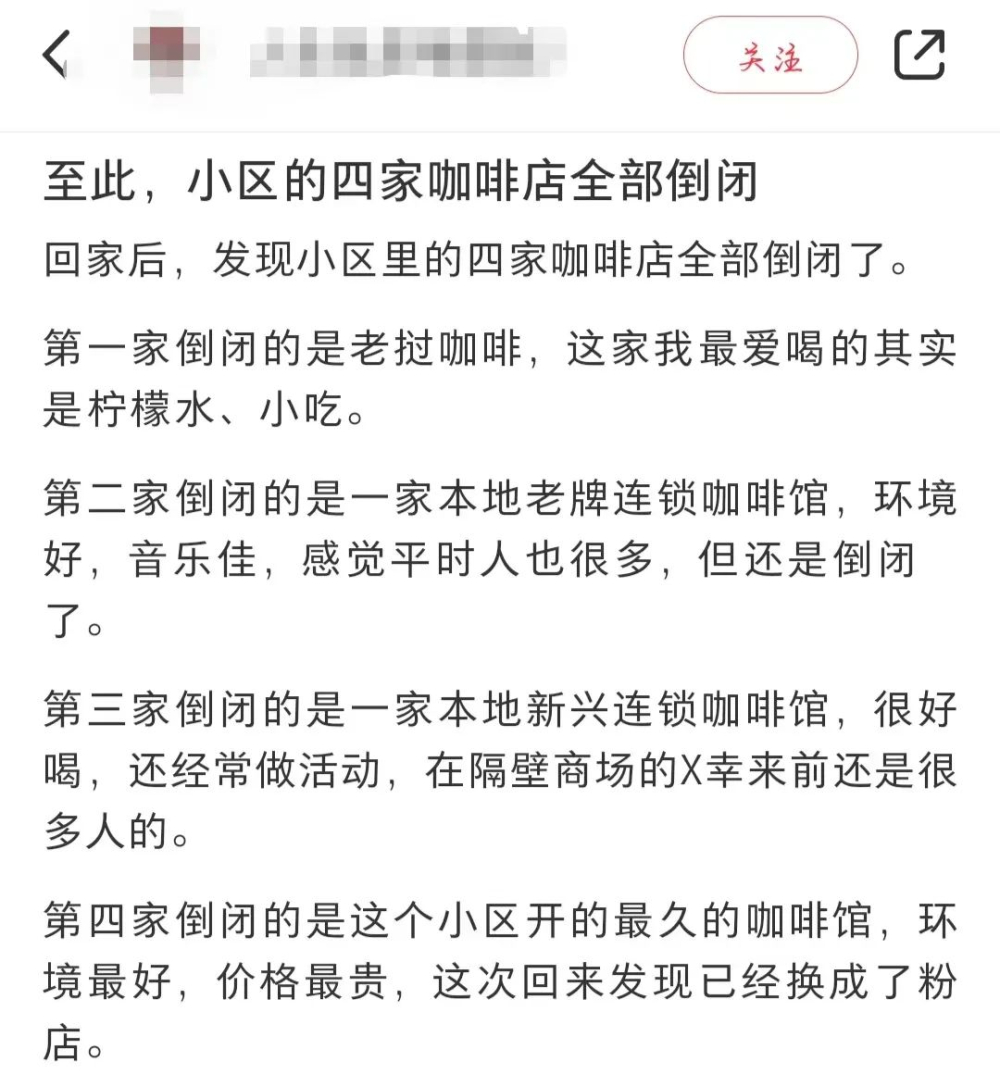
Two pressures drove the contraction. Coffee bean futures prices reached a record high, raising costs for every operator, while market saturation left too many shops chasing the same customers. One residential compound saw all four of its coffee shops shut and the premises sublet to other businesses, a pattern repeated in cities across the country.
Over the past year, the domestic coffee sector has undergone an unprecedented shakeout. Data from Zhaomen Canyan shows that nearly 53,000 new stores opened in the past year, but net growth was only just over 6,000, meaning more than 45,000 coffee shops have quietly exited the market. From the microcosm of all four cafés in one residential compound shutting down, to the sharp contraction of chains such as Benlai Budaiyou and Seesaw, to head brands like Starbucks and Manner adjusting their store layouts, the wave of closures has swept across operators of all sizes. At the same time, coffee bean futures prices hit a record high, and with cost pressures compounded by market saturation, many café owners find it hard to be optimistic about the outlook. This article sorts through industry data and typical cases to present this hard battle over the survival of coffee shops.
▲
Click to follow | Daily specialty coffee culture magazine Coffee Works
During the Spring Festival holiday that just passed, scenes of coffee professionals working nonstop could be seen everywhere on social media. Yet some observant users also noticed that a number of coffee shops had failed to make it through the winter and had silently pulled down their roller shutters.
A netizen from Guangxi recorded what he saw after returning to his hometown. According to his description, the residential compound where he lived originally had four coffee shops, including both independently run small cafés and outlets of local chain brands. Each had a different positioning: some focused on spacious and comfortable spaces, while others attracted neighbors with discounts and affordability.
But recently, these four shops posted closure notices one after another, and some of the premises had already been sublet and converted to other businesses. Faced with this scene, the netizen could not help but sigh: "At this point, all four coffee shops in the compound have gone bankrupt," while onlookers who saw the post also left comments expressing regret.
Coffee shops that can no longer hold on choosing to close down to cut losses is nothing new these days. However, looking back at the just-passed 2024, many netizens noticed that the density of cafés on the streets seemed lower than before, and many chain brands also cut a considerable number of stores over the past year.
Industry data provided by Zhaomen Canyan confirms this impression: the number of newly opened stores in the past year was about 53,000, but net growth was only just over 6,000. Converted, this means more than 45,000 coffee shops have exited this track. These figures also reveal that last year the pace of store openings in the coffee industry slowed while the number of closures climbed. At this rate, net growth figures will likely decline further.
It is worth noting that those caught up in the wave of closures are not only independent cafés with limited resources; chain brands are also struggling.
Benlai Budaiyou, known for its fruit coffee, saw a net decrease of 190 stores in 2024, effectively halving its scale; Seesaw became embroiled in economic disputes and withdrew from multiple cities, leaving it with only 56 stores. Older chain brands such as Costa, UBC Coffee, and Pacific Coffee also saw their store counts shrink by 65, 40, and 126 respectively.
As for brands such as Starbucks, Manner, and Mstand, last year they likewise closed some older stores or underperforming outlets out of considerations such as adjusting market layout and cutting operating costs.
As the domestic coffee market becomes increasingly saturated, leading brands have begun opening new stores in specific scenarios such as schools, hospitals, and transportation hubs to capture precise customer groups, while also extending their competitive reach from China to overseas markets.
Cotti Coffee last year set up operations in Qatar, Dubai, and other parts of the Middle East, while Luckin Coffee entered the Hong Kong and Southeast Asian markets late in the year. Other chain brands are also interested in opening overseas stores to raise brand awareness, but whether they can carve out a share from local coffee brands remains unknown.
Recently, coffee bean futures prices rose for 10 consecutive days, reaching $4 per pound and setting a historic record. For the already fiercely competitive coffee industry, this is like adding frost to snow. Operators have no choice but to start considering how to cope with the cost pressure brought by the surge in coffee bean prices.
On one side, leading brands are expanding everywhere and continuously squeezing the living space of small and medium-sized cafés; on the other side are operational difficulties brought by rising costs across raw materials, rent, and labor. Facing this hard battle over store survival, many café owners are not optimistic, admitting that they are just "doing the monk's job for a day and striking the bell for a day," and that when they truly can no longer hold on, they will pull the switch, lock the door, and withdraw from this increasingly difficult track.
Image source: internet screenshot
Disclaimer: Some images in this article are from the internet. For some content on the website, such as images, we will respect the original author's copyright and indicate the source. However, due to the large volume, there may be individual images or texts that have not yet been credited. Please forgive us. If the original author has any dispute, they may contact the website for handling. Once verified, we will correct it immediately. Compiled and edited by "Coffee Works." Please indicate the source when reprinting. If there is infringement, please inform us for deletion. Thank you~!
The above content is compiled by CoffeeHunters, a coffee news website.


