







What Is Happening With the Colombian Coffee Crop?
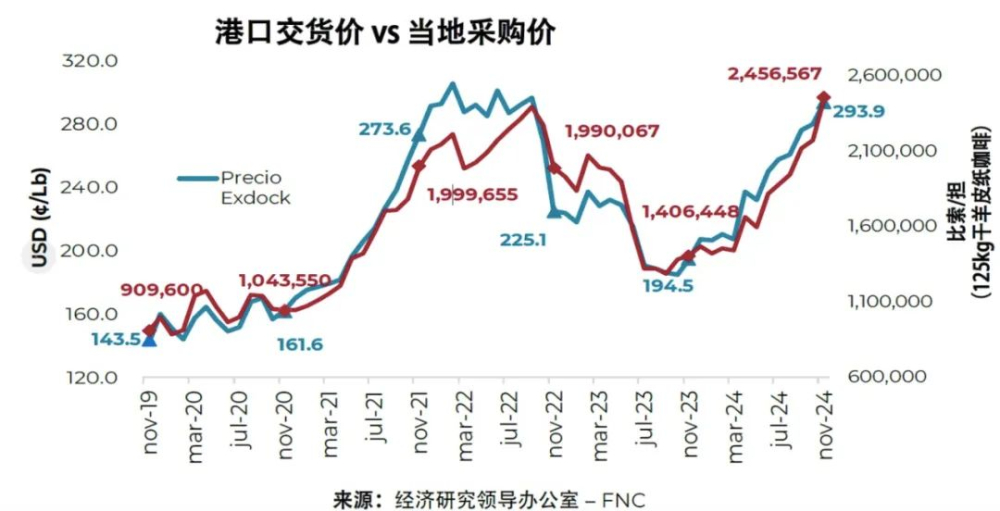
Colombia's average domestic coffee purchase price reached 2,456,567 pesos per carga (125 kg of dry parchment coffee), about US$557, in November, a 13% month-on-month rise and a new monthly closing record, according to the National Federation of Coffee Growers of Colombia. Year on year, the purchase price is up 74.7%, while the port delivery price has climbed 51.2%.
Production is recovering alongside prices. November output hit 1.76 million 60-kg bags, up 37% from a year earlier, the highest for that month in nearly 29 years, and October exports rose 14.4% to 1.039 million bags. Even so, coffee production faces cost pressure from fertilizer imports, Red Sea shipping detours and lower output in Brazil and Vietnam.
The latest report from the National Federation of Coffee Growers of Colombia shows that, driven by rising international futures prices, the country's average domestic coffee purchase price climbed 13% month-on-month, setting a new monthly historical closing record, while production and exports also showed recovery growth. However, the shipping detours, port congestion and container shortages triggered by the Red Sea crisis are bringing additional cost pressure to the export segment. In addition, dependence on fertilizer imports and geopolitical risks continue to push up cultivation costs, while the global supply gap caused by reduced production in Brazil and Vietnam is difficult for Colombia to fully fill in the short term, and coffee prices are expected to remain high.
The National Federation of Coffee Growers of Colombia (FNC) recently released a report stating that, boosted by the continued strength of international coffee futures prices, the country's average domestic coffee purchase price rose in tandem, reaching 2,456,567 pesos per carga (125 kg of dry parchment coffee) (about US$557), not only setting a new monthly historical closing high, but also marking a historic peak for November, with a month-on-month increase of 13%.
At the same time, the port delivery price rose 5% from the previous month. On an annual basis, compared with November 2023, Colombia's domestic coffee purchase price has risen by a cumulative 74.7%, while the port delivery price has climbed 51.2%.
While prices are rising, Colombia's coffee production is also gradually recovering. Over the past few years, the country's coffee industry has encountered multiple challenges, and production has consistently failed to reach ideal levels. In 2023, it was further hit by the alternating effects of El Niño and La Niña, causing production to continue shrinking. Entering this year, the situation has turned around, with weather conditions returning to normal, and combined with the earlier expansion of coffee planting area, production has recovered, and export volume has increased accordingly.
Report data show that in November Colombia's coffee production reached 1.76 million bags (60 kg each), up 37% from the same period last year, setting the highest production record for that month in nearly 29 years. The increase in production also drove export growth. According to the report, Colombia's final coffee exports in October were 1.039 million bags (60 kg each), up 14.4% year-on-year.
Although export volume has grown, reports indicate that multiple ports in Colombia are currently facing a series of problems, which are constraining coffee exports. Geopolitical conflicts and the Red Sea crisis have forced many shipping routes to detour, extending vessel voyages, leading to congestion at multiple ports and, in turn, container shortages.
The above situation has caused large quantities of coffee to be stranded at port terminals awaiting shipment, and many exporters are facing cost overruns and reduced efficiency due to additional storage, detention and pre-stacking fees. In addition, Colombian traders are also worried that after the new U.S. President Trump takes office in January next year, the country may face harsher trade policies toward the United States, and tariff measures may further push up import and export costs.
On the other hand, Colombia is a major fertilizer importer and needs to import large quantities of fertilizer every year. In recent years, the planting areas of corn, bananas and coffee in the country have all expanded in order to increase crop yields, but this has also pushed up fertilizer demand at the same time.
However, affected by geopolitical factors, Colombia's fertilizer import costs continue to climb. Coupled with the strong U.S. dollar, the Colombian peso has continued to depreciate, further intensifying import cost pressure. Although the Colombian government and agricultural associations are taking measures to reduce dependence on imported fertilizers, it is still difficult to completely resolve the shortage contradiction in the short term, causing many coffee farmers' cultivation costs to keep rising, which has also become one of the factors driving coffee prices higher.
At present, the international market remains optimistic about the outlook for Colombian coffee. Since the beginning of this year, both Brazil and Vietnam have suffered severe weather, with coffee production falling sharply; although Colombia also experienced a period of drought, it was affected to a limited extent and production has maintained an upward trend. However, Colombia's current coffee production is not yet enough to fill the supply gap left by reduced production in Brazil and Vietnam, so coffee prices are expected to remain high.
To learn more about coffee origin news and information, please scan the QR code to follow: Coffee Review
Long-press the QR code to follow:
TRANSLATE with
x
English
Arabic Hebrew Polish Bulgarian Hindi Portuguese Catalan Hmong Daw Romanian Chinese Simplified Hungarian Russian Chinese Traditional Indonesian Slovak Czech Italian Slovenian Danish Japanese Spanish Dutch Klingon Swedish English Korean Thai Estonian Latvian Turkish Finnish Lithuanian Ukrainian French Malay Urdu German Maltese Vietnamese Greek Norwegian Welsh Haitian Creole Persian
TRANSLATE with
COPY THE URL BELOW
Back
EMBED THE SNIPPET BELOW IN YOUR SITE Bing Webmaster Portal
Back
The above content is compiled by CoffeeHunters, a coffee news website.


