








Why Does a Starbucks in Ningbo Look Like an Old Street Coffee House?
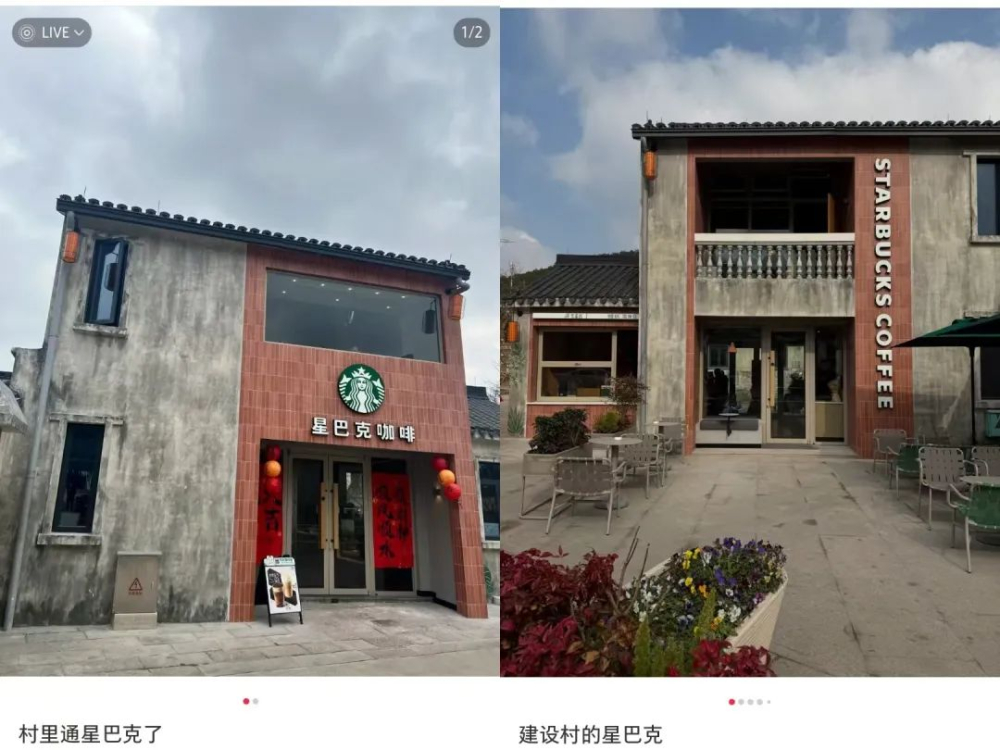
A new Starbucks in the Taolu Block of Dongqian Lake in Ningbo looks like a local old village house, not a standard chain storefront. The two-story building keeps its courtyard, balcony, concrete-and-red-tile facade, and original roof tiles. Red lanterns and couplets were added for Spring Festival, so the store reads as a village building that happens to serve coffee rather than a branded cafe.
The store reflects a wider push into lower-tier markets. Starbucks now covers more than 1,000 county-level areas in China, and some new county stores are more profitable than those in first-tier cities. Even a rural-looking site keeps the usual Frappuccino menu and mermaid logo, which is why the local coffee culture reaction mixes surprise with familiarity.
In recent years, Starbucks has continued to expand into county-level markets in China, with its stores now covering more than 1,000 county-level areas, and some new stores have even outperformed those in first-tier cities in terms of profitability. Recently, some internet users in Jiangsu and Zhejiang noticed that Starbucks has opened a store in the Taolu Block of Dongqian Lake in Ningbo that looks extremely like a local old village house, a two-story building with a courtyard and a balcony, with red lanterns and couplets hung on the storefront, full of village flavor. Is this store a real "village cafe," or a specially designed store in a scenic area? Let's take a look.
▲
Click to follow | Daily specialty coffee culture magazine Coffee Workshop
About a year ago, Starbucks began expanding its stores from core commercial districts in major cities to small county towns, and the brand gradually entered commercial districts and consumer streets across various places, with some stores even opening next to vegetable markets, not missing any good location.
So far, Starbucks has established a presence in more than 1,000 county-level markets across the country, and many newly opened stores are actually performing better in profitability than those in first-tier cities. Young people returning to their hometowns see the familiar storefront, the familiar Frappuccino, and the familiar mermaid logo, and cannot help joking: Starbucks is just short of opening in the village.
However, recently, many internet users in Jiangsu and Zhejiang noticed that after more than a year of penetrating lower-tier markets, Starbucks has really opened a store in a rural village.
From the photos shared by internet users, this new Starbucks store is a two-story building, with a courtyard on the first floor, a balcony on the second floor, and a small hut next to it specifically for picking up "Feikuai" orders. The overall exterior has not undergone much renovation, retaining a large amount of the original appearance of a small township building, half concrete wall and half red tile, and even the roof tiles have not been replaced, making it look like a typical old-style village house in Ningbo.
As the Spring Festival atmosphere grows stronger, Starbucks has also hung red lanterns and pasted couplets on the storefront, matching the moss-covered tiles on the eaves and blending naturally with the old houses beside it. In the lens of passersby without filters and without attention to composition, this Starbucks store's rural flavor is directly maxed out.
Seeing Starbucks' move into the village this time, internet users joined in the memes one after another: "Auntie, having latte in the field again at noon," "Who can refuse: a cup of latte on the way home after transplanting rice seedlings," "I'll bring you a copy of Karbuchi, that sweet one, big girl, do you like it?" "If we go order after herding the cattle, where do we put the cattle?" "After a day of farm work, went to the east end of the village and bought a matcha Frappuccino"... These comments instantly made the image of the village cafe much more concrete.
Another group of internet users from other places sighed that this village is too far ahead: "No wonder it's the free-shipping area," "As expected, villages in Zhejiang are rich," "Your countryside, my countryside, seem different," "Jiangsu, Zhejiang, and Shanghai are still too developed"... After all, at present, the only "village Starbucks" that can be found on the map is this one.
Although the exterior of this "village cafe" blends into the surrounding houses, in reality, Starbucks still fully renovated the interior space, with every corner from the bar to the customer area filled with a modern style. In other words, this "down-to-the-village store" has only been given a rural treatment on its shell, while the inside is no different from other stores.
It is understood that the "village store" opened by Starbucks this time is located in the Taolu Block of Dongqian Lake in Ningbo, situated in Jianshe Village on Taogong Island. Although the name contains "village," the store's location belongs to the core area of the Dongqian Lake Tourist Resort, focusing on the experience of villages and street markets, and therefore to a certain extent restores the appearance of the historical Taogongshan street market.
Since the store is in a scenic area, the customer group it faces is naturally out-of-town tourists, so this Starbucks cannot yet be regarded as a true "village cafe."
Image source: internet screenshot
Disclaimer: Some images in this article are from the internet. For some content on the website, such as images, we will respect the original author's copyright and indicate the source. However, due to the large quantity, there may be individual images and texts that have not yet been credited in time. Please understand. If the original author has any dispute, they may contact the website for handling. Once verified, we will correct it immediately. Compiled and edited by "Coffee Workshop." Please indicate the source when reposting. If there is infringement, please inform us for deletion. Thank you~!
The above content is compiled by CoffeeHunters, a coffee news website.


