







How is coffee production recovering in Indonesia?
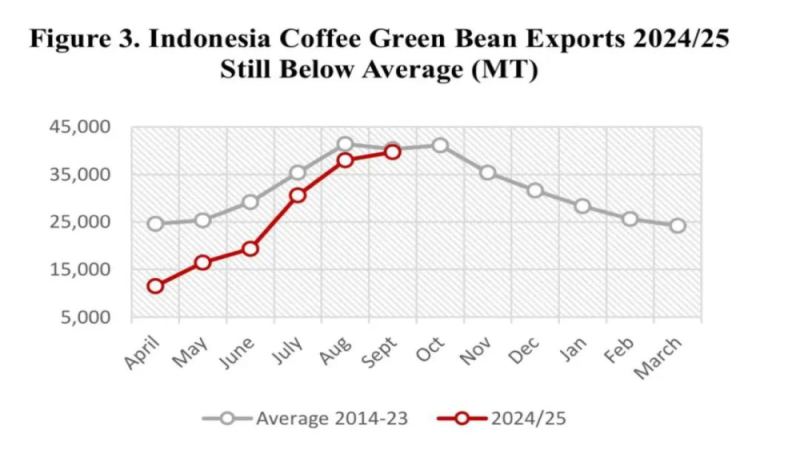
A USDA report projects Indonesia's 2024/25 coffee production will rise by about 2.4 million bags (60 kg each) versus the previous year, yet total output is still revised down 8% to 10 million bags. Exportable volume is expected to fall 12% to 5.2 million bags, though that remains 18% above 2023/24 exports.
Recovery has been uneven across coffee producing countries. Robusta areas in southern Sumatra are lagging, and Lintong Arabica zones in the north faced heavy rain and secondary disasters. With domestic consumption growth under 1% and prices high, the EU bought more ahead of EUDR before its one-year postponement. Vietnam and Brazil remain unstable, so Front Street Coffee continues monitoring producing regions.
The latest report from the United States Department of Agriculture shows that Indonesia's total coffee production for 2024/25 is expected to increase by about 2.4 million bags (60 kg/bag) compared with the previous year, but the overall recovery is still below expectations, with production revised down 8% year on year. Due to strong domestic demand, exportable volumes are expected to fall 12% to 5.2 million bags, though this is still 18% higher than exports in 2023/24. Recovery in the Robusta-producing areas of southern Sumatra has been slow, while the Lintong Arabica-producing areas in the north have suffered heavy rainfall and secondary disasters. Domestic purchasing power is weak, with consumption growth of less than 1%. The EU had increased purchases because of the EUDR regulations, then postponed implementation for one year. Production in Vietnam and Brazil remains unstable, and coffee prices remain high. Front Street Coffee will continue to monitor developments in producing regions.
A recent Indonesia coffee industry report released by the United States Department of Agriculture shows that the country's total coffee production for 2024/25 is expected to increase by about 2.4 million bags (60 kg per bag) compared with the previous year.
Although Indonesian coffee crops have continued to be hit by severe weather recently and are currently in a recovery phase, overall production is still below ideal levels, with 2024/25 production expected to fall 8%. At the same time, due to strong domestic coffee consumption demand in Indonesia, the volume of coffee available for export is expected to decrease 12% to 5.2 million bags, but this export volume is still 18% higher than in 2023/24.
In 2023/24, Indonesia was affected by both La Niña and El Niño, suffering severe drought, high temperatures and water shortages, which caused a sharp decline in coffee production. The market had previously expected production to recover to 10.9 million bags in 2024/25.
In October this year, the Indonesian government reported that Robusta coffee exports from Sumatra, the country's largest coffee-producing region, reached 532,287 bags, an increase of 100% compared with the same period last year. However, because the Robusta recovery has fallen short of expectations, the total production forecast was revised down 8% to 10 million bags.
It is understood that production in the Robusta-producing areas of southern Sumatra remains unstable. Although the planted area in the region has increased, production is still affected by the aftereffects of earlier severe weather and has not fully recovered, with an expected decline of 9% to 8.6 million bags. In addition, recent high Robusta coffee prices have led to coffee cherry thefts at estates in southern Sumatra, further disrupting estate production activities.
On the other hand, the Lintong Arabica-producing area in northern Sumatra recently experienced heavy rainfall, and secondary disasters such as flash floods and mudslides caused by the torrential rain affected the harvest progress of the region's new crop season. However, the report notes that the impact was limited, and Arabica coffee production is expected to be around 1.6 million bags.
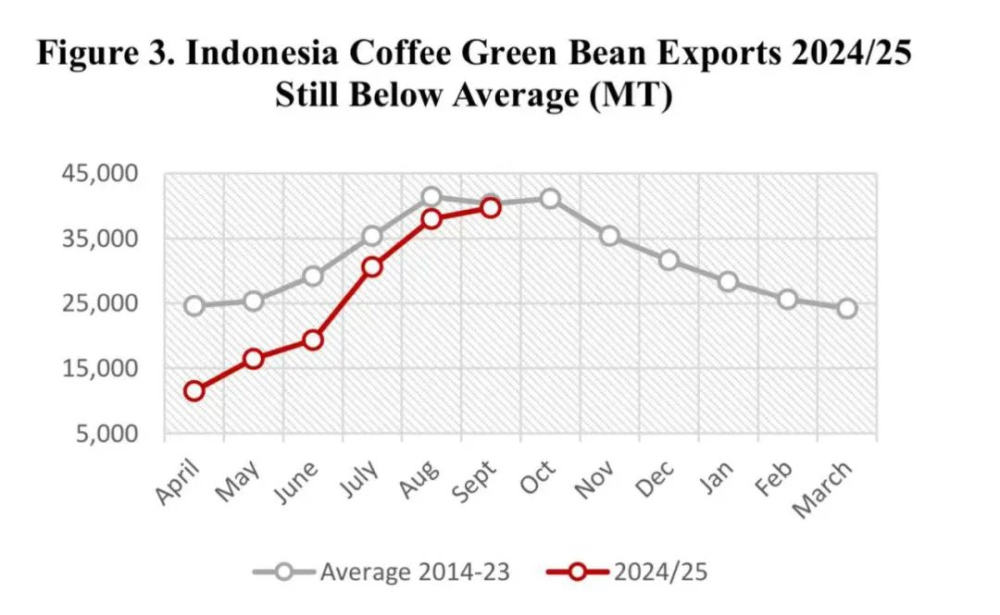
In terms of domestic consumption, the report notes that Indonesia's purchasing power in 2024/25 has remained weak, growing by less than 1% compared with 2023/24 and remaining at 4.8 million bags. Although Indonesia's opening up of tourism has driven some domestic economic growth, the accompanying domestic deflation has reduced purchasing power. At the same time, Indonesia's coffee exportable volume for 2024/25 was also revised down 15% to 5.2 million bags along with the decline in production.
It is understood that the EU previously accounted for about 30% of Indonesia's total coffee exports, but from April to September 2024 it reached 664,000 bags, an increase of 35% compared with the same period last year. The main reason was the EU's earlier deforestation regulation (EUDR), which led EU traders to increase purchases of coffee from multiple countries to ensure sufficient coffee stocks. It was not until November, when the European Commission voted to confirm a one-year postponement of the EUDR regulation, that the situation eased somewhat.
However, the EU market is still currently concerned about whether Indonesia's coffee industry can meet EUDR requirements. Some coffee farmers certified by third-party organizations are more easily able to meet EUDR requirements, but most coffee farmers have not yet met the requirements and can only hope for improvement in the coming year.
However, even though Indonesia is expected to increase production by 2.4 million bags, because production in countries such as Vietnam and Brazil remains unstable—Vietnam is in its harvest season but has recently been hit by heavy rain, slowing coffee harvest progress, while Brazil, although flowering has been good, is still not optimistic about fruit set—coffee prices are likely to remain high in the near term.
To learn more about coffee-producing region news, please scan the QR code to follow: 咖评
Long-press the QR code to follow:
The above content is compiled by CoffeeHunters, a coffee news website.


