







Why Are Coffee Production and Prices Under Pressure?
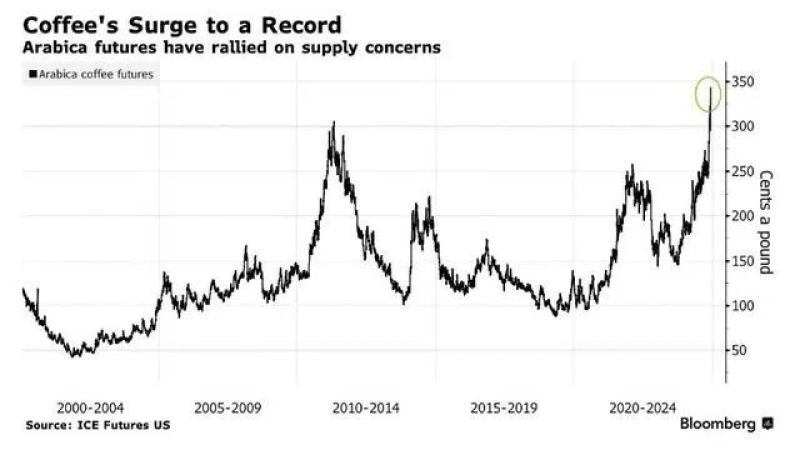
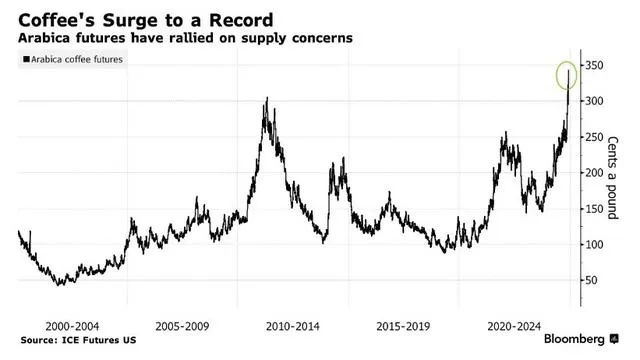
New York Arabica coffee futures broke through $3.43 per pound, a record since the benchmark began in 1970, after Brazil's worst drought in nearly 70 years and adverse weather in Central America. US C coffee futures closed at 334.03 cents per pound on December 10. Trader Volcafe cut its Brazil forecast and predicts a fifth straight year of global supply deficit.
Brazil's drought withered coffee tree flower buds before they could set fruit, and fires burned more than 22.38 million hectares of forestland from January to September, hitting plantations. The outlook for robusta coffee beans in Vietnam is also weak. Tight inventories, geopolitics, and rising shipping costs are expected to keep prices high, with the cost passed to consumers.
The global coffee market is facing severe supply challenges. Affected by Brazil's worst drought in nearly 70 years and adverse weather in Central America, New York Arabica coffee futures prices have soared, breaking through $3.43 per pound and hitting a historic high since records began in 1970. At the same time, the outlook for Vietnam's Robusta coffee production is also not optimistic. Major trader Volcafe has sharply lowered its forecast for Brazil's production and predicts a fifth consecutive year of global coffee supply deficit. Driven by multiple factors including tight inventories, geopolitics, and rising shipping costs, coffee prices are expected to remain high, with the ultimate cost pressure passed on to consumers.
According to media reports, although Robusta coffee futures have retreated recently, market concerns about a global coffee supply shortage continue to intensify, pushing coffee futures prices to a record high. On December 10, the closing price of U.S. C coffee futures, the industry benchmark for coffee bean prices, reached 334.03 cents per pound.
Since the beginning of this year, crop production in major coffee-growing countries has been severely hit. New York Arabica coffee futures prices have risen by more than 4%, breaking through the highest level since the statistical benchmark began in 1970 and setting a historic high of $3.43 per pound, with a cumulative increase of 80% during the year.
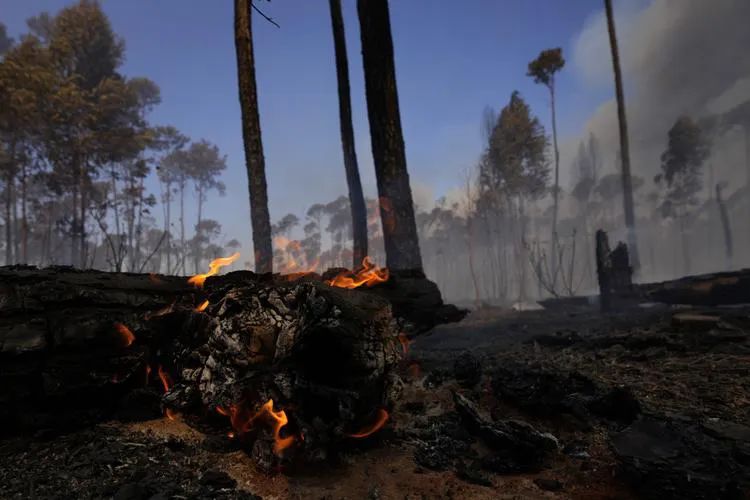
The main reason for this situation is that Brazil has suffered its worst drought in nearly 70 years. Severe water shortages in several major coffee-growing areas have caused coffee tree flower buds to wither prematurely, significantly affecting production. At the same time, fires have occurred frequently in many South American countries under drought and high temperatures, with Brazil particularly hard hit. From January to September this year alone, more than 22.38 million hectares of forestland in Brazil were burned by fires, with many coffee plantations and sugarcane plantations severely affected.
Even though rainfall recovered somewhat after the rainy season began in October, it is still difficult to make up for the damage caused by drought to Brazil's coffee plantations, and the rainfall situation has not been stable, which has increasingly intensified market concerns about future coffee supply. In addition, Central America has been hit by tropical storms, bringing heavy rain, floods, and landslides that damaged local roads, power facilities, and other infrastructure, while coffee-growing areas experienced leaf drop and fruit drop, further affecting coffee supply.
As one of the world's largest traders of Arabica and Robusta coffee, Volcafe provides coffee beans for 80 billion cups of coffee each year. In response to the current situation, Volcafe recently lowered its forecast for Brazil's Arabica coffee production to 34.4 million bags (60 kg/bag), a reduction of 11 million bags from its September estimate.
At the same time, the market is also concerned about Vietnam's Robusta coffee production. According to a recent Vietnam industry forecast released by the U.S. Department of Agriculture, due to drought during the key growth period for coffee cultivation and heavy rain at the beginning of the harvest, coffee production is expected to be 27.5 million bags in 2023/24 and fall to 20.1 million bags in 2024/25, both lower than the June forecast values.
Although some coffee-producing countries have recently reported increased output, the market believes this cannot make up for the production shortfalls in countries such as Brazil and Vietnam. Volcafe also predicts that global coffee production will face a shortage of 8.5 million bags in 2025/2026 and believes this will be an unprecedented fifth consecutive year of deficit.
In addition, poor coffee harvests in many countries, combined with growth in the global coffee consumption market, have led to a reduction in global coffee inventories. Factors such as geopolitics, rising shipping costs, and short-squeeze speculation in some commodity trading have also jointly pushed coffee prices higher.
A research assistant at Sucden Financial said that the coffee futures market is currently in a very strong fundamental phase, and coffee prices are expected to remain at a relatively high level. This will further raise costs for traders and importers, ultimately passing them on to consumers.
To learn more about coffee origin news and information, please scan the QR code to follow: Coffee Review
Long-press the QR code to follow:
The above content is compiled by CoffeeHunters, a coffee news website.


