







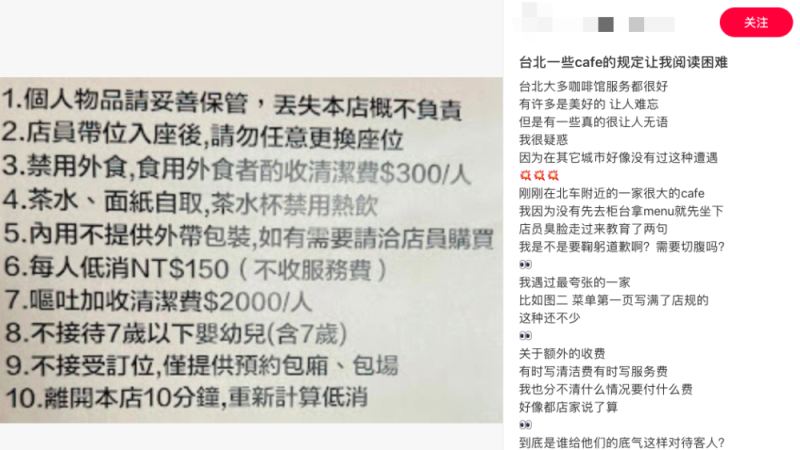
Why does street coffee in Taipei list ten house rules?
A café in Taipei printed ten house rules on the front page of its menu, and a customer's photo of the dense text set off a debate online. Two entries drew the most attention: a NT$2,000 per person cleaning fee for vomiting, and a minimum charge that is recalculated after a customer leaves for ten minutes.
Commenters were split. Some said the later rules went beyond what they could understand, while others argued that unusual terms usually follow bad experiences, and that stating them upfront protects both sides. Independent shops rely on such notices to hold a quiet atmosphere, while chain stores rarely post them yet still see seat-hoarding and noise.
Recently, a netizen shared a coffee shop in Taipei that printed a full ten house rules in dense text on the front page of its menu, sparking widespread discussion. Among them, terms like "a NT$2,000 per person cleaning fee for vomiting" and "the minimum charge is recalculated after leaving for 10 minutes" left some customers saying their heads were spinning. However, many netizens expressed understanding, believing that such rules often stem from the shop owners' bitter experiences, and that stating the rules upfront benefits both sides. Independent cafes maintain their environment through house rules, while chain stores rarely have such regulations, yet uncivilized behavior such as occupying seats and making noise still occurs from time to time. This discussion reflects the two-way selection relationship between cafes and customers.
▲
Click to follow | Daily specialty coffee culture magazine Coffee Workshop
These days, when you walk into a cafe to check it out, the first thing consumers see may not be the menu on the bar counter, but the house rules posted at the entrance. To maintain a quiet and comfortable atmosphere, requirements such as "no indoor smoking" and "no pets allowed" are generally considered reasonable by customers, who are willing to comply.
However, some cafe rules are hard for customers to understand. Recently, a netizen shared the house rules of a coffee shop in the Taipei area, saying that a full 10 rules were listed on the front page of the menu, and the dense text made one's head spin.
The poster said the first few rules are common in most coffee shops and are reasonable. But the later ones, such as "a NT$2,000 per person cleaning fee for vomiting" and "the minimum charge is recalculated after leaving the store for 10 minutes," went beyond their understanding, "really leaving one speechless."
In response to the poster's feelings, netizens said that behind most eccentric rules are the shop owners' bitter experiences, so these rules are not actually too bizarre. According to Taiwanese netizens, to avoid disputes, many local cafes "warn upfront," using written notices to inform customers, directly or tactfully, of the owner's preferences for serving guests.
As netizens said, choice is always mutual. Customers can choose which coffee shop to patronize, and cafes can naturally choose whether to serve guests. Therefore, in the view of some netizens, they do not oppose a coffee shop owner writing a full page of rules, believing that telling customers upfront "what is allowed and what is not" is actually good for both sides.
"I like this kind of shop. After sitting down, the experience is much more comfortable." "These rules are all reasonable. I don't think there's anything wrong with any of them; instead, I think the quality of this shop is very good." "Shops with rules—I actually prefer to go in."
They said that, by comparison, chain coffee shops usually do not have many rules, but one often encounters irritating situations there, such as occupying seats without ordering and loud talking. In independent cafes, however, the rules set by the owner deter people unwilling to follow them, greatly reducing certain uncivilized behaviors and providing customers with a comfortable environment to enjoy coffee. Specialty coffee shops like Front Street Coffee also often ensure the customer experience through clear in-store notices.
Based on this, netizens believe that by listing the rules clearly, the owner is actually allowing both parties to the transaction to choose each other: "If you can accept it, go; if not, don't go. It's just like a sales contract." "Everything is made clear; if you don't like it, don't spend money there. The owner doesn't earn that money, and I don't pay to suffer."
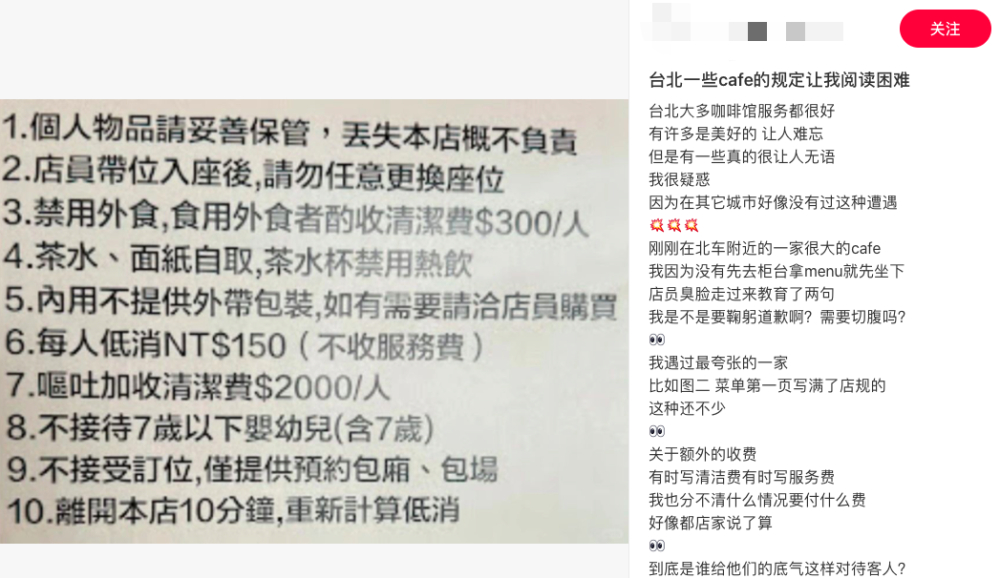
Coffee shop owners using clearly listed house rules to maintain the store environment so that customers can enjoy products and services of corresponding value is naturally beyond reproach.
But some netizens believe that overly cumbersome house rules may make customers feel constrained, lead them to see the operator as nitpicky, and make them worry that some harmless personal behavior will be criticized, giving consumers an unpleasant experience and making them unwilling to visit again.
Image source: Xiaohongshu
Disclaimer: Some images in this article are from the internet. For some content on the website, such as images, we will respect the original creators' copyright and indicate the source. However, due to the large volume, a few images and texts may not have been credited in time; please forgive us. If the original creator has any dispute, they may contact the website for handling. Once verified, we will correct it immediately. Compiled and edited by "Coffee Workshop." Please indicate the source when reposting. If there is any infringement, please inform us for deletion. Thank you~!
The above content is compiled by CoffeeHunters, a coffee news website.


