







Editor Coffee Best: How Hacienda La Esmeralda Geisha Labels Differ
Hacienda La Esmeralda grades its Geisha lots by plot, altitude and cupping score, then sells them under Red Label, Green Label and Black Label. The former Blue Label, known as Geisha 1500, has faded from the lineup in recent years, which is why buyers no longer see it listed. The estate's four farms split into small plots, and each label reflects where the coffee grew and how it scored.
Red Label, or Esmeralda Special, comes from selected Geisha plots and requires a cupping score of about 91 points or higher. Green Label draws from broader estate lots and typically scores lower, while Black Label and Diamond Mountain represent separate plot and altitude tiers. The Blue Label was tied to a specific production level that the estate eventually folded into its current structure.
Panama's Hacienda La Esmeralda, with its unique vision, discovered the potential of the Geisha variety and propelled it to fame through the Best of Panama (BOP) competition. Since then, the Geisha produced by Hacienda La Esmeralda has remained a hot topic in coffee circles, with terms like Red Label, Green Label, and Blue Label (Geisha 1500) appearing frequently. However, in recent years, "Geisha 1500" has gradually faded from view—why did it disappear? How many grading systems does Hacienda La Esmeralda currently have? This article will start with the layout of the estates under Hacienda La Esmeralda, systematically outline the grading logic and traceability rules of brands such as Red Label, Green Label, Black Label, and Diamond Mountain, and explain the ins and outs of the discontinuation of Blue Label Geisha, helping coffee enthusiasts clarify the full picture of Hacienda La Esmeralda's Geisha product line.
The reason Geisha enjoys its current reputation is partly due to the variety's excellent genes, and partly due to the unique vision of Panama's Hacienda La Esmeralda—they were the first to uncover Geisha's potential and brought it to prominence by participating in the Best of Panama (BOP) competition. Since then, Geisha from Hacienda La Esmeralda has consistently drawn the attention of coffee enthusiasts, with terms like "Red Label," "Green Label," and "Geisha 1500" frequently mentioned. But in the past two years, "Geisha 1500" has rarely appeared in discussions. So what exactly is this vanished "Geisha 1500"?
Hacienda La Esmeralda has four coffee-growing estates, among which Jaramillo, Cañas Verdes, and El Velo all cultivate the Geisha variety, and each estate is further divided into different small plots. There is also Palmira farm at the lowest altitude, mainly planted with Catuai, with a total planting area of about 30 hectares; this is also where Hacienda La Esmeralda's offices and the processing plant for all green beans are located.
For the coffee it grows, Hacienda La Esmeralda employs an exclusive and relatively mature grading system, and launches different brands accordingly. Currently, Front Street Coffee sells Red Label Geisha, Green Label Geisha, and Diamond Mountain.
Red Label Geisha (Esmeralda Special) Also known as Esmeralda Special, it is a Geisha carefully selected by Hacienda La Esmeralda, requiring a cupping score of 91 points or above. Red Label Geisha mainly comes from plots at altitudes of 1,600–1,800 meters in the Cañas Verdes and Jaramillo estates. Since each estate is independently divided into several different small plots, and Geisha grown in different plots has subtle differences in flavor, each batch of Red Label Geisha comes from a single independent plot and has very detailed traceability information.
In addition, Hacienda La Esmeralda's auction batches (Esmeralda Auction) are batches carefully selected from the Red Label, offered to global buyers for bidding through auctions. This year, Hacienda La Esmeralda also launched a "Black Label" batch, which consists of some experimental batches, special processing method batches, or batches grown in extremely high-altitude plots within the Red Label; the price is higher than Red Label, and the standard color is black.
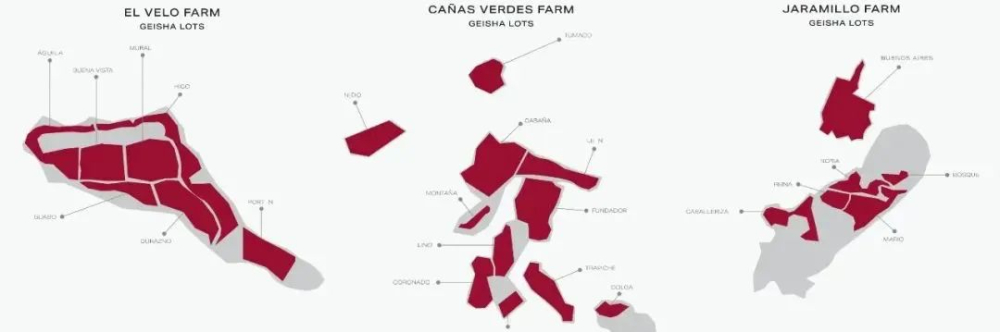
Green Label Geisha (Private Collection) is also known as Private Collection. It also comes from Esmeralda's three sub-estates, with growing altitudes of 1,600–1,800 meters, but Green Label Geisha comes from blended harvests of plots across the three estates, and can only be traced to the estate, not to specific small plots like Red Label.
Besides Red Label and Green Label, there was once a "Geisha 1500" (Geisha 1500). This Geisha was labeled in blue, hence commonly known as Blue Label Geisha. It was relatively inexpensive and was Hacienda La Esmeralda's most cost-effective Geisha. Blue Label Geisha came from growing plots at around 1,500 meters altitude in the three sub-estates, hence the name Geisha 1500. But in 2021, Hacienda La Esmeralda stopped releasing Blue Label Geisha, so fewer and fewer people mentioned Blue Label or Geisha 1500 afterward.
For commercial viability, Hacienda La Esmeralda's El Velo sub-estate, in addition to growing the Geisha variety, also cultivates many different coffee varieties, including SL34, Pacamara, Laurina, etc. For this reason, Hacienda La Esmeralda also launched the Varietals collection brand.

In addition, there is another traditional brand, Diamond Mountain, mainly from Jaramillo and Cañas Verdes among the four sub-estates under Hacienda La Esmeralda, growing the Catuai variety at altitudes of 1,400–1,600 meters.
To learn more about coffee origin news and information, please scan the QR code to follow: Coffee Review
Long-press the QR code to follow:
TRANSLATE with
x
English
Arabic Hebrew Polish Bulgarian Hindi Portuguese Catalan Hmong Daw Romanian Chinese Simplified Hungarian Russian Chinese Traditional Indonesian Slovak Czech Italian Slovenian Danish Japanese Spanish Dutch Klingon Swedish English Korean Thai Estonian Latvian Turkish Finnish Lithuanian Ukrainian French Malay Urdu German Maltese Vietnamese Greek Norwegian Welsh Haitian Creole Persian
TRANSLATE with
COPY THE URL BELOW
Back
EMBED THE SNIPPET BELOW IN YOUR SITE Bing Webmaster Portal
Back
The above content is compiled by CoffeeHunters, a coffee news website.


