








What a 2% Foreign Exchange Spread Means for Coffee Exporters
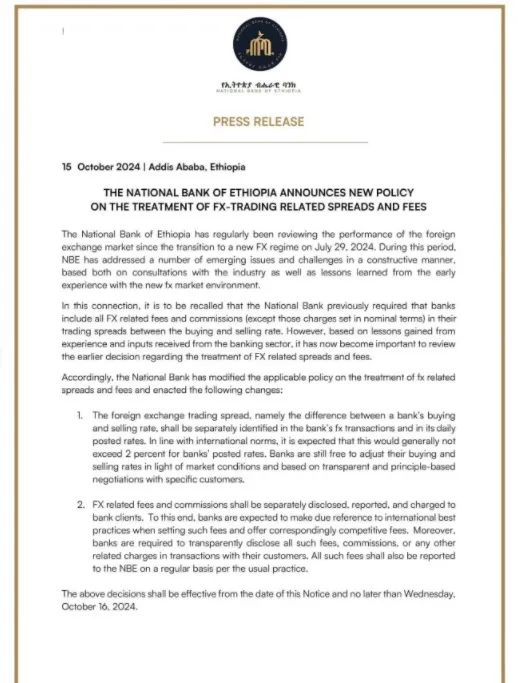
Ethiopia's National Bank issued rules on October 15 capping the spread between foreign exchange buying and selling rates at 2 percent, effective October 16. Banks must also disclose all fees and commissions transparently. The move follows the country's July shift to a market-based exchange rate, when the birr fell sharply and spreads exceeded 10 birr.
Tighter spreads should cut exchange losses for exporters, and coffee is one of Ethiopia's main export commodities, so the coffee industry stands to gain. Challenges remain, including conflict in the Amhara region, the Red Sea blockade and port disputes with neighboring Somalia. Ethiopia is a key coffee beans origin country, and its export flow affects global arabica supply.
The National Bank of Ethiopia issued new regulations on October 15, capping the spread between the buying and selling rates for foreign exchange transactions at 2%, effective the following day. This is another significant adjustment following the country's shift to a market-based exchange rate system in July of this year. Previously, the birr depreciated sharply, with the bid-ask spread once exceeding 10 birr, placing heavy pressure on exporting enterprises. The new policy requires banks to transparently disclose all fees, which is expected to reduce exchange losses for exporters and benefit major export commodities such as coffee. However, Ethiopia still faces multiple challenges, including the conflict in Amhara region, the Red Sea blockade, and port disputes with neighboring Somalia.
According to local Ethiopian media reports, the country's National Bank (NBE) issued a new foreign exchange management policy on October 15, stipulating that the spread between the buying and selling rates for foreign exchange transactions must not exceed 2%. The regulation officially took effect on October 16, 2024, against the backdrop of a review of the foreign exchange market by regulators after the country adopted a entirely new foreign exchange system in July of this year.
The National Bank of Ethiopia explicitly stated that the spread on foreign exchange transactions should be constrained, and publicly announced exchange rates generally should not exceed the 2% fluctuation cap. At the same time, banks may still retain flexibility to adjust rates based on actual market conditions and on the basis of transparent, principled negotiations with specific clients. In addition to limiting the spread, the National Bank also requires banks to transparently disclose to customers all fees, commissions, or other charges, and these fees must be reported to the National Bank in accordance with current regulations.
It is understood that Ethiopia announced its transition to a market-based foreign exchange system at the end of July this year, a key component of a package of reform measures aimed at correcting long-standing economic distortions, with the goal of narrowing the gap between the official exchange rate and the parallel market (black market) rate and replacing the previous exchange rate mechanism with a more flexible arrangement.

However, after the new system was introduced, the Ethiopian birr exchange rate fell sharply. Before the new policy was issued, the birr exchange rate at commercial banks was approximately 57 birr to 1 US dollar, with a bid-ask spread of less than 1 birr. By October 12, the average selling rate had soared to 125 birr to 1 US dollar, with a spread exceeding 10 birr. After the National Bank issued the new policy on October 15, Ethiopian commercial banks quickly adjusted their quotes, with the buying rate dropping to 113 birr and the selling rate dropping to 115 birr, narrowing the spread from 11.23 birr to 2.26 birr.
It is understood that before the new policy was introduced, the bid-ask spread in Ethiopia's foreign exchange market exceeded 10 birr, and this wide spread had a significant impact on the country's exports. Taking October 14 as an example, most Ethiopian banks had a buying rate of approximately 112 birr and a selling rate of approximately 123 birr for 1 US dollar. This meant that local exporters and enterprises had to exchange US dollars at the higher selling rate of 123 birr when paying for goods transportation, while when they received export payments, banks settled at the lower buying rate of 112 birr.
High transportation costs and low settlement prices severely eroded these enterprises' profits and dragged down their overall business operations, with some exporters potentially forced to raise commodity prices to make up for losses. Previously, the minimum selling price across the board for coffee beans, Ethiopia's main export product, was raised by 2% for this reason.
However, the new policy is a positive signal for Ethiopian exporters. Limiting the foreign exchange bid-ask spread to within 2% helps prevent banks from using excessively wide spreads to extract unreasonable profits, thereby protecting the legitimate rights and interests of trading parties. At the same time, requiring banks to separately disclose relevant fees and commissions to customers also enhances transaction transparency.
As for Ethiopia's current coffee industry, affected by previous policies, exchange rate fluctuations, and the parallel market (black market), coffee cultivation costs and living costs have continued to climb, and exporters can only maintain income by raising prices. The new policy not only benefits the export of coffee and other commodities but can also reduce the cost of imported goods, thereby increasing income.
However, Ethiopia is currently still beset by internal and external troubles. In the north-central Amhara region, large-scale conflict broke out recently, and exchanges of fire between government forces and Fano armed forces are still ongoing, with even weapons of mass destruction being used, severely affecting the regional economy and people's livelihoods. In addition, in early October, the Houthi armed group announced it would continue to take more military actions and maintain its blockade of the Red Sea, which also continuously disrupts Ethiopia's import and export operations. Meanwhile, relations with neighboring Somalia have not yet eased, and the port issue remains one of the key topics the country urgently needs to resolve.
To learn more about coffee origin news and information, please scan the QR code to follow: Coffee Review
Long-press the QR code to follow:
TRANSLATE with
x
English
Arabic Hebrew Polish Bulgarian Hindi Portuguese Catalan Hmong Daw Romanian Chinese Simplified Hungarian Russian Chinese Traditional Indonesian Slovak Czech Italian Slovenian Danish Japanese Spanish Dutch Klingon Swedish English Korean Thai Estonian Latvian Turkish Finnish Lithuanian Ukrainian French Malay Urdu German Maltese Vietnamese Greek Norwegian Welsh Haitian Creole Persian
TRANSLATE with
COPY THE URL BELOW
Back
EMBED THE SNIPPET BELOW IN YOUR SITE Bing Webmaster Portal
Back
The above content is compiled by CoffeeHunters, a coffee news website.


