








What Do These Pacific Coffee Store Closures Mean for the Chain?
Pacific Coffee will close several Zhuhai stores in mid-October as part of an operational adjustment, including Huafa Waterfront Store, Haitian Station Store and City Balcony Store, all along Lovers' Road. After this round, the brand's directly operated stores in Zhuhai are fully withdrawn, leaving only three franchise stores.
The chain once peaked at nearly 500 stores in China but now operates far fewer. Narrow Door Restaurant Eye data showed 203 operating stores as of October 7, after deducting 104 in Hong Kong. Some coffee enthusiasts reacted with shock that a brand once firmly second in the Chinese market had shrunk so far, while others worry about its prospects.
Pacific Coffee has once again become the focus of industry attention. Recently, reports emerged that several stores in Zhuhai will close in mid-October due to operational adjustments, including Huafa Waterfront Store, Haitian Station Store, and City Balcony Store, all distinctive locations along the Lovers' Road. After this round of adjustments, Pacific Coffee's directly operated stores in Zhuhai will all be withdrawn, leaving only three franchise stores. From a peak of nearly 500 stores to now fewer than 100, the situation of this former second-largest coffee chain brand in China is lamentable. This article will outline the specifics of this store closure, the brand's contraction trajectory in recent years, and the complex emotions of coffee enthusiasts regarding Pacific Coffee's current state.
▲
Click to follow | Daily specialty coffee culture magazine Coffee Workshop
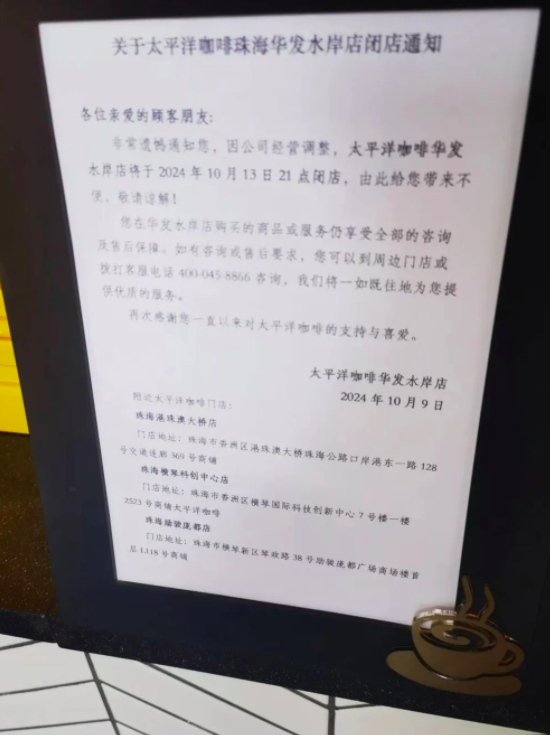
Recently, several local public accounts in Zhuhai announced that Pacific Coffee's Huafa Waterfront Store plans to officially cease operations after October 13 due to adjustments in the company's business strategy.
Subsequently, netizens further discovered that in addition to the Huafa Waterfront Store, which has posted a closure notice, Pacific Coffee will also close Haitian Station Store, City Balcony Store, and several other locations between October 13 and 14. These stores are all situated along Lovers' Road, with distinctive locations that have long been popular check-in and photo spots for tourists on social media. Because of this, local residents have expressed regret upon learning of the closures.
It is worth noting that after this round of closures, the only three remaining Pacific Coffee stores in Zhuhai are all franchise stores. In other words, what the brand is withdrawing this time are its directly operated outlets in Zhuhai.
In fact, as early as the end of last year, the media had reported on Pacific Coffee's large-scale store closures. Its total number of stores shrank from a peak of nearly 500 to just over 100. Faced with this change, coffee enthusiasts have mixed feelings—some are shocked that a brand once firmly in second place in China's coffee market has fallen to such a state, while others are deeply worried about its prospects.
Data from Narrow Door Restaurant Eye shows that as of October 7, Pacific Coffee had 203 operating stores. After deducting 104 stores in Hong Kong and 1 in Macau, only about 98 remain in the mainland market.
However, according to incomplete statistics, only 68 stores are shown as still operating on Pacific Coffee's official mini-program. No stores can be found in cities such as Chengdu, Hefei, and Dongguan, while Hangzhou, Huzhou, Chongqing, and other places still show 1 to 2 stores, but all are marked as "resting." Whether they are merely temporarily closed or permanently shut cannot be confirmed at present.
In addition, Guangdong was originally the region with the most Pacific Coffee stores outside Hong Kong, but the number of stores there has actually been quietly shrinking. Coffee Workshop previously reported that five Pacific Coffee stores in Dongguan closed one after another. If the directly operated stores in Zhuhai are also withdrawn this time, the brand will have only 21 stores left in Guangdong.
As Pacific Coffee gradually declines, the attitude of coffee enthusiasts has long shifted from frustration at its failure to meet expectations to regret and sorrow.
Many people feel that Pacific Coffee is no worse than chain brands such as Starbucks and Luckin in terms of ingredients and product quality. Coupled with the backing of the capital-rich China Resources Group, it should logically be fully capable of entering high-traffic malls under China Resources such as MixC and MixC One, using brand promotion to make its stores bloom everywhere and secure a place in China's coffee market.
But reality did not develop according to the script imagined by netizens. On the contrary, this brand that started with a royal flush played a good hand badly, failed to keep up with the ever-changing pace of the industry in time, and saw its visibility continue to decline. From its once glorious position as a rival to Starbucks, it slid into becoming an almost ignored "nobody" in the industry.
In response, longtime customers understand in their hearts that the glorious years belonging to Pacific Coffee have turned the page. In the market competition of survival of the fittest, the number of stores will only continue to decrease, but they still hope the pace of closures can slow down a little, so they can taste that flavor from memory a few more times.
Image source: Internet
Disclaimer: Some images in this article are from the Internet. For some content on the website, such as images, we will respect the original author's copyright and indicate the source. However, due to the large quantity, some images and texts may not have been credited in time. Please understand. If the original author has any disputes, they can contact the website for handling. Once verified, we will correct it immediately. Compiled and edited by "Coffee Workshop." Please indicate the source when reprinting. If there is infringement, please inform us for deletion. Thank you~!
The above content is compiled by CoffeeHunters, a coffee news website.


