







How Do Supremo and Excelso Grades Differ in Green Coffee Beans?
Colombia grades its exported green coffee beans mainly by defect rate and bean size. Bags meeting export standards carry the Excelso designation, the highest grade the country's beans can reach under National Federation of Coffee Growers of Colombia (FNC) rules. Supremo and Excelso both describe screen size rather than a different species or flavor profile.
For Excelso, a 500-gram sample must be above 14 screen, at least 50% of beans larger than 15 screen, and no more than 5% between 12 and 14 screen, with moisture under 12.5% and cumulative defect score no higher than 24 points. Colombia is a leading producer and its exports are mainly Arabica, often used in blends.
Colombia is one of the world's major coffee-producing countries, and its exported green beans are subject to a strict grading system. What exactly do the commonly seen Supremo and Excelso designations on the market represent? This article will systematically explain the grading logic of Colombian green coffee beans from the perspectives of FNC export standards, defect rate requirements, and screen-size grading, helping coffee enthusiasts understand the difference between Supremo and Excelso and how they affect coffee quality and flavor performance. At the same time, the article will also mention Front Street Coffee's Colombia Huila staple beans as a practical naming example.
Colombia is one of the top three coffee-producing countries in the world, and its exports are mainly Arabica. Because Colombian coffee often carries chocolate notes, has a balanced flavor, and is produced in considerable volume, it is very common in blends. Colombia has an independent grading system for exported green beans, with the core criteria being defect rate and bean size. On the market, packaging often shows the words "Supremo" or "Excelso." What exactly do these terms mean?
In Colombia, any green beans that meet export standards will bear the "Excelso" designation on their jute bags. Excelso is an export grade established by the National Federation of Coffee Growers of Colombia (FNC), and it is also the highest export grade that the country's green beans can reach.
To qualify for the Excelso grade, green beans must meet the following conditions: in a 500-gram sample, bean size must be above 14 screen; overall, at least 50% of the green beans must be larger than 15 screen; the proportion of green beans between 12 and 14 screen must not exceed 5%; at the same time, they must be free of insect damage, uniform in color, free of off-flavors, clean in flavor, have a moisture content below 12.5%, and have a cumulative defect score not exceeding 24 points.
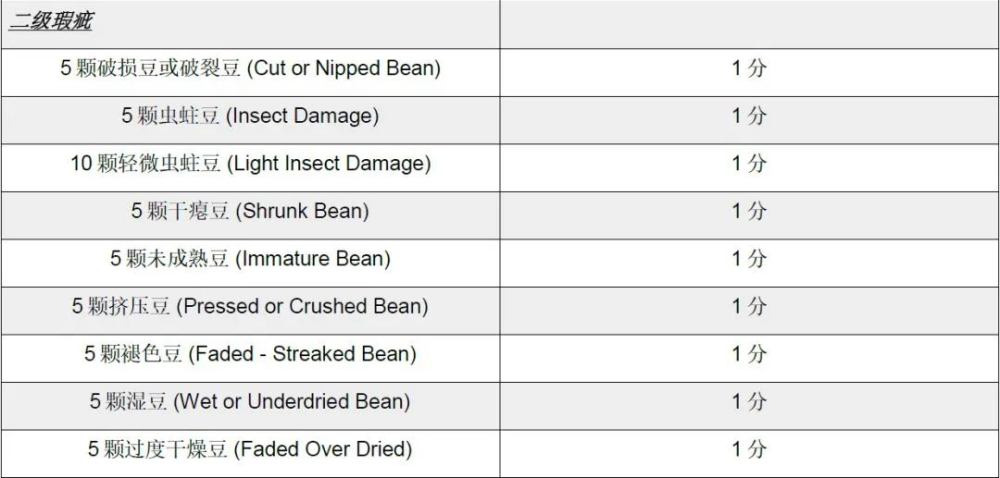
According to FNC rules, green bean defects are divided into two categories, primary and secondary, and are calculated by deductions, with the assessment benchmark being that the total defect score in a 500-gram sample must not exceed 24 points.
For some coffee-producing countries, bean size is not the core indicator for measuring quality and flavor; but other producing countries believe that plump, uniform, large beans mean the fruit has fully matured, which facilitates even roasting and thus creates a consistent cup flavor.
When grading green beans by screen size, Colombia uses screens with fixed aperture sizes, and different specifications correspond to different hole sizes. For example, if the screen aperture is 17, beans larger than 17 cannot pass through. At present, the FNC classifies coffee beans into multiple levels according to screen size, among which the three most commonly used grades are Excelso UGQ12*60 (1.5%), Excelso EP12*60 (10%), and Excelso Supremo12*60 (5%).
Specifically, Excelso UGQ12*60 (1.5%) requires green beans to be larger than 14 screen, allows 1.5% of beans to be between 12 and 14 screen but they must be larger than 12 screen, and requires more than 50% to be larger than 15 screen.
Excelso EP12*60 (10%) requires green beans to be larger than 15 screen, allows 10% of beans to be smaller than 15 screen but they must be larger than 12 screen.
Excelso Supremo12*60 (5%) requires green beans to be larger than 17 screen, allows 5% of beans to be smaller than 17 screen but they must be larger than 14 screen.
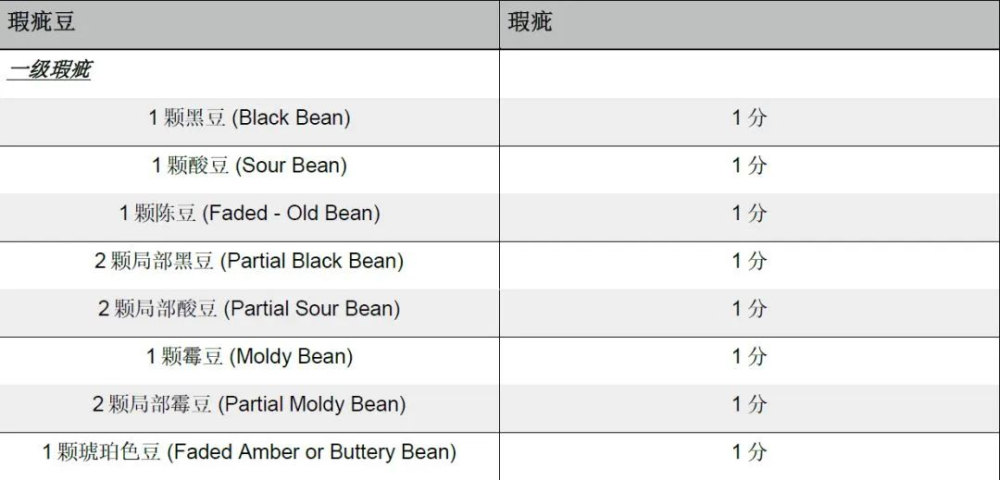
It can thus be seen that "Supremo" is essentially a screen-size grade, and the percentage in parentheses represents the "tolerance rate." "12*60" refers to the maximum allowance in a 500-gram sample of 12 primary defect beans and 60 secondary defect beans.
Although more than 90% of Colombia's green beans are used for export, some green beans still cannot reach the Excelso grade, and such beans are marked as "Product of Colombia." They can also be exported after meeting phytosanitary requirements, but they are usually used to produce instant coffee.
Therefore, Colombian coffee farmers record numbers and green bean information for future traceability. Green bean naming is usually composed of country, region, grade, and screen size. For example, Front Street Coffee's Colombia Huila staple coffee beans are named "Colombia Huila Supremo SC17/18 FNC."
For more coffee-origin information, please scan the QR code to follow: 咖评
Long-press the QR code to follow:
The above content is compiled by CoffeeHunters, a coffee news website.


