







Where Did Robusta Coffee Originate and Where Is It Grown Today?
Robusta originated in the Congo Basin of Africa. A Belgian scholar identified the variety there in 1898, in what is now the territory of the Democratic Republic of the Congo. It belongs to the species Coffea canephora, also called the Congo species, and it now holds roughly a 40 percent share of the global coffee market.
High yield, disease resistance and drought tolerance spread Robusta through coffee production in Brazil, Vietnam and Indonesia, with Vietnam becoming the world's second-largest coffee-producing country. It carries about twice Arabica's caffeine, giving a stronger, more bitter cup, so it is a primary raw material for instant coffee and appears in espresso blends.
In the global coffee landscape, Robusta stands toe-to-toe with Arabica, holding roughly a 40% market share. It originated in the Congo Basin of Africa and, thanks to advantages such as high yield, disease resistance, and drought tolerance, is widely cultivated in countries like Brazil, Vietnam, and Indonesia. Vietnam has even leveraged this to become the world's second-largest coffee-producing country. This article will trace the discovery history of Robusta, analyze its varietal characteristics, and review the cultivation trajectory and current status of major producing countries one by one. Whether you are a coffee enthusiast or a professional in the industry, you will gain a complete understanding of Robusta. Front Street Coffee will also recommend Robusta products worth paying attention to in this article.
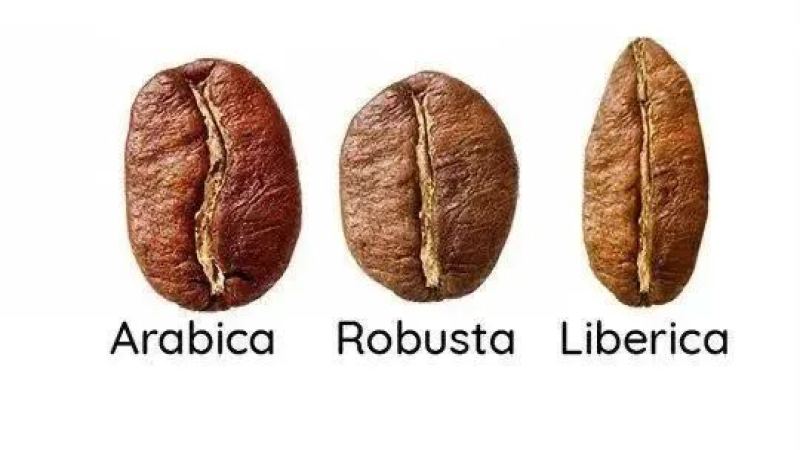
In the global coffee consumer market, Arabica, Robusta, and Liberica constitute the three major mainstream varieties, and beneath these broad categories, numerous subdivided varieties have emerged. In terms of commercial cultivation scale, Arabica and Robusta are the most prominent, with the former occupying about 60% of the global market share and the latter about 40%.
The reason Robusta can secure a firm foothold in the market is inseparable from its own varietal characteristics. In terms of chromosome count, Arabica has 44 chromosomes and is self-pollinating; Robusta has only 22 and is cross-pollinating. In addition, Robusta's caffeine content is twice that of Arabica. For this reason, Robusta lacks the delicate aroma of Arabica, and its flavor is stronger and more direct, with a more pronounced bitterness. However, it is rich in caffeine and has high body, making it the primary raw material for instant coffee; at the same time, its oil content is considerable, so it is also often used in espresso blends.
According to historical records, in 1898 a Belgian scholar discovered the Robusta variety in the Congo Basin of Africa (in what is now the territory of the Democratic Republic of the Congo). Strictly speaking, Robusta belongs to the species Coffea canephora, also known as the Congo species, similar to how Typica belongs to the Arabica species. However, under Coffea canephora, only Robusta has achieved commercialization and become widely known, so today Robusta has almost become synonymous with the Coffea canephora lineage. Thanks to advantages such as high yield, strong resistance to pests and diseases, and good environmental adaptability, many coffee-producing countries around the world are cultivating and exporting Robusta.
Brazil
Brazil is the world's largest coffee producer and exporter, cultivating both Arabica and Robusta, with Arabica accounting for 60% of total exports and Robusta 40%. Coffee was introduced to Brazil in the 18th century. Initially, Arabica was cultivated, and it then rapidly expanded across the country. By the 19th century, Brazil's coffee production already accounted for 30% of the world's total, and the coffee industry also drove Brazil's economic growth.
Entering the 20th century, Robusta began to enter Latin America in the form of commercial cultivation and spread across multiple countries. Because Arabica is relatively delicate and vulnerable to climate change, some Brazilian growers switched to cultivating Robusta. Robusta is drought-tolerant, disease-resistant, and highly adaptable, so its suitable cultivation areas in Brazil are quite extensive.
Vietnam
Vietnam is currently the world's second-largest coffee producer and exporter. Unlike Brazil, Vietnam's coffee output and exports are dominated by Robusta. Although Arabica is also cultivated in northern Vietnam, it accounts for only 2% to 3% of the country's production. Thanks to Robusta's high-yield characteristics, although Colombia's land area is about 3.4 times that of Vietnam, Vietnam's coffee production exceeds Colombia's and firmly ranks second in the world.
According to records, coffee was introduced to Vietnam by the French in the mid-19th century and planted in the northern region. At that time, Arabica was dominant and plantation-style cultivation was used. However, in the late 19th century, coffee leaf rust ravaged Asia, and Vietnam was not spared, with production falling sharply. After entering the 20th century, Vietnam carried out land reform, distributing land to farmers, and coupled with rising global coffee prices, Vietnam's coffee production climbed rapidly. Because early Arabica had poor disease resistance, this period began to shift toward a cultivation strategy aimed at high yield, and Robusta thus became the main force. At that time, Robusta already accounted for half of total production, and later it gradually replaced Arabica, occupying most of the production and export share.
Indonesia
Indonesia is currently the fourth-largest coffee-producing country, cultivating both Arabica and Robusta, with Arabica accounting for 15% of total production and Robusta 85%. Indonesia is the world's largest archipelagic country, with numerous mountains and volcanoes, and many islands are suitable for coffee cultivation. Arabica is mainly grown in high-altitude mountainous areas, while Robusta is distributed in low-lying areas.
As early as the 17th century, Indonesia was a Dutch colony. Because the terrain and climate conditions were suitable, the Dutch introduced Arabica coffee to Indonesia for cultivation. By the early 18th century, Indonesia was already exporting thousands of pounds of coffee each year. But in the 1860s, an outbreak of coffee leaf rust destroyed coffee production in multiple producing countries, and Indonesia was also deeply affected. After that, Indonesia introduced the more disease-resistant and easier-to-grow Robusta, which gradually replaced Arabica.
Currently, Brazil, Vietnam, and Indonesia are the main Robusta cultivating and exporting countries. In addition, Uganda borders the Democratic Republic of the Congo, and there are native Robusta tree species around Lake Victoria in its south, so the country mainly cultivates Robusta. India also cultivates Robusta and has launched Indian "Coffee Royal" Robusta, which belongs to specialty-grade Robusta, but its production is extremely limited. Apart from these, some Asian countries and West African countries also cultivate Robusta. With the recent rise in Robusta coffee prices, some American countries have also begun to introduce it for cultivation.
For more coffee origin information, welcome to scan the QR code to follow: Coffee Review
Long-press the QR code to follow:
TRANSLATE with
x
English
Arabic Hebrew Polish Bulgarian Hindi Portuguese Catalan Hmong Daw Romanian Chinese Simplified Hungarian Russian Chinese Traditional Indonesian Slovak Czech Italian Slovenian Danish Japanese Spanish Dutch Klingon Swedish English Korean Thai Estonian Latvian Turkish Finnish Lithuanian Ukrainian French Malay Urdu German Maltese Vietnamese Greek Norwegian Welsh Haitian Creole Persian
TRANSLATE with
COPY THE URL BELOW
Back
EMBED THE SNIPPET BELOW IN YOUR SITE Bing Webmaster Portal
Back
The above content is compiled by CoffeeHunters, a coffee news website.


