








Why are coffee beans roasted, and what does blooming reveal?
Blooming is often used as a freshness test, but the size of the dome is not proof on its own. Two batches of beans roasted on the same day, ground moments apart and bloomed at the same time, can still puff up very differently. The bulge reflects carbon dioxide release, and freshness is only one of several factors shaping it.
During the roasting process, coffee beans generate carbon dioxide that escapes gradually after the roast. Grind size, water temperature, agitation and the time since grinding all change how quickly that gas leaves the bed. Reading the bloom accurately means weighing these variables alongside roast date, rather than assuming a small dome automatically means stale beans.
In the process of pour-over coffee, blooming is a step that seems simple but contains a wealth of information. Many enthusiasts are accustomed to judging whether coffee beans are fresh by observing the extent to which the coffee bed puffs up during blooming—the larger the bulge, the fresher the beans; the smaller the bulge, the staler they are. However, Front Street wants to tell everyone today that bean freshness is not the only factor affecting the size of the bulge. This article will start from the principle of how blooming works, deeply analyze why the coffee bed expands, and discuss what variables besides freshness can cause differences in the bulge. At the same time, we will also explore how the process of carbon dioxide release after coffee beans are roasted affects extraction, helping you more accurately understand the blooming phenomenon in your daily brewing.
In addition to allowing the beans to be extracted better, the phenomenon of the coffee bed puffing up during blooming is also used by many friends as a reference for judging the freshness of coffee beans. How exactly do they judge? For example: the higher the coffee bed expands during blooming, the fresher the beans are; on the contrary, if the coffee bed does not bulge noticeably, that means the freshness of the beans may have declined.
(The coffee bed on the left expands very little)
However, do you know that the freshness of coffee beans is actually not the only variable affecting the size of the bloom bulge? For example, in this picture provided by Front Street above, at first glance the beans on the left seem less fresh than those on the right (because the bulge is not large enough), but in fact, these two portions of beans were roasted on the same day! Not only that, their grinding times were only one after the other, and they even started blooming at the same time! So the question arises: besides freshness, what other factors can cause changes in the size of the bulge?
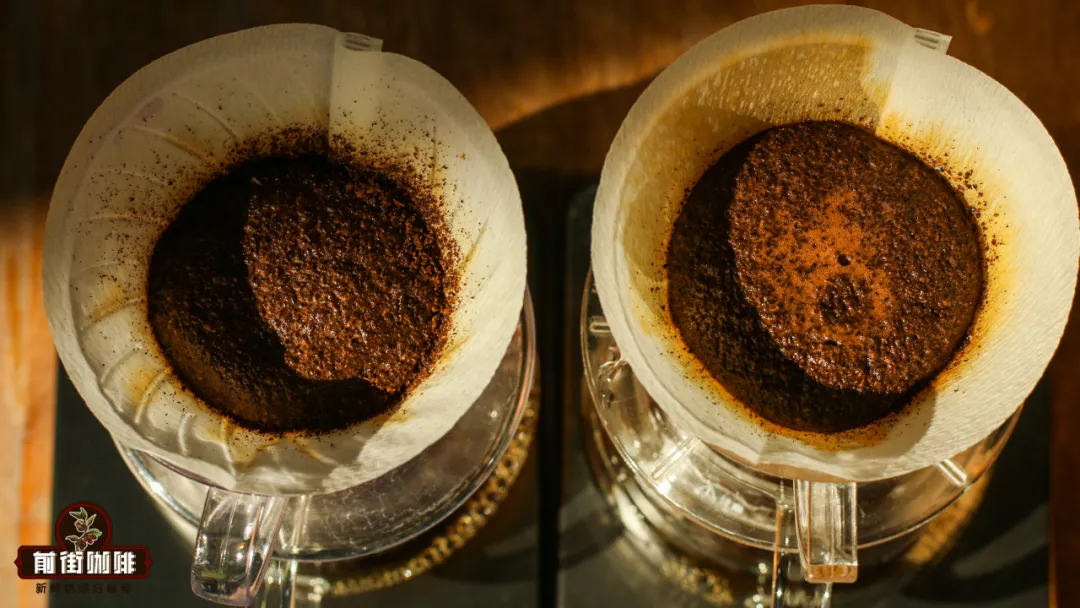
Before answering this question, considering that many friends who are new to pour-over may not yet know why coffee bean freshness is related to the bulge, Front Street will first talk about what blooming actually does, and why the coffee bed expands during blooming! What exactly is the role of blooming? Coffee beans continuously generate carbon dioxide during the roasting process, and these gases are slowly released after roasting ends. But before they are completely discharged, the presence of a large amount of carbon dioxide will hinder the extraction of flavor substances from the coffee grounds by hot water, acting like a barrier. Therefore, we need to use the blooming step to release the carbon dioxide! The period of waiting after pouring in a small amount of hot water is precisely the key window for allowing carbon dioxide to escape. When the gas has mostly been released, we then pour in a large amount of hot water for the formal extraction. At this point, because the "obstacle" (carbon dioxide) has been reduced, the hot water can more fully extract the flavor substances in the coffee.


The above content is compiled by CoffeeHunters, a coffee news website.


