







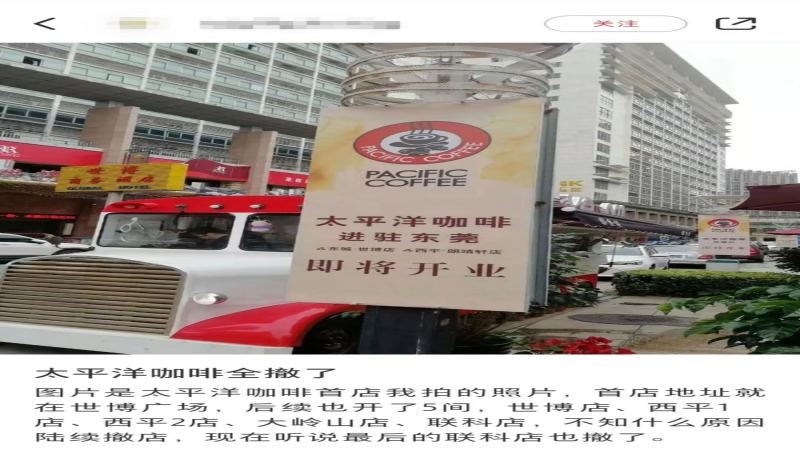
Why is Pacific Coffee retreating from mainland China?
Pacific Coffee has closed its five downtown Dongguan stores one after another and, with the Lianke store gone, has exited the Dongguan market entirely. The brand, founded in Hong Kong in 1992, once operated close to 500 mainland stores after China Resources Enterprise acquired 80% of its shares in 2010.
The company ranked second among China's coffee chain brands in 2017 but now has only a hundred-plus stores. It did not match the pace of new product launches and collaborations from brands like Luckin and Manner, nor keep expanding like Starbucks, and its Starbucks-level pricing lost ground as affordable rivals grew. The case has drawn attention across the history of the coffee shop industry.
Pacific Coffee, once backed by China Resources and having opened nearly 500 stores at its peak, is now experiencing a significant contraction in the mainland market. Recently, netizens reported that five stores in downtown Dongguan have been closed one after another, and with the withdrawal of the Lianke store, the brand has completely exited the Dongguan market. From ranking second in the industry in 2017 to having only a hundred-plus stores today, Pacific Coffee's decline has drawn sighs from many coffee enthusiasts. This article will review its development history, analyze the reasons for its fall behind, and present observations and sentiments from netizens across various regions regarding its current situation.
▲
Click to follow | Daily specialty coffee culture magazine Coffee Workshop
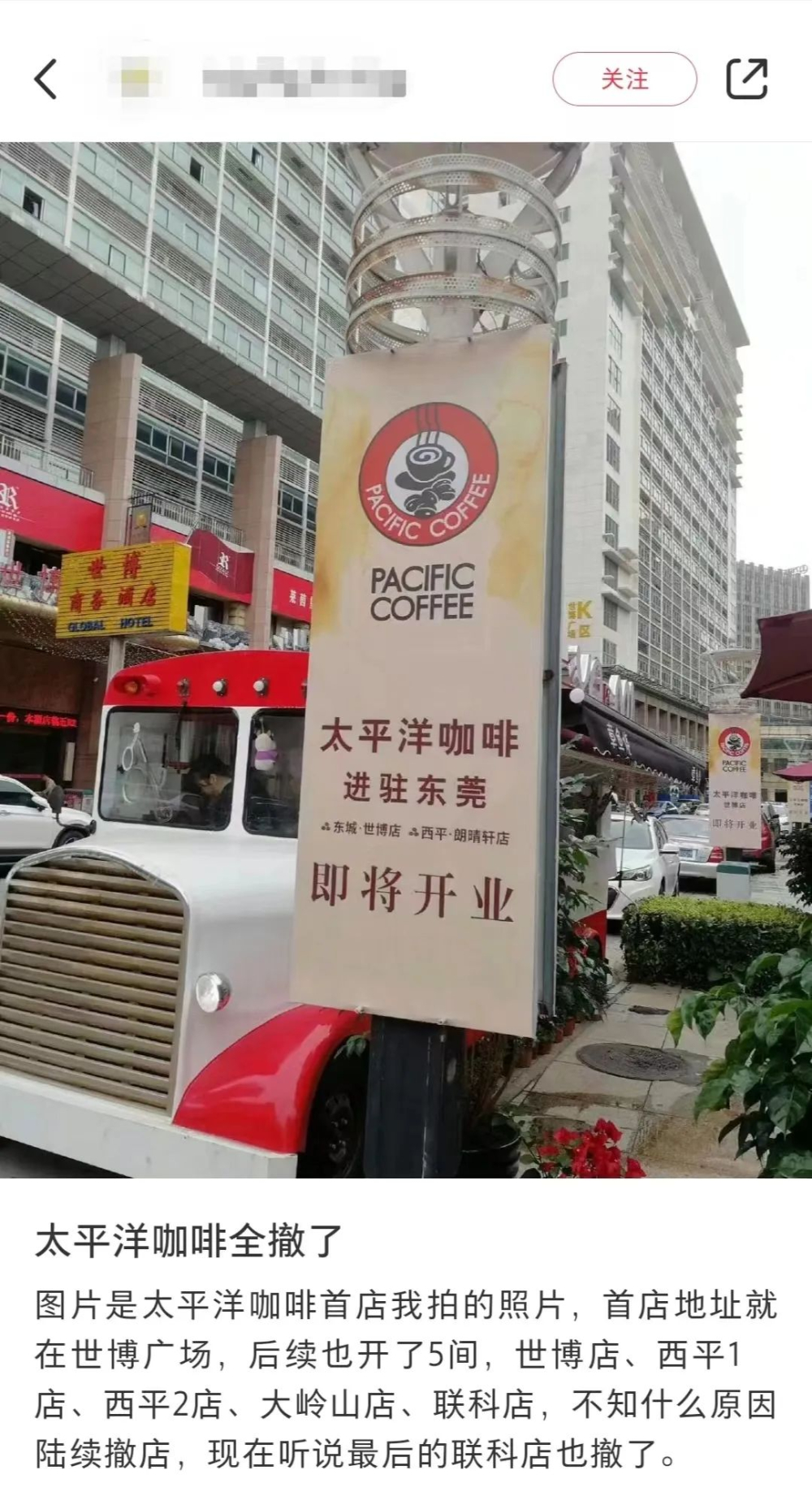
Recently, a netizen posted on social media that the original five Pacific Coffee stores in downtown Dongguan have been closed one after another. The netizen pointed out that with the closure of the Dongguan Lianke store, Pacific Coffee no longer has any stores remaining in the Dongguan coffee market.
Mentioning this "coffee brand with a state-owned enterprise background," many netizens familiar with its history are filled with emotion. Public records show that Pacific Coffee was founded in Hong Kong in 1992. In 2010, China Resources Enterprise acquired 80% of Pacific Coffee's shares, becoming its largest shareholder, and brought the brand into the mainland market.
Thanks to China Resources' financial support, Pacific Coffee expanded rapidly in the mainland, with the number of stores once approaching 500. In 2017, it even rose to second place among China's coffee chain brands. At that time, it was at the height of its glory and had accumulated a loyal customer base.
However, in the wave of rapid iteration in the coffee industry, Pacific Coffee seemed unable to keep up. It neither frequently launched new products and collaborations like emerging brands such as Luckin and Manner, nor continued opening stores and maintaining brand exposure like Starbucks. Instead, it gradually fell silent in the competition, with its visibility steadily declining.
Many longtime customers recall that Pacific Coffee once regarded Starbucks as its main rival, and its product pricing also aligned with Starbucks. But with the rise of affordable brands like Luckin and Manner, Pacific Coffee's price advantage completely disappeared, making it increasingly difficult to attract consumers.
Although the brand attempted a transformation, launching a tea beverage line called "Taicha" to try to enter the tea drink track, the new business yielded little results and failed to reverse the decline of its core coffee business. The mainland market subsequently saw large-scale store closures, with the number of stores plummeting from over 500 at its peak to just over 100.
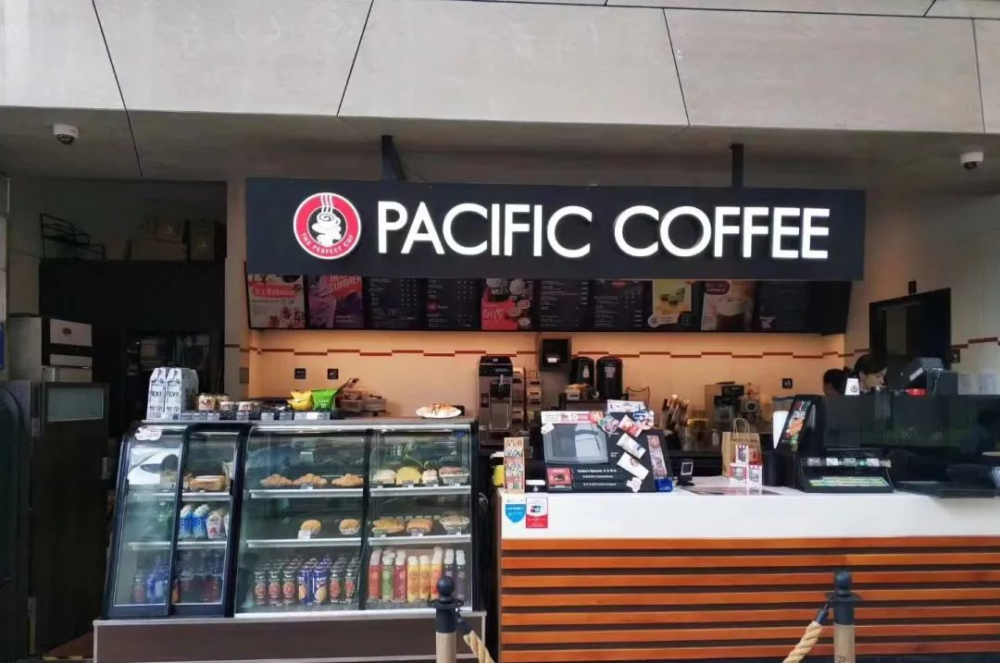
As of now, data from GeoHey brand monitoring shows that Pacific Coffee has only 106 stores in operation. Although it covers more than twenty provinces, most stores are concentrated in Guangdong Province, with only one or two stores scattered in some areas.
Some netizens deeply regret Pacific Coffee's decline. Some believe that after being acquired by China Resources, Pacific Coffee had ample financial support and quickly rolled out over a hundred stores. But perhaps internal management problems, or insufficient management capability, prevented this veteran coffee brand from gaining more consumer recognition and led it to gradual decline.
Some local coffee enthusiasts said that when Pacific Coffee opened five stores in Dongguan one after another, everyone thought it would use community stores as a starting point to reignite the market and sweep through the coffee scene again like a spark. But unexpectedly, some stores closed hastily in less than a year of operation, and now all have closed, completely exiting Dongguan.
Netizens in other parts of Guangdong also reported that Pacific Coffee stores are now mostly located in low-traffic areas, making them hard for consumers to find. Some longtime users said that although the brand still has some stores barely hanging on, it would not be surprising if these stores suddenly closed.
After all, the glorious era belonging to Pacific Coffee had already come to an end years ago.
Image source: Internet
Disclaimer: Some images in this article are from the Internet. For some content on the website, such as images, we will respect the original copyright and indicate the source. However, due to the large quantity, some images and texts may not have been credited in time. Please forgive us. If the original author has any disputes, they can contact the website for handling. Once verified, we will correct it immediately. Compiled and edited by "Coffee Workshop." Please indicate the source when reposting. If there is infringement, please inform us for deletion. Thank you~!
The above content is compiled by CoffeeHunters, a coffee news website.


