







How Does the US Emergency Extension Affect the Coffee Industry?
On September 6, the White House announced it will continue the national emergency on Ethiopia through 2025, keeping the country outside AGOA benefits and tariffs in place on coffee, textiles, and leather goods. The decision followed news that China and Ethiopia reached a currency swap agreement, confirmed by Ethiopia's finance minister without published details or a timetable.
Ethiopia is a major coffee countries player, but its largest coffee importer is Germany, while the United States ranks fourth at 9.3% of imports. Continued emergency status may restrict bilateral trade, reduce US purchases of Ethiopian coffee, and hit fertilizer and industrial supply exports, adding pressure to local prices and raising coffee costs.
On September 6, the White House announced that the United States will continue to impose a national emergency on Ethiopia, a decision that came after news that China and Ethiopia had reached a currency swap agreement. Ethiopia's finance minister has confirmed the existence of the agreement, but the specific details and timetable have not yet been made public. Meanwhile, the United States has imposed a state of emergency on Ethiopia since 2021 under the International Emergency Economic Powers Act, and this extension will run until 2025. Ethiopia was removed from the African Growth and Opportunity Act (AGOA) in 2022, and tariffs were reinstated on its main exports such as coffee, textiles and leather goods, dealing a severe blow to its economy. Although the U.S. attitude eased slightly after Ethiopia implemented a new foreign exchange policy in August this year, AGOA eligibility remains out of reach. Ethiopia's largest coffee importer is Germany, while the United States ranks only fourth, accounting for 9.3%. The continuation of the state of emergency may further restrict bilateral trade, reduce U.S. imports of Ethiopian coffee, and at the same time hit Ethiopia's exports of fertilizer and industrial supplies, exacerbating local price increases and rising coffee costs.
According to media reports, on September 6 the White House issued a statement announcing that Ethiopia will remain under a national state of emergency. The backdrop to this decision is news that China and Ethiopia have reached a currency swap agreement.
Ethiopia's finance minister confirmed the currency swap agreement with China in an interview, but the specific details of the financial arrangement have not yet been made public, and the final timetable is still being formulated. It is reported that China and the National Bank of Ethiopia have already launched relevant work, and Chinese financial service institutions will conduct business in Ethiopia. A currency swap agreement helps the two countries deepen financial cooperation, promote trade and investment facilitation, and at the same time reduce dependence on the U.S. dollar, lower exchange costs and exchange rate risks, thereby promoting the development of international trade.
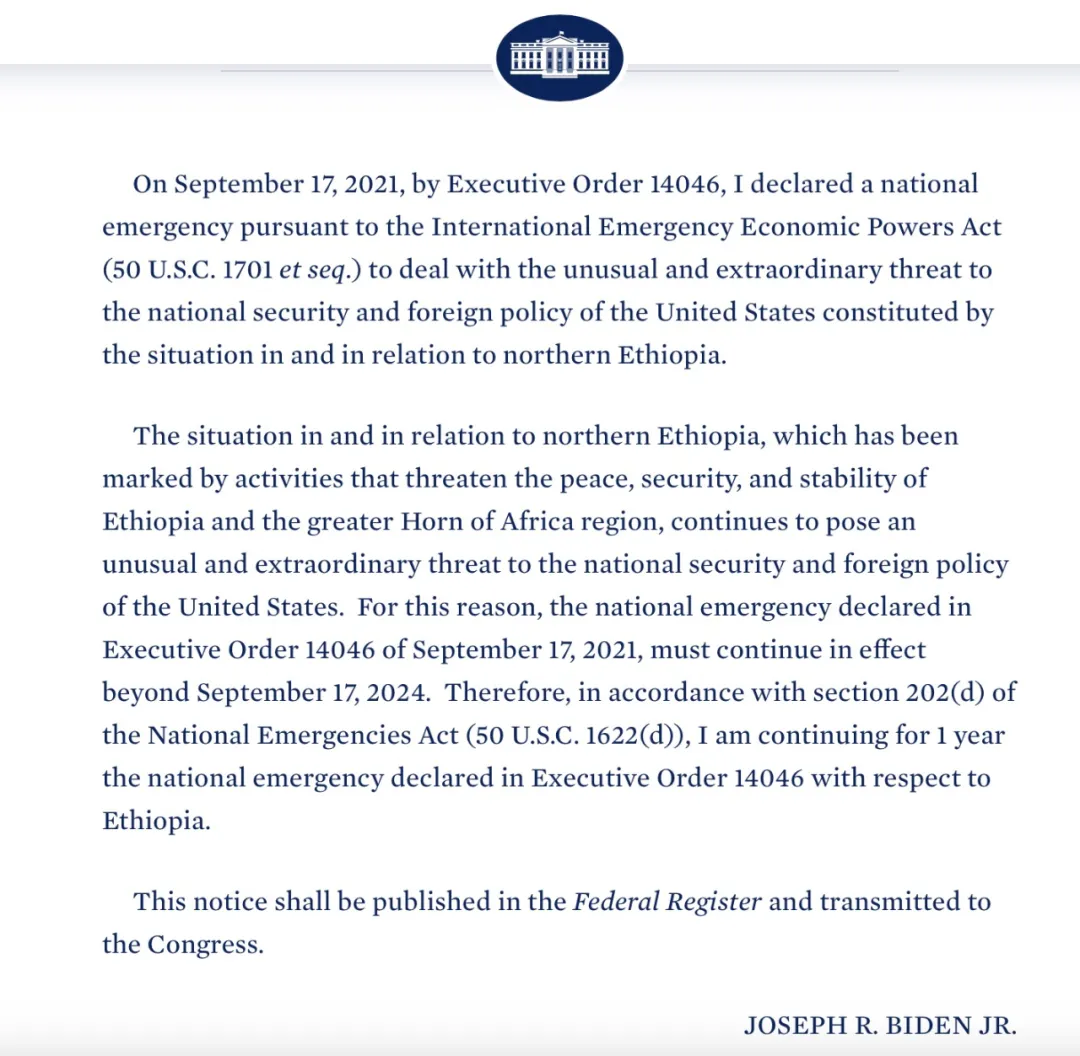
According to the U.S. statement, as early as September 17, 2021, the United States declared a state of emergency under the International Emergency Economic Powers Act in response to the threat posed by the situation in northern Ethiopia. The situation in the region has long affected peace, security and stability in Ethiopia and the Horn of Africa, and poses a challenge to U.S. national security and foreign policy. Therefore, after September 17, 2024, Ethiopia's national state of emergency will continue for another year, until 2025.
It is reported that the President of the United States may declare a national state of emergency on national security grounds and impose sanctions on specific governments, organizations, enterprises, political parties or individuals. This means that the United States may take a series of measures to respond to threats from Ethiopia, including restricting trade and imposing restrictions on investment or technology transfer to specific countries.
To promote the development of African countries, the U.S. government passed the African Growth and Opportunity Act (AGOA) in 2015, allowing African countries to enjoy low-tariff or duty-free treatment for exports to the United States. However, in 2022, Ethiopia was removed from the act by the United States, and its main exports—coffee and other crops, textiles and leather goods—once again faced tariffs, dealing a severe blow to multiple industries, because at that time the United States and the European Union were Ethiopia's main importers.
In August this year, Ethiopia implemented a new foreign exchange policy, and the country's currency, the birr, began to depreciate. After that, the U.S. attitude toward Ethiopia regaining AGOA eligibility softened somewhat, and it said that the Ethiopian government needed to resolve civil unrest outside the capital in order to meet AGOA eligibility requirements. But judging from the current situation, the possibility of Ethiopia regaining AGOA treatment is very slim.
In addition, Ethiopia's current situation is not optimistic. Armed conflicts have broken out in multiple regions of the country, and the conflict originally concentrated in the north is spreading toward the central capital and the surrounding south. At the same time, due to its relations with Somaliland, Ethiopia's relations with neighboring Somalia and Eritrea have deteriorated, and conflict could break out at any time.
Ethiopia's foreign exchange earnings are highly dependent on exports, especially agricultural exports, with coffee and other agricultural products being the main source of foreign exchange. However, data analysis shows that the largest importer of Ethiopian coffee is Germany, followed by Saudi Arabia and Japan, with the United States in fourth place, accounting for 9.3% of Ethiopia's coffee exports.
At present, the state of emergency imposed by the United States on Ethiopia may restrict trade between the two sides, reduce imports of Ethiopian coffee, and also reduce exports to Ethiopia of goods such as fertilizer and industrial supplies. This will deal a severe blow to Ethiopia's economy. Since the previous foreign exchange policy has already led to rising local prices and a higher cost of living, this situation may further worsen. For the coffee industry, rising costs and reduced exports will together drive a sharp increase in coffee prices.
To learn more news and information about coffee origins, please scan the QR code to follow: Coffee Review
Long-press the QR code to follow:
The above content is compiled by CoffeeHunters, a coffee news website.


