







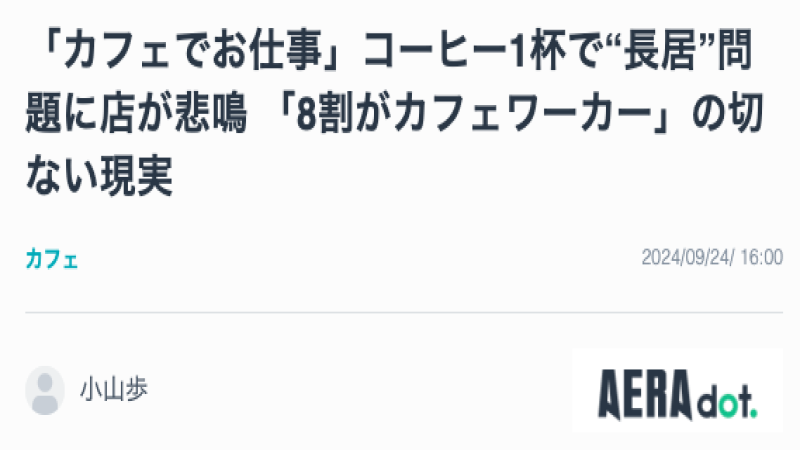
Why Is Coffee Culture in Japan Facing a Long-Stay Backlash?
Japan recorded 72 café bankruptcies last year, more than double the 34 the year before and a record high, according to a January survey by Teikoku Databank. The cause is a mismatch between low-priced coffee and slow table turnover: remote workers pay about 420 yen for one cup and can stay more than 10 hours.
Cafés that depend on high turnover are responding with time limits, fewer power outlets and other restrictions, which frustrate customers. The same tension over who has the right to use café space appears in other countries. For anyone weighing how much does it cost to open up a coffee shop, turnover per seat matters as much as rent and equipment.
As remote work becomes increasingly common, more and more people are choosing to treat cafés as their second office. For just a few hundred yen spent on a cup of coffee, they can stay in the shop for hours or even longer. For customers, this is an efficient and comfortable way to work; but for cafés that rely on high table turnover to survive, it can be a fatal business burden. Last year, the number of café bankruptcies in Japan hit a record high, and prolonged stays were thrust into the spotlight. Time limits, fewer power outlets, customer dissatisfaction… operators are caught in a dilemma. This battle over the right to use café space is playing out around the world.
▲
Click to follow | Daily specialty coffee culture magazine Coffee Workshop
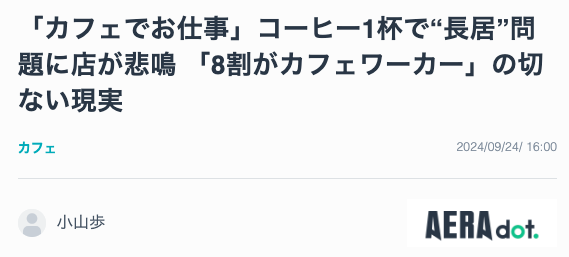
A recent report by the Japanese media outlet Aeradot sparked widespread discussion: a large number of customers who order only one cup of coffee but occupy seats for long periods have already caused multiple cafés to close one after another. This phenomenon quickly became a focus of social attention.
The report said that the popularity of remote work has led more and more office workers to treat cafés as workplaces. They often spend just 420 yen (about 21 yuan) on a cup of coffee and can sit in the shop for many hours, or even longer.
Some workers who are used to working in cafés admit that they find it easier to concentrate in a café, so they often treat a certain shop as their regular base for remote work. One of them said he might stay in a café for more than 10 hours at a time.
From the perspective of shop operations, having long-term stable customers is not inherently a bad thing. However, for cafés that rely on high table turnover to support sales, customers staying for long periods can seriously threaten survival, and this contradiction is especially prominent in urban areas.
According to reports, the number of café bankruptcies in Japan last year set a record high. A survey released by Teikoku Databank in January this year showed that 72 cafés went bankrupt nationwide last year, more than double the 34 the year before and a historic peak. The root cause is simply the combination of low coffee prices and poor in-store turnover.
Because direct price increases often provoke complaints and criticism from consumers, some coffee shops are unwilling to adopt such a blunt method to boost revenue and instead use time limits to deal with customers who work or study in the shop for long periods.
They put eye-catching notices near the power outlets in the shop, clearly informing paying customers that there is a 90- to 120-minute time limit for use, and some even directly reduce the number of public power outlets to improve store turnover efficiency.
However, some café owners admit that implementing time limits may cause some customers to be dissatisfied with the service, leading them to no longer be willing to patronize the shop, with customer traffic draining away as a result.
In fact, this dilemma is not unique to Japanese café owners. Cafés in Europe, South Korea, and elsewhere also face the problem of "digital nomads" working in stores for long periods.
Many operators say that when they first opened, they did not care how long customers sat, but as operating pressure has continued to increase, those coffee workers who stay for long periods have become a source of anxiety. They point out that these office workers mostly order only one or two drinks, yet sit from morning until the store closes. During that time, they may also charge electronic devices and ask for ice water, invisibly adding a lot of operating costs.
What troubles operators even more is that some customers brazenly hold video conferences and make phone calls in the shop, not only affecting other customers but also destroying the café's originally quiet and comfortable atmosphere. Some operators even say outright that they do not particularly welcome customers who may interfere with the café's normal operations.
It can thus be seen that how to increase café revenue while maintaining the customer consumption experience is probably a difficult problem faced by café operators around the world.
Image source: Internet
Disclaimer: Some images in this article are from the Internet. For some content on the website, such as images, we will respect the original copyright and indicate the source. However, due to the large volume, a few images and texts may not have been credited in time. Please understand. If the original author has any dispute, they may contact the website for handling. Once verified, we will correct it immediately. Compiled and edited by "Coffee Workshop." Please indicate the source when reprinting. If there is infringement, please inform us for deletion. Thank you~!
The above content is compiled by CoffeeHunters, a coffee news website.


