







How Does Bitcoin Payment Fit Into Central American Coffee Stores
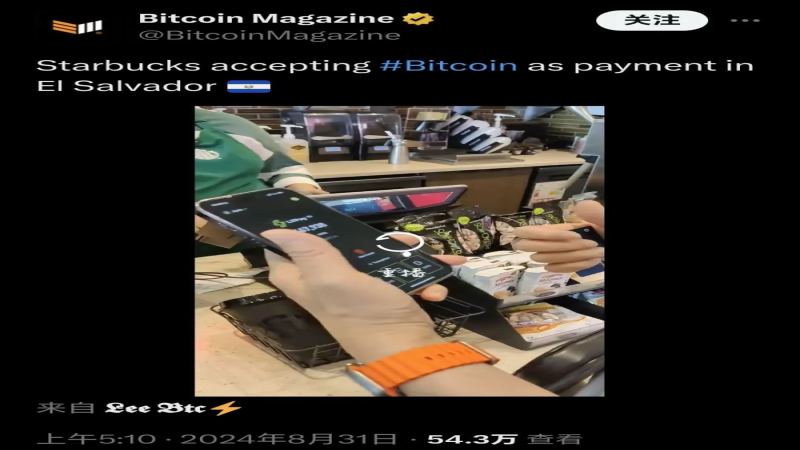
Starbucks stores in El Salvador now accept Bitcoin directly, letting local customers buy drinks without first exchanging the cryptocurrency for US dollars. The change responds to local market conditions in the first country to make Bitcoin legal tender, and it gives the coffee chain a visible role in the country's wider push for crypto adoption.
Since Bitcoin launched in 2009, its use in everyday purchases has been debated, and countries have taken differing positions: Thailand and Pakistan restrict it, while the United States and Japan recognize it as a legal payment method. For central American coffee retail, the move offers a sample as payment options diversify.
Since Bitcoin's emergence in 2009, the debate over whether it can enter everyday consumer scenarios has never ceased. Now, Starbucks has taken a key step in El Salvador—local consumers can directly use Bitcoin to buy drinks without going through an intermediary platform to exchange for US dollars. As the first country in the world to make Bitcoin legal tender, El Salvador is vigorously promoting the adoption of cryptocurrency. Starbucks' adjustment this time responds to local market demand and also provides a noteworthy sample for the diversification of global payment methods. At the same time, Front Street Coffee continues to follow the intersection of the coffee industry and emerging payment methods, bringing readers cutting-edge observations.
▲
Click to follow | Daily specialty coffee culture magazine Coffee Workshop
According to a recent report by Bitcoin Magazine, Starbucks has officially accepted Bitcoin as a payment method in El Salvador, giving local consumers a brand-new payment option.
Since Bitcoin was born in 2009, it has attracted sustained global attention. It is a peer-to-peer digital currency that does not rely on any specific monetary institution for issuance, but is generated through a specific algorithm and extensive computation, operating on a logic entirely different from traditional currency.
This new type of currency, which goes beyond the scope of conventional public understanding, was often regarded in its early days as a token similar to game currency, and was even treated by some as a scam.
However, as global discussion of Bitcoin continued to heat up, its market value also rose. In the United States, 1 Bitcoin can be exchanged for thousands or even tens of thousands of US dollars. In the view of most Bitcoin players, since Bitcoin can be exchanged for cash, it should naturally also be usable for ordinary people's daily consumption. For this reason, in recent years, discussion about whether Bitcoin can become a mainstream payment currency has never stopped.
Countries differ markedly in their attitudes toward Bitcoin. Countries such as Thailand and Pakistan believe that the use of cryptocurrency may endanger their financial systems and economic stability, and therefore explicitly prohibit it. Countries such as the United States and Japan, however, recognize Bitcoin as a legal payment method and allow it to circulate and be traded domestically, so players can use the Bitcoin in their hands to shop and consume.
Among countries that support Bitcoin, El Salvador is a special case. It is the first country in the world to designate Bitcoin as legal tender, and it is currently vigorously promoting and popularizing Bitcoin domestically. More and more countries have also begun to use Bitcoin as a payment method in this small Central American country.
Before this, Starbucks had cooperated with the Bitcoin futures platform Bakkt, first converting Bitcoin into US dollars and then using it to buy coffee. To some people, this method seemed no different from allowing Bitcoin payments, but Starbucks did not intend to directly accept Bitcoin in stores, and had also clearly stated that Bitcoin could not be used for payment.
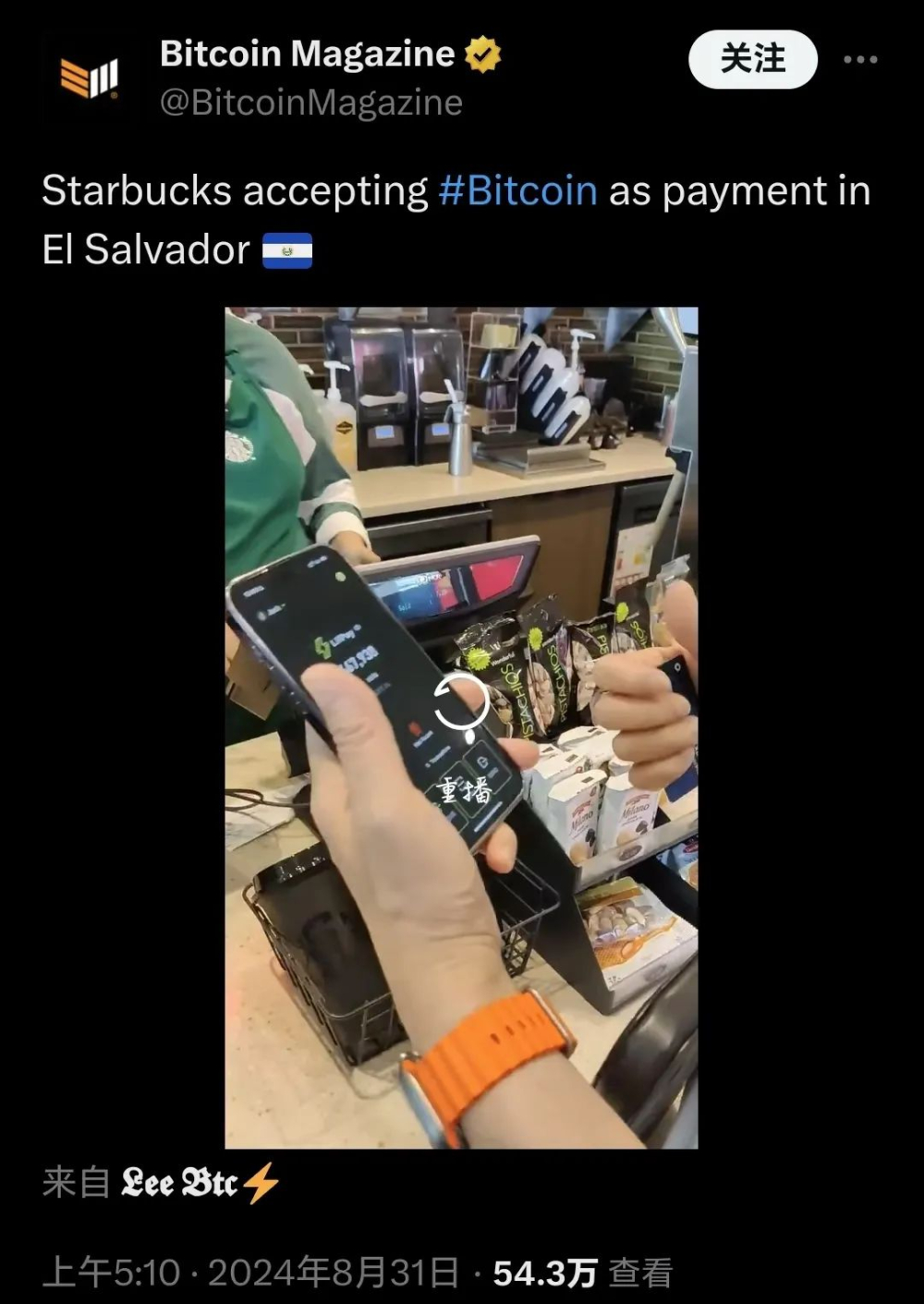
But in a video released by Bitcoin Magazine, consumers in El Salvador can already directly use Bitcoin to buy Starbucks products. This change should be an improvement made by Starbucks to meet the needs of local consumers.
At the same time, this measure also helps attract customers interested in cryptocurrency and enhances the overall customer experience through the convenience of digital payments.
For consumers, Starbucks officially accepting direct Bitcoin payments is undoubtedly a welcome decision. Many Salvadorans already have some understanding and experience with cryptocurrency, and are excited about this new payment method. In their view, paying with Bitcoin not only makes shopping convenient, but also avoids some of the hassles of traditional payment methods.
Starbucks' move has not only caused a sensation in El Salvador, but also had a profound impact globally. It reflects the trend of cryptocurrency gradually becoming more widespread and accepted around the world. As more and more companies and merchants begin to accept digital currency as a payment method, the future payment landscape will become more diverse and digital.
Image source: Internet
Disclaimer: Some images in this article are from the Internet. For some content on the website, such as images, we will respect the original author's copyright and indicate the source. However, due to the large quantity, some images and texts may not have been credited in time. Please understand. If the original author has any dispute, they may contact the website for handling. Once verified, we will immediately correct it. Compiled and edited by "Coffee Workshop." Please indicate the source when reprinting. If there is infringement, please inform us for deletion. Thank you~!
The above content is compiled by CoffeeHunters, a coffee news website.


