







Why Did the Yunnan Coffee Giant Hougood Fail to Restructure?
Hougoud Coffee, once a leading Chinese coffee group, saw its draft reorganization plan rejected after the financial institution group and the secured creditor group voted against it. The company once managed more than 200,000 mu of planting area and 300,000 farmers, with annual output of 33,000 tons and revenue reaching 5.691 billion yuan at its peak.
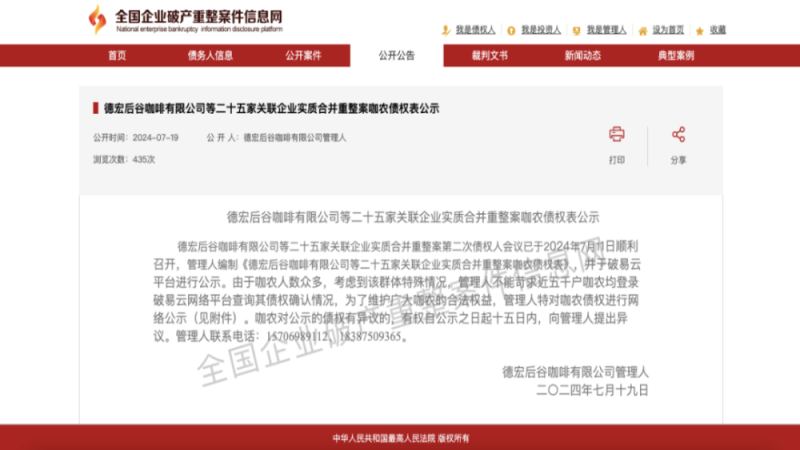
The vote covered the draft plan for Dehong Hogood Coffee and 25 other enterprises, split into eight creditor groups including tax, construction project, social insurance and employee claims. Hogood built its business on a company-plus-farmers model, buying and processing cherry into green or roasted beans. The failed vote leaves the Yunnan coffee group facing possible exit.
The once Chinese domestic coffee giant Hogood Coffee now stands at a crossroads of life and death. The draft reorganization plan failed to pass due to opposition from the financial institution group and the secured creditor group, which means this Yunnan coffee enterprise, which once managed over 200,000 mu of planting area and had annual revenue as high as 5.691 billion yuan, may permanently exit the stage of history. From supplying instant coffee raw materials to international brands such as Nestlé and Maxwell, to Chairman Xiong Xiangren being sentenced for unit bribery, Hogood's rise and fall epitomizes a dramatic chapter in Yunnan's coffee industry. This article will review the entire process of Hogood Coffee from its highlight to its predicament, presenting its debt crisis, reorganization vote, and the details of the criminal judgment behind it, for the reference of coffee enthusiasts and practitioners.
▲
Click to follow | Daily specialty coffee culture magazine Coffee Workshop
Yesterday, the administrator of domestic coffee giant Hogood Coffee Co., Ltd. issued an announcement. The announcement stated that, in accordance with the Enterprise Bankruptcy Law of the People's Republic of China and relevant legal provisions, Hogood Coffee voted on the "Draft Reorganization Plan for Dehong Hogood Coffee Co., Ltd. and Twenty-Five Other Enterprises." The voting groups were set as eight groups, including the tax claim group, construction project claim group, social insurance claim group, and employee claim group. In the end, because the financial institution group and the secured creditor group did not agree to the reorganization plan, Hogood Coffee's draft reorganization failed to pass after the vote, meaning that the reorganization process of this once-largest domestic coffee brand may once again enter a dead end.
Company plus farmers is a typical business combination in coffee. Its basic operating model is that farmers are responsible for planting and harvesting, while the company is responsible for purchasing, processing, and turning the beans into green beans or roasted beans, or other product forms, and selling them. Brands engaged in similar operations in Yunnan production areas include Hogood, Lingfeng, Starbucks, and others. At its peak, Hogood Coffee managed more than 200,000 mu of planting area and 300,000 farmers, with an annual output of 33,000 tons of instant coffee raw powder.
To most people, Hogood Coffee may be somewhat unfamiliar. Unless tourists who have been to Yunnan have a vague impression of this brand at Changshui Airport, or unless they recall the Minister of Foreign Affairs' remark: "I am not exaggerating, this is the best coffee I have ever drunk anywhere in the world." For the industry, however, Hogood Coffee was once a giant. It provided instant coffee raw materials to major global brands such as Nestlé, Maxwell, and Kraft, which then sold the products under their own packaging. This single business alone accounted for more than 60% of the market share. According to public reports, even before it fell into trouble, Hogood Coffee's annual revenue in 2017 was 5.691 billion yuan. Even in the past two years, under the strong demand in the coffee market, judging solely from the sales business level, Hogood Coffee has still maintained good momentum.
Whether for the coffee industry itself or for the company itself, this originally looked like a very good business story. From 2010 to 2012, affected by Brazil's rust disease, Yunnan coffee beans once reached a high price of 40 yuan/kg, and in the following years quickly fell back to the 13-17 yuan range. This wave of rising prices put Hogood Coffee on a fast track of development, continuously buying land and expanding projects. Hogood's finances becoming unsustainable may precisely have been related to the story being too good.
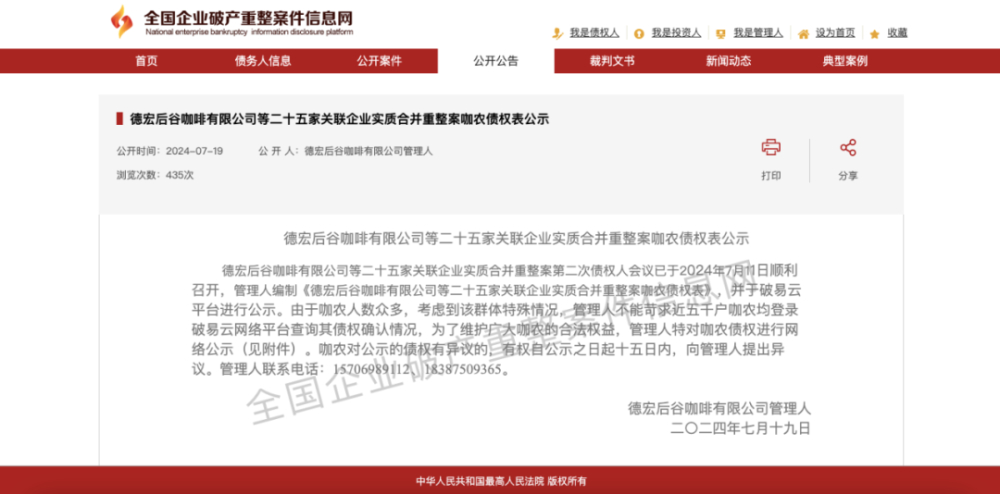
In 2018, news gradually emerged that Hogood Coffee was experiencing difficulties in capital turnover and had developed a debt crisis. In 2019, Hogood, unable to repay its debts, began to be sued in court by banks. In April last year, Hogood had to begin looking for new investors to take over and reorganize it. According to the reorganization draft announcement, Hogood Coffee's total liabilities were 11.5 billion yuan, and the number of creditor representatives eligible to vote on the reorganization plan was 637, a scale larger than the number of employees at most private enterprises.
We watched him build high buildings, we watched him entertain guests, we watched his building collapse. Hogood Coffee Chairman Xiong Xiangren turned Hogood Coffee into a star enterprise in Yunnan through heavy borrowing, while also sending himself to prison. At the beginning of this year, a judgment on China Judgments Online gave the outside world a small glimpse of the story and also revealed the recent situation of Xiong Xiangren, who had been silent for several years. This criminal judgment disclosed the details of Hogood Coffee and Chairman Xiong Xiangren being sentenced for the crime of unit bribery, in which leaders of two state-owned bank branches were involved: Dai Shihong, then former president of the Yunnan Branch of the Export-Import Bank of China, and Zhou Dong, then former member of the Party Committee and vice president of the Yunnan Branch of Bank of Communications.
The first-instance judgment shows that from 2012 to 2018, for the company's benefit, when Hogood Coffee was unable to repay maturing debts, had poor credit status, had a relatively high asset-liability ratio, and did not meet financing and loan conditions, Xiong Xiangren, in order to obtain funding support, improve Hogood Coffee's credit rating and loan credit line, and secure large bank loans, successively bribed multiple people totaling 51.72924527 million yuan, of which more than 21 million yuan involved the leaders of two state-owned bank Yunnan branches.
Among them, from 2015 to 2018, when Hogood Coffee had poor credit status, a relatively high asset-liability ratio, and did not meet loan conditions, Xiong Xiangren used accepting the non-performing loans of the Export-Import Bank Yunnan Branch as a condition to improve Hogood Coffee's credit rating and loan credit line in order to obtain large loans. He successively gave Dai Shihong and his lover Zhang a total of about 21.3792 million yuan, of which 18.4 million yuan was given after being solicited for a bribe. In this first-instance judgment, the court held that Hogood Coffee committed the crime of unit bribery and imposed a fine of 5 million yuan; Xiong Xiangren was also sentenced to two years in prison for the same crime and fined 500,000 yuan.
Many, many years ago, French missionary Alfred Liétard brought coffee trees to Zhugula Village via the Yunnan-Vietnam Railway, where they took root and sprouted. In the 1980s, Liétard's first generation of coffee trees basically all died due to frost, and Xiong Xiangren made one of them into a root carving and placed it in his office as a decoration. Perhaps he did not expect at the time that he would also become part of this Yunnan coffee story. Where Hogood goes from here will require waiting for another vote.
Disclaimer: Some images in this article are from the internet. For some content on the website, such as images, we will respect the original author's copyright and indicate the source. However, due to the large quantity, some images and texts may not have been credited in time. Please forgive us. If the original author has any dispute, they may contact the website for handling. Once verified, we will correct it immediately. Compiled and edited by "Coffee Workshop." Please indicate the source when reprinting. If there is infringement, please inform us for deletion. Thank you~!
The above content is compiled by CoffeeHunters, a coffee news website.


