







Can three shots lock in the day's espresso recipe on coffee machines?
Baristas can set the day's espresso recipe within three shots by judging before adjusting. First decide whether the grind actually needs changing, then read under-extraction or over-extraction from taste, and only then adjust. Dose and yield remain adjustable ranges, so if the time is close to yesterday's parameters, changing the grind wastes beans and time.
Grind adjustment is a last resort, because purging the grinder alone costs several doses of coffee. Two details matter when adjusting: understanding the scale increment on the grinder and clearing retained grounds. Practical steps such as preheating the blind basket also cut waste on coffee machines. Many beginners drink through half a bag during morning calibration, so a fixed routine reduces both cost and caffeine intake.
Adjusting the espresso recipe every morning is a required course for many baristas, but many people waste a lot of beans through repeated trial and error, which is costly and can easily cause heart palpitations from drinking too much. Front Street Coffee also went through this stage. Ultimately, it was because they only stared at the grind setting and adjusted it repeatedly, without finding the real source of the problem. This article sorts out a method from the beginning for determining the day's extraction formula within three shots: first judge whether the grind needs to be changed, then infer under-extraction or over-extraction from the taste, and finally grasp the two key details when adjusting the grind—distinguishing the scale increment and clearing retained grounds. The article also includes practical tips such as blind basket preheating to help reduce waste and improve morning adjustment efficiency.
However, five cups, eight cups, ten cups, or even more—many friends consume half a bag of beans during morning adjustment before barely finding a usable extraction parameter. Not only are costs high, but people also drink themselves nearly to caffeine poisoning. So why does this happen?
In fact, Front Street Coffee made the same mistake many times when just starting out. This is almost a pit every beginner cannot avoid. Ultimately, it is because they did not pinpoint where the problem was and just kept turning the grind setting. So today Front Street Coffee will talk about how to quickly lock in the espresso extraction formula. As long as you understand the following key points, three shots—only three shots—are enough to determine the day's espresso recipe.
1. Do not rely too much on adjusting the grind.
When morning espresso adjustment is mentioned, everyone always emphasizes grind adjustment. Grind size is of course important, but Front Street Coffee does not recommend relying excessively on the changes brought by grinding. This is because changing the grind consumes a large amount of material and time; just purging the grinder alone costs quite a few beans. Therefore, grind adjustment is a last resort after the extraction time shows a major deviation, not the first choice for quickly solving the problem.
Dose and yield are both adjustable ranges. If you make it according to yesterday's extraction parameters and the time does not change much, you can adjust the dose or yield according to differences in taste (it is also possible that no adjustment is needed at all, and the taste is the same as yesterday or even better). Only when the time changes too greatly do you need to change the grind.
2. Learn to identify the shortcomings of the coffee.
An ideal espresso is balanced in acidity, sweetness, and bitterness, with a rich and smooth mouthfeel. This requires the coffee to reach an appropriate extraction yield and concentration. When the extraction yield or concentration is below or above standard, the balance of taste is broken, and the mouthfeel also develops negative sensations such as thinness and astringency.
So we need to figure out where a cup of coffee's defects come from: whether it is under-extraction or over-extraction, whether the concentration is too low or too high. After finding the shortcoming, adjust according to the corresponding correction method, and an ideal espresso can be made.
For example, if this dark-roast espresso tastes sour, even somewhat sharp, that is typical under-extraction. We can reduce the dose or increase the yield from the original recipe to raise the extraction yield, and the taste can be corrected. Other situations can be handled by analogy.
3. Points to note when adjusting the grind.
If, with the same dose, the extraction time differs too much from the previous day, that means the grind must be changed for adjustment.
When adjusting the grind, two things must be noted; otherwise, adjustment will become much more difficult.
1. Distinguish adjustment increments:
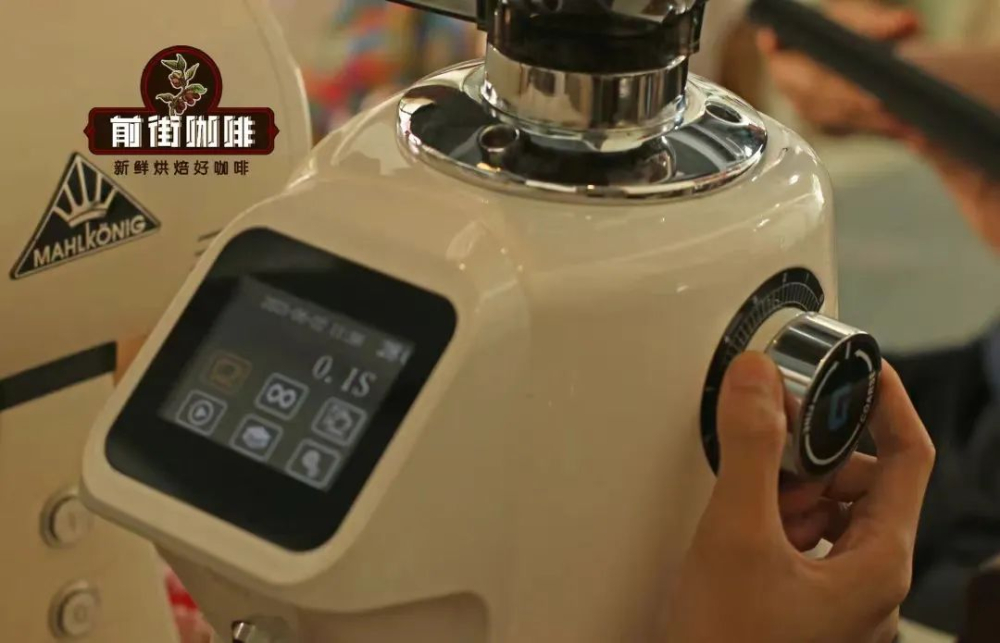
Single-origin grinders have many scale positions because single-origin extraction has relatively lower requirements for coffee grounds (compared with espresso extraction), so the adjustment range can be larger, generally with 0.5 as one step. Espresso grinders are different: the particles produced are finer, and extraction is more extreme. A slight change in coffee particle size can have a great impact on extraction. Therefore, their steps are generally 0.2 per increment.
When adjusting, never turn it a full circle in one go. This makes the machine prone to "not catching up" because the change is too large, causing it to idle for a long time without grinding beans. The particle size produced also easily deviates far from the target, making adjustment even more difficult.
2. Remove retained grounds from the grinder:
During grinding, the grinder does not release all the ground coffee. Some grounds get stuck in the burrs because they cannot exit in time. Front Street Coffee specifically conducted an experiment: after emptying all coffee beans from the machine, they took out the coffee grounds stuck inside, and the result was about 4 grams.

So if this portion of grounds is not brought out in advance when adjusting the grind, it will mix into the next portion of coffee grounds. Old and new mixed together causes a large deviation in extraction. Generally speaking, after adjusting the grind, we pre-grind about 10 grams of coffee to flush out the residual grounds left in the grinder.
In summary, as long as you understand these three things, you can quickly find the espresso extraction formula to use that day based on the original one. Finally, Front Street Coffee adds three more small details:
1. When the extraction interval is too long, the pressure of some coffee machines will change—simply put, it becomes unstable. This introduces a variable into the first extraction after restarting, and extraction only returns to normal after the pressure starts running again. The usual practice is to directly discard one serving of coffee to "preheat" the pressure, but a friend of Front Street Coffee provided a good idea: use a blind basket to let the pressure run in advance, about 10 seconds is enough, and the coffee machine can enter normal condition for extraction. Testing confirms it is indeed effective. Everyone can use this method to reduce the waste of one serving of coffee grounds and avoid misleading extraction. (Blind basket: a special portafilter basket with no holes.)
2. The formula is not universal for the whole day. Coffee beans and the environment are constantly changing, so it is best to recalibrate once every few hours.
3. Friends who have just gotten a coffee machine can set the dose, time, and yield according to their own basket specifications and the roast level of the beans, then adjust according to this parameter. If you do not understand, you can check Front Street Coffee's past articles; there is no need to elaborate further here.
The above content is compiled by CoffeeHunters, a coffee news website.


