








Which Geisha Coffee Label Is Worth Trying First?
The Emerald Estate Red Label and the Gesha Village Gold Label are both top-grade geisha coffees, and they differ in price, variety origin, growing terroir and flavor. Emerald's Red Label carries the English name Esmeralda Special and is the estate's highest-quality geisha; in the shop's pour-over list it is priced at 75 yuan per cup against 60 yuan for the Gold Label.
Label colors such as red, gold, green and blue are a grading shorthand, and the Chinese-language naming does not map directly onto English names, so buyers can lose track of which is which. A labeled geisha from a given estate sits above ordinary geisha in grade and usually in price, which is why a side-by-side cupping helps set expectations before buying.
Geisha coffee has always been a top-tier topic in the specialty coffee world, and the Emerald Estate Red Label and Gesha Village Gold Label on Front Street Coffee's bean list are exactly what many enthusiasts agonize over when first encountering Geisha. These two beans represent the highest grades of their respective estates, yet the "red" and "gold" in their Chinese names leave many people unable to tell which is which. They differ not only in price but also in variety origin, growing terroir, and flavor expression. This article systematically sorts out the similarities and differences between these two top Geishas for Front Street's customers—from naming logic and variety tracing to origin environment and actual cupping comparison—to help you find the cup that suits you best.
Guests who often chat about Geisha at Front Street are always drawn to two names with "label" on the blackboard—Emerald Estate's Red Label Geisha and Gesha Village's Gold Label Geisha. Because the green bean purchase price is relatively high, Front Street has specially pulled them out of the regular bean list and marked their pour-over prices separately: Red Label at 75 yuan per cup, Gold Label at 60 yuan per cup. This price gap also makes many friends curious, especially those who have long heard of Geisha's fame but have not yet truly tasted it.
If you are trying Geisha for the first time, which one should you choose? Or rather, which "label" is more worth it?
Let's first talk about how these "label" colors came about.
Actually, those labeled Geishas that baristas talk about essentially use colors to distinguish grade levels. Whether it is the Red Label and Gold Label discussed today, or the lower Green Label and Blue Label, even if you cannot figure out the order of the prefixes, you can at least determine one thing: a certain labeled Geisha from a certain estate is definitely higher grade than ordinary Geisha, and the price is most likely higher too.

It should be noted that this "label" naming only exists in the Chinese-language context. In other words, if switched to English names, you might not be able to tell who is who, let alone compare levels.
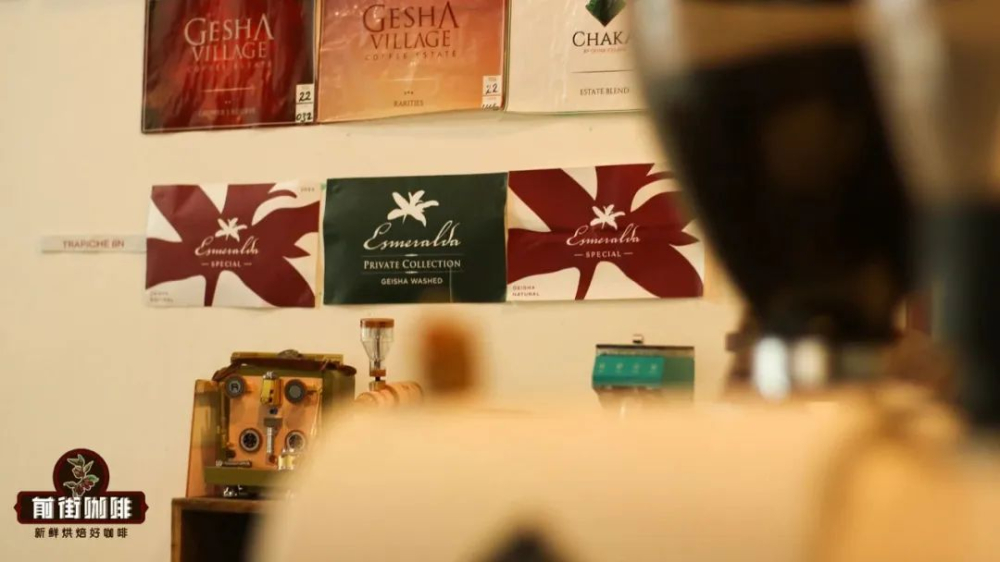
Emerald Estate's Red Label Geisha has the original English name "Esmeralda Special," which can be translated into Chinese as "Emerald Special Selection." This is the highest-quality Geisha produced by the estate, requiring a cupping score of at least 91 points, and each lot also comes with detailed origin information. The "red" in Red Label comes from the background color of this product's trademark, and Green Label and Blue Label follow the same naming logic, with the purpose of making it easier for domestic consumers to remember and distinguish.
Gesha Village's Gold Label also has its own English name—"Rarities," meaning "rare treasures," representing the highest-grade Geisha launched by Gesha Village (excluding auction lots). The word "gold" also comes from the background color of the product trademark. According to Gesha Village's official website, this grade accounts for only 10% of the estate's total production, and like Emerald Red Label, each lot is marked with plot information for buyers to check.
Although this naming method circulated domestically makes different grades of Geisha easy to remember and understand, it occasionally causes misunderstandings due to "color clashes." For example, in the production and sales systems of both estates, there are grades with red and green backgrounds, so on the market there are two "Red Labels" and two "Green Labels." When ordering, it is worth paying a little more attention, or simply asking the barista which estate this cup of Geisha comes from and which grade it belongs to.
Both are called Geisha, but variety-wise they are actually "distant relatives"
That "Geisha originated in Ethiopia" is something almost everyone in the coffee world knows. Rewinding to 2004, Geisha won the BOP competition in one fell swoop and stunned the entire field. Later, through sample comparison, it was found that it was actually a variety collected in the 1930s near the Gesha area by the Kafa forest in southwestern Ethiopia, and was later cataloged by Costa Rica's Tropical Agricultural Research and Higher Education Center (CATIE) as a fungus-resistant variety under the number "geisha T2722."
The variety name of Gesha Village Gold Label, however, has an extra year after it, called "Gesha 1931." The selection work at Gesha Village was led by Willem Boot—he was one of the judges shocked by Geisha in 2004, and also the owner of Mule Estate and Sophia Estate. At that time, gene comparison technology was not yet mature, so estate owner Adam, referring to the plant morphology and flavor performance of Panamanian Geisha, selected two Geisha varieties from the vast Gesha area. One of them had a flavor extremely similar to Emerald Estate's Geisha, so it was named "Gesha 1931," meaning the year 1931 when Geisha was discovered.
From this it can be confirmed that today's highly sought-after Panamanian Geisha (including that of Emerald Estate) is exactly the variety recorded at the time as "T2722." Gesha Village's "Gesha 1931," however, is a similar variety found in the vast Kafa forest using Panamanian Geisha as a reference template, so it cannot be proven whether it is homologous with Panamanian Geisha.
Different origins naturally mean different tastes of terroir
For ordinary consumers, the core charm of specialty coffee lies in the taste of place. So besides variety differences, where it is grown is equally key.
Emerald Estate is located in the Boquete production area of Chiriquí Province, Panama, where high altitude, volcanic soil, and a unique microclimate allow the T2722 variety to fully express floral and honeyed notes while retaining creamy and nutty aromas. Good coffee cannot be separated from a superior growing environment. The reason this land in Panama can continuously produce high-quality Geisha year after year, Front Street believes, is largely due to the Boquete production area.
Gesha Village, on the other hand, is located in southwestern Ethiopia near the South Sudan region, hidden within the densely forested Bench Maji, where standing in the village you can gaze out at the scenery of ancient forest. This is a typical Ethiopian highland terrain, and even the lowest-altitude plots exceed 1,900 meters. The advantage brought by high altitude is that it allows coffee cherries to mature slowly in a low-temperature environment, thereby accumulating more flavor compounds.
Both are top Geishas—which tastes better?
Currently, both the "Gesha Village Gold Label" and "Emerald Estate Red Label" on Front Street's bean list are natural-process lots. Among them, the more expensive Red Label comes from Emerald Estate's Buenos Aires plot in Jaramillo, while the Gold Label comes from Gesha Village's Oma plot; both are natural process.
Next, temporarily setting price aside, brew these two top Geishas representing their respective estates together, then taste to see whose flavor comes out ahead. The brewing parameters are as follows: 15 grams of coffee, ground at 10 on an ek43, 80% passing through a No. 20 sieve, 1:15 coffee-to-water ratio, 92°C water temperature, three-stage pouring, V60 dripper.
In terms of dry aroma: the Gold Label Geisha's coffee grounds give off a very bright citrus fruit fragrance, close to the fresh scent of orange peel, very appealing; Emerald Red Label Geisha, on the other hand, is dominated by the rounded sweetness of roses, candied fruit, and apricot, accompanied by a hint of nuts and toffee, with "sweetness" as its main theme.
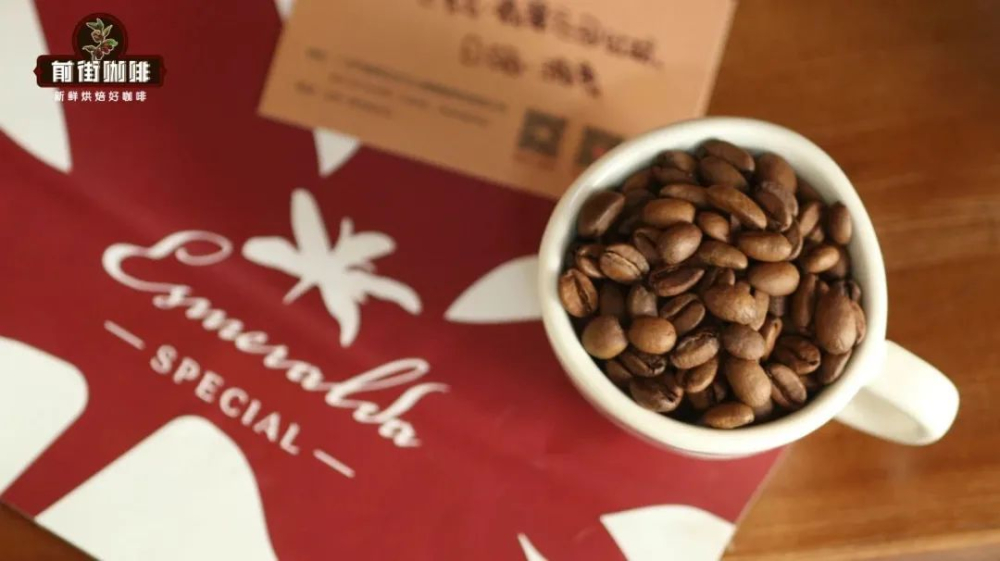
In terms of flavor: the freshly brewed Gold Label Geisha presents lifted notes of blueberry, sweet cherry, honeydew, and magnolia, with bright acidity, clean and elegant; as the temperature drops slightly, the finish begins to show a unique charm similar to young tangerine tea. Emerald Red Label Geisha, meanwhile, smells of pleasant floral aromas, and on the palate immediately delivers rich tropical fruit flavors, with lingering layers of jasmine, cranberry, dried mango, and fruit candy. The fragrant finish is full without being astringent, and it is very comfortable to drink. After direct comparison, Front Street believes that in terms of flavor complexity, Emerald Red Label Geisha is indeed slightly superior.
The above content is compiled by CoffeeHunters, a coffee news website.


