








What does the Panama coffee association award recognize?
The 2024 Panama competition introduced an annual Producer of the Year award for the first time, and the Lamastus family won it. The family's three estates, Elida, El Burro, and Luito, all sit in the Boquete region. The Specialty Coffee Association of Panama planned and promoted the BOP competition, which began in 1996.
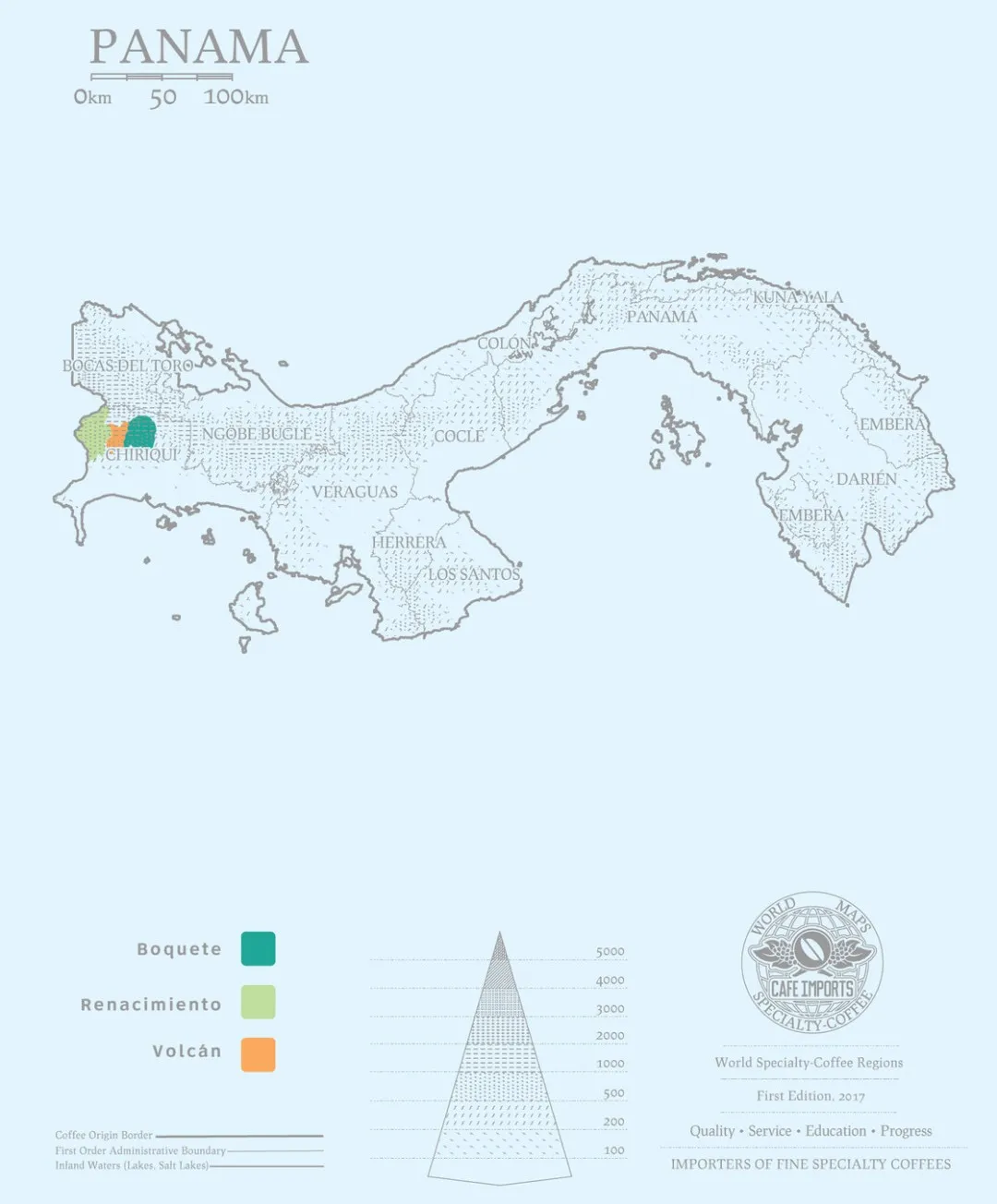
Panama's terrain is mountainous with interlacing valleys, rich forests and rivers, and several volcanoes, giving coffee trees varied microclimates. Average annual temperatures run about 23°C to 27°C, with rainfall between 1,500 and 2,500 millimeters. Geisha rose to fame after strong results in 2005, and main producing regions include Boquete, Volcan-Candela, and Renacimiento.
In 2024, the Best of Panama (BOP) introduced an annual Best Producer award for the first time, which was won by the Lamastus family. Its three estates—Elida, El Burro, and Luito—are all located in the Boquete region. This article will guide you through the background of Panama coffee's rise, the development of the BOP competition, and the history, altitude conditions, cultivated varieties, and terroir characteristics of these three estates. It also includes a brewing and flavor reference for Front Street Coffee's Elida Estate Catuai beans.
Panama coffee holds a pivotal position in the international specialty coffee landscape, thanks not only to the star variety Geisha but also to the efforts of the Specialty Coffee Association of Panama (SCAP)—it was this association that planned and promoted the BOP (Best of Panama) competition.
Since the first BOP was held in 1996, the high-quality coffees entered each year have repeatedly fetched high prices in subsequent auctions, allowing Panamanian producers to establish broader connections with the international market and gradually build their reputation. In 2005, Geisha stood out with its outstanding flavor performance and remarkable results, and from then on, this variety rose to fame.
Of course, the birth of good coffee is also inseparable from Panama's natural endowments. The country has pronounced undulating terrain with interlacing valleys and ravines; aside from coastal plains, it is mostly mountainous, rich in forests and rivers, and home to several volcanoes. Due to its proximity to the equator, Panama has a tropical maritime climate, humid during the day and cool at night, with an average annual temperature of about 23°C to 27°C and annual rainfall between 1,500 and 2,500 millimeters. The complex terrain also creates varied microclimates, providing an ideal growing environment for coffee trees.
Panama's main coffee-producing regions include Boquete, Volcan-Candela, and Renacimiento.
Boquete is arguably Panama's most famous coffee-producing region, where numerous well-known estates are concentrated. In 2024, BOP added the Best Producer award, which was ultimately won by the Lamastus family. The family owns Elida Estate, El Burro Estate, and Luito Estate, all located in the Boquete region.
Elida Estate
The history of this farm dates back to 1918, and it is owned by the Lamastus family. The estate name "Elida" comes from the name of the wife of the then farm owner Robert Louis Lamastus, and it is now managed by their son Wilford Lamastus.
Elida Estate covers 65 hectares, more than half of which lies within the boundaries of Baru Volcano National Park. Within the estate, 30 hectares are used for growing coffee trees, while the remaining 35 hectares are preserved as primary forest. Coffee is grown at altitudes between 1,670 and 1,850 meters, making it one of the two highest-altitude coffee estates in Panama. The estate mainly cultivates high-quality varieties such as Geisha, Typica, and Caturra. In this year's BOP competition, Elida Estate's Geisha Natural group won the championship with 95.13 points.
El Burro Estate
This estate was founded by Amado Boutet, the maternal grandfather of Mr. Wilford Lamastus, the current heir of the Lamastus family. At the time, coffee market prices were sluggish, and his grandfather once intended to sell the estate. Unwilling to let the family business change hands, Mr. Wilford and his younger brother Patrick Lamastus bought it and continued to operate it. The original site of the estate was once a livestock farm, hence the name "El Burro" (donkey).
El Burro Estate is located at the southern end of the producing region, at an altitude between 1,550 and 1,800 meters, with an area of about 50 hectares. Of this, 20 hectares are planted with Geisha and Catuai, 10 hectares are reserved for planting, and the rest belongs to the protected area of Baru Volcano National Forest Park, preserving the primary forest ecosystem.
Luito Estate
Luito Estate is owned by Luito Lamastus, the brother of Mr. Wilford Lamastus, the owner of Elida Estate. The estate is located at the northernmost end of Boquete, close to the mountains, with part of its area lying within La Amistad International Park (Parque Internacional de la Amistad).
This estate is relatively small, only 5 hectares, at an altitude between 1,600 and 1,750 meters, and only grows the Geisha variety. The rainfall pattern in the area where the estate is located is quite unique, with still abundant rainfall during the dry season, allowing coffee to grow year-round. Due to the rainfall and microclimate, the flowering period of this farm differs from that of most farms in Boquete.
FrontStreet Coffee Panama Elida Estate Catuai Coffee Beans Region: Boquete Altitude: 1,850 meters Variety: Catuai Processing Method: Natural Flavor: Peach, Raisin, Orange, Caramel, Green Tea
FrontStreet Coffee's Panama Elida Estate Catuai coffee beans are naturally processed and medium-light roasted. Front Street brews it using a V60 dripper, a 1:15 coffee-to-water ratio, and a water temperature of 92°C. The resulting cup is smooth, presenting notes of peach, raisin, orange, and caramel, with a tea-like green tea sensation and overall good cleanliness.
The above content is compiled by CoffeeHunters, a coffee news website.


